
About Turkey Creek Overlook (TN Side)
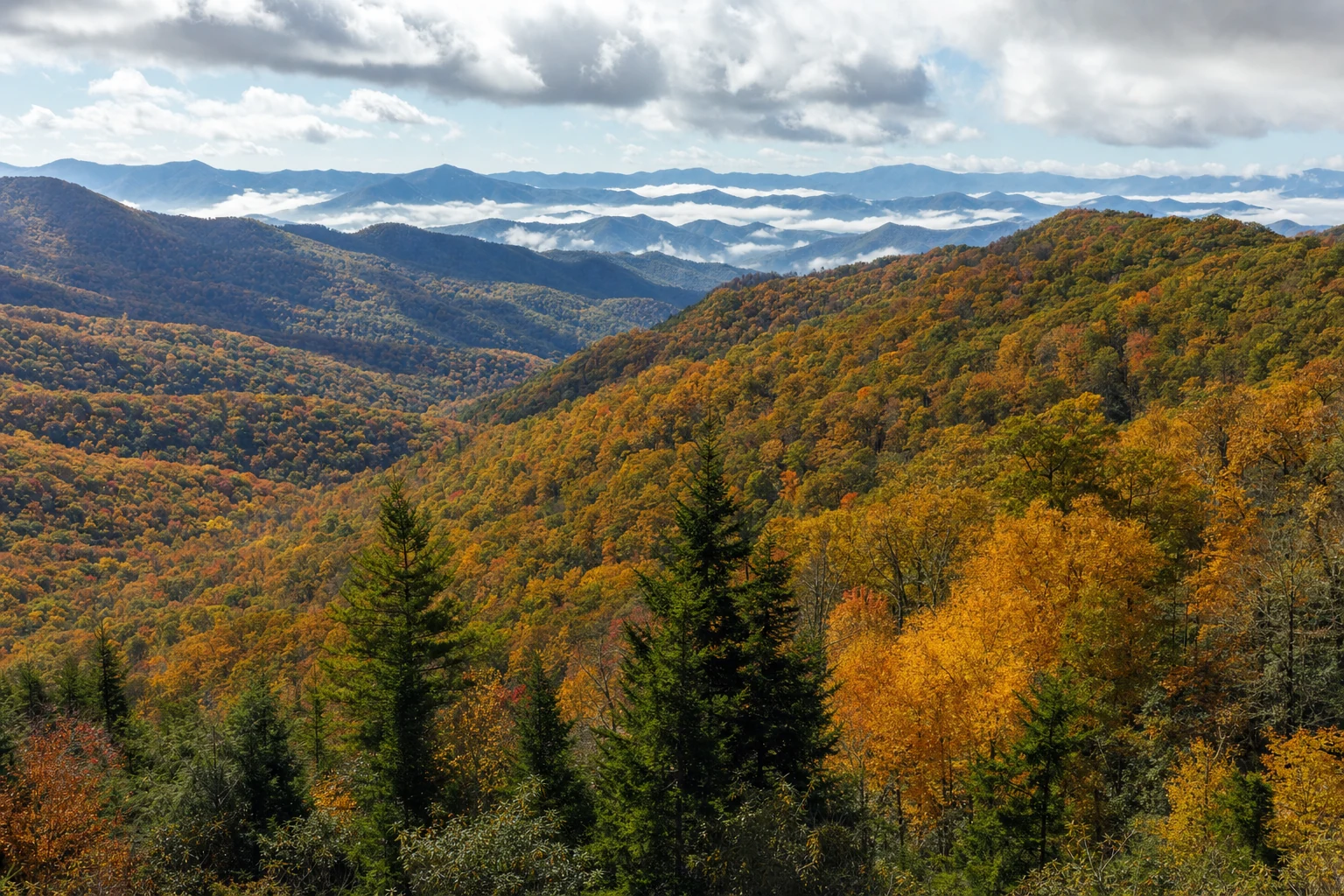
Turkey Creek Overlook sits on the Tennessee side of Great Smoky Mountains National Park, a roadside pullout that passes without ceremony while you're driving through. Most visitors don't stop. The ones who do find a view oriented down into the Turkey Creek drainage: a deep forested valley with distant ridgelines layered behind it, quiet and largely uncrowded, the kind of spot that rewards a deliberate pause more than a hurried one.
What the View Delivers
The scene here is oriented toward a forested drainage rather than an open ridge, which gives it a different character than the classic Smokies high-elevation panoramas. You're looking across and down into the Turkey Creek valley, with successive layers of deciduous canopy filling the foreground and middle ground; the ridgelines in the distance provide scale without dominating the composition. It reads as intimate rather than sweeping, and that's not a shortcoming so much as its particular quality.
On clear days, the far ridges separate into distinct shapes that repay attention. The Smokies are rarely without some atmospheric haze, especially from late spring through summer, and here the effect works in the view's favor: the valley softens into layered greens and blues at depth, and the ridgelines behind fade progressively, giving the landscape a sense of distance that's hard to manufacture with camera settings after the fact.
What you won't get is a 180-degree horizon or a view of peaks above treeline. This overlook's appeal is in reading a forest landscape in three dimensions, not in getting a high perch over everything.
Seasonal Timing
Any time the park road is open and clear, Turkey Creek is worth including in a drive. The seasons change what you're looking at substantially, though.
Fall is the prime window, roughly mid-October through early November depending on elevation. The Turkey Creek drainage fills with changing hardwoods; the reds, oranges, and yellows break up the otherwise uniform canopy and give the layered valley view a different kind of depth than the green-season version offers. At peak color, even a modest overlook like this one becomes photogenic without much effort.
Summer brings deep green and the heaviest haze. The views hold, but distant ridges lose definition. Early morning visits in summer can put the valley partially in fog, which is its own kind of interesting if you come prepared for it but frustrating if you came for clarity. Spring shows the successive greening that starts in the valley floor and works uphill, with bare upper branches still visible in early April before the canopy fills. Winter, when road conditions permit, strips the leaves and opens sightlines you can't get in other seasons.
When to Come During the Day
Mid-day is the recommended light for Turkey Creek, which runs counter to the usual outdoor photography advice. The drainage orientation here means direct overhead light reaches into the valley in a way that lower-angle morning or afternoon sun doesn't. When the sun is lower on the horizon, surrounding ridges shadow the drainage and flatten the scene.
If you arrive mid-morning on a clear day and the valley is still in shade, give it an hour or two. The shift when direct light hits the canopy is noticeable. Overcast days are also workable: soft diffuse light reads the forest's texture evenly, without the contrast extremes that bright sun creates in a shadowed valley.
Getting There
Turkey Creek Overlook is on the Tennessee side of the park, accessible from the Gatlinburg entrance. Enter through the park gate and proceed past the Sugarlands Visitor Center, then continue into the park interior. The overlook is a roadside pullout along the park road, so there's no trailhead or parking area beyond the pullout itself.
The pullout is small, with room for a handful of vehicles. During peak fall color weekends it may be occupied when you arrive; the wait is usually short given the low overall traffic here, though you can't count on an immediate open spot on the busiest October days.
A Park It Forward parking tag is required for any stop inside Great Smoky Mountains National Park lasting longer than 15 minutes. The cost is $5 for a single day, $15 for a week, or $40 for an annual pass. Purchase at park entrance kiosks or through recreation.gov before your visit. Display it on your dashboard.
Before You Drive Up
Cell service inside the park is unreliable through most of the Tennessee interior. Download offline maps before leaving Gatlinburg; don't count on navigation working reliably once you're in.
High-elevation and interior park roads can close when winter conditions make them unsafe, typically at various points from October through March depending on the year. Check current road status through the park's official resources before heading in during that window. Conditions can change quickly.
The pullout itself has nothing: no restrooms, no trash receptacles, no picnic area. If you're doing a full day of park driving, stock your vehicle in Gatlinburg before entering. The nearest fuel, food, and facilities are back in town.
Because this overlook sees low traffic, it's easy to pass without registering that you've passed it. Mark it on your map before you go rather than relying on a sign catching your attention while you're moving.
Building It Into a Larger Day
Turkey Creek works best as one stop among several rather than a standalone destination. The pullout offers no surrounding amenities or trail access; the experience is the view and nothing else, so budget five to fifteen minutes and continue on.
A natural approach is to string it with other overlooks along the Tennessee side, pairing this intimate valley view with the more open perspectives available at higher-elevation stops. The contrast makes both more interesting than either is alone. If you're driving a loop through the park interior, Turkey Creek adds almost no time to your itinerary and offers a different texture of the landscape than ridge-top panoramas tend to give you. It's the kind of stop that fills in your mental map of how the Smokies are actually structured: not just peaks and summits, but the drainages and valleys between them that most park visitors only see from above.