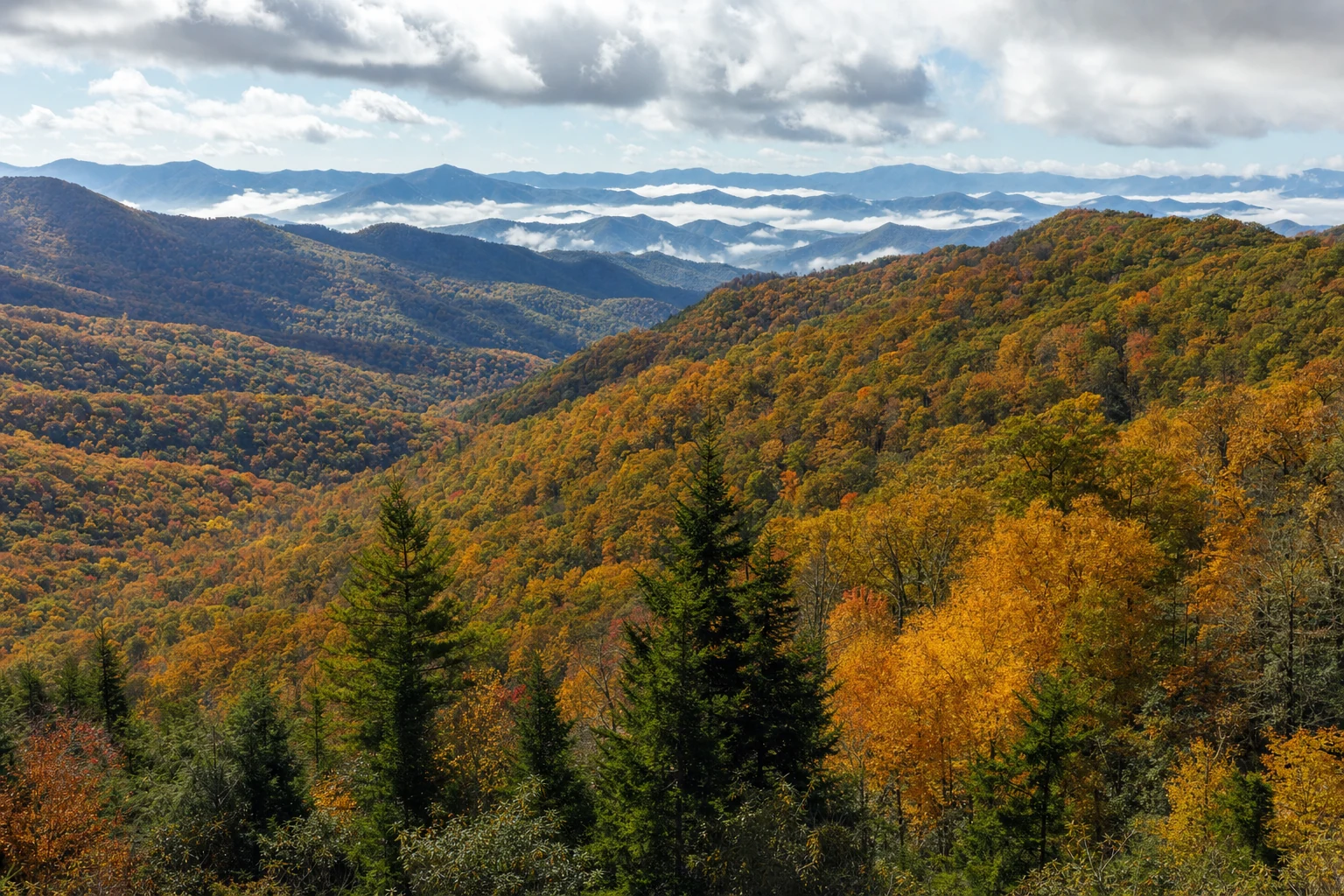

About Various Stream & Forest Pullouts
Along the Roaring Fork Motor Nature Trail, the road keeps offering you reasons to stop that don't appear on any official map. Not grand overlooks with interpretive signs, but informal gaps in the roadside vegetation where you can pull off, cut the engine, and sit next to moving water for as long as you want.
What You're Actually Looking At
These pullouts aren't framed vistas or cleared viewpoints. They're small gaps at the road's edge where Roaring Fork runs close enough to the pavement that you can hear it from inside your car. The stream moves fast for a mountain creek, dropping over mossy boulders and tangled root systems before sliding back under the canopy. The rocks carry thick moss that gets almost fluorescent when the light is soft and the surfaces are wet, which they usually are. Hemlocks and tulip poplars close in overhead, and the understory stays dense enough that genuine shade falls across the road even in summer.
What separates these stops from the trail's named landmarks is the scale. You're not looking across a gap at something far away; you're standing a few feet from the water, eye level with the stream. Small cascades form wherever the streambed pitches sharply, and they're scattered throughout the loop. The cumulative effect, if you stop at several rather than driving past, is more satisfying than a single prominent waterfall viewed from a distance.
Light and Conditions
Overcast days or dappled light through the canopy: that's the accurate advice for shooting or simply looking here. Direct sun causes severe contrast problems in this type of landscape. Bright patches blow out while the shadowed water underneath goes dark, and the range of texture in moss, wet rock, and flowing water compresses into something flat. On an overcast morning, the light evens out and you get the full tonal range at once.
Rain improves things noticeably. After even moderate rainfall the stream runs faster and louder, the moss saturates to a deeper green, and the rock faces take on a silvery sheen they lose during dry stretches. If you're visiting after several dry days, the stream will still be running but the visual intensity drops considerably. Morning hours, particularly on weekdays, keep crowds thinner and give the road a different quality before the day builds up.
Parking and Getting In
Parking at these pullouts is tight; each holds roughly one to two cars. They're not developed stops with gravel lots and trail signs. You spot one as you drive the one-way loop and pull cleanly out of the lane without blocking traffic. If a pullout is occupied, the next gap usually comes within a short distance. The critical thing to understand about the Roaring Fork road is that it runs one-way: if you pass a spot you wanted, you're completing the whole loop before you can try again.
A Park It Forward parking tag is required anywhere inside Great Smoky Mountains National Park for stays over 15 minutes. The fee is $5 per day, $15 per week, or $40 for an annual pass; purchase at recreation.gov or at park entrance kiosks before heading up. Rangers do check. The Roaring Fork Motor Nature Trail is entirely within park boundaries, so don't skip this step.
Crowd Level and Timing
Crowd pressure at these informal stops runs low to moderate. They don't appear prominently on most visitor maps, and since each holds so few cars there's rarely a queue. The road itself gets congested on summer and fall-foliage weekends, which slows traffic to a crawl, but the upside is that drivers moving slowly through the loop are more likely to spot and use the pullouts. Heavy traffic doesn't eliminate the stops; it just means you'll have company on the road.
The shoulder seasons tend to produce the strongest visits: late April through early June when the stream is still running high from spring rains and the new-growth green is intense; or mid-September through October when moisture returns and the upper canopy starts showing color. Midsummer works fine, especially on overcast days, but the stream runs lower and the light situation is harder to manage.
How to Use the Loop Well
The Roaring Fork Motor Nature Trail connects several named stops, including Ogle Place (a preserved historic cabin) and Place of a Thousand Drips, a seasonal waterfall that runs directly down a roadside rock face after rain. These informal stream and forest pullouts are the connective tissue between those landmarks. Most visitors drive past them en route to something specific; stopping at the ones that catch your eye changes the loop from a drive-through tour into something worth an actual half-day.
If you're combining the loop with a hike, the Grotto Falls trailhead sits off the Roaring Fork road and leads to a waterfall you can walk behind; that lot fills early on busy weekends. Parking pressure there doesn't spill over to the roadside pullouts, which are a different experience entirely: no hiking required, close access to the stream, and very little foot traffic.
What to Bring
Waterproof footwear is worth having if you want to step off-road onto the stream bank, which some pullouts allow. The rocks are slippery and the bank stays muddy. A polarizing filter cuts surface glare on moving water and brings out color in submerged rocks; it's specifically useful here in a way it isn't at every mountain stream, because the low light levels under the canopy mean you're often shooting at angles where glare is the main problem.
Cell service is unreliable along much of the route. Download the GSMNP park map before entering, and check the park's road status page for seasonal closures; the Roaring Fork Motor Nature Trail closes in winter when ice makes the grades and tight curves unsafe.