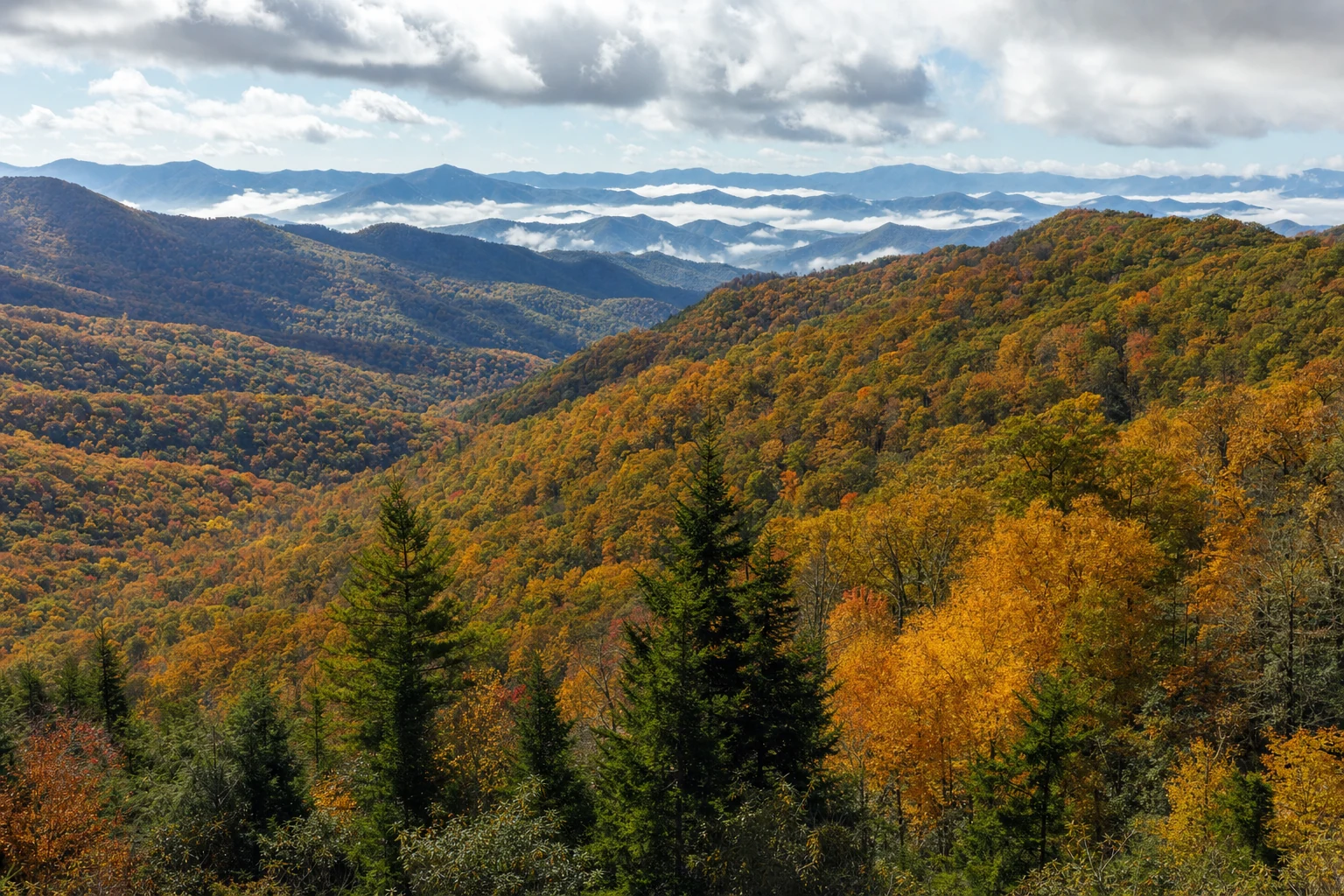

About Various Unnamed Pullouts (Along Kuwohi Road)
Now I'll write the body copy applying the anti-slop constraints alongside the page's own rules.
---
Kuwohi Road, the spur that climbs from Newfound Gap toward the park's highest point, is mostly driven as a means to an end. But a handful of small pullouts cut into the shoulder along the way, each barely wide enough for a car or two, and they give you a reason to actually stop and absorb the forest rather than push straight through it.
What to Expect
These aren't formal overlooks. There's no interpretive signage, no guardrail with a plaque. What you get is a modest widening of the road and a direct, close encounter with the spruce-fir forest that defines this high-elevation corridor. At most of these stops, the trees close in tightly; the primary experience is the forest itself, not a sweeping view of the valley far below.
Occasionally, where the canopy breaks, you'll catch a glimpse of distant ridgelines. On clear days those sightlines can stretch well beyond the immediate terrain. But count on the forest being the main draw. The spruce-fir zone is ecologically distinct from the mixed hardwood forest lower on the mountain: the trees run shorter and denser, the air is noticeably sharper, and light filters differently through the needles than it does through broad leaves. If you're already stopping at Newfound Gap and at the Forney Ridge lot before the tower, these pullouts offer something neither of those larger stops can provide. Quiet.
Best Light
Mid-day works best here. The road runs through the forest rather than above it, so the soft raking light that makes lower overlooks glow tends to get absorbed before it reaches anything worth photographing. When the sun is high and direct, it punches through the canopy in shafts, landing on moss-covered rocks and root tangles in a way that actually rewards a camera. Don't chase golden hour at these spots; save that effort for Newfound Gap or Look Rock.
Parking
Each pullout holds one car, two if the second driver is unusually confident. That's not metaphor: if someone's already pulled over, you keep moving and check the next one. The very small size keeps foot traffic low by default; there's simply no room for a group to converge. Come with the patience to try two or three spots before finding an open one, and build that possibility into your timing.
The Park-It-Forward fee applies anywhere inside Great Smoky Mountains National Park for stays over 15 minutes. Passes run $5 daily, $15 weekly, or $40 annually, available at park entrance kiosks or through recreation.gov. Given how many stops a Kuwohi Road visit usually involves, a daily or weekly pass is the practical choice.
Road Access and Seasonal Closure
Kuwohi Road begins at Newfound Gap, where US-441 crosses the Tennessee–North Carolina state line. The pullouts sit between that junction and the Forney Ridge Parking Area at the road's end, where the steep paved walk to the observation tower begins.
The road closes for winter when ice and snow make it unsafe, typically from early December through late March or into April, with exact dates varying by year. Check the park's current road status before planning a visit any time outside summer or early fall. Even in May and October, conditions at this elevation shift fast: cold rain, dense fog, and low clouds are common even when the valley below is clear. Dress warmer than you think you need to.
The Ecological Story at Road Level
The spruce-fir forest on Kuwohi Road carries visible evidence of the balsam woolly adelgid, an invasive insect that has killed Fraser firs across the southern Appalachians over the past several decades. Standing dead snags are scattered through the forest on both sides of the road, and the openings they leave in the canopy are part of why mid-day light works at the pullouts in the first place. It's worth pausing to register what you're seeing: a forest that's simultaneously dying and regenerating, with young firs filling the gaps left by older ones. That ecological process isn't visible at the tower, where your attention goes to the panorama. It's visible here, at road level, from a car-sized pullout.
Fitting These Into a Kuwohi Day
Treat the pullouts as informal breaks within a larger drive, not as standalone destinations. The Forney Ridge lot at the end of the road fills quickly on peak-season weekends; arriving early means you haven't burned time stopping repeatedly on the way up. Save a pullout or two for the return trip instead, when the crowd pressure is off and you can spend five minutes in the forest without worrying about the lot filling.
Photographers drawn to intimate forest subjects, particularly moss, bark texture, filtered light on decomposing wood, or the specific character of high-elevation conifers, will get more from these stops than visitors expecting valley panoramas. The payoff is quiet and close rather than wide and distant, which suits some days and some moods better than others.