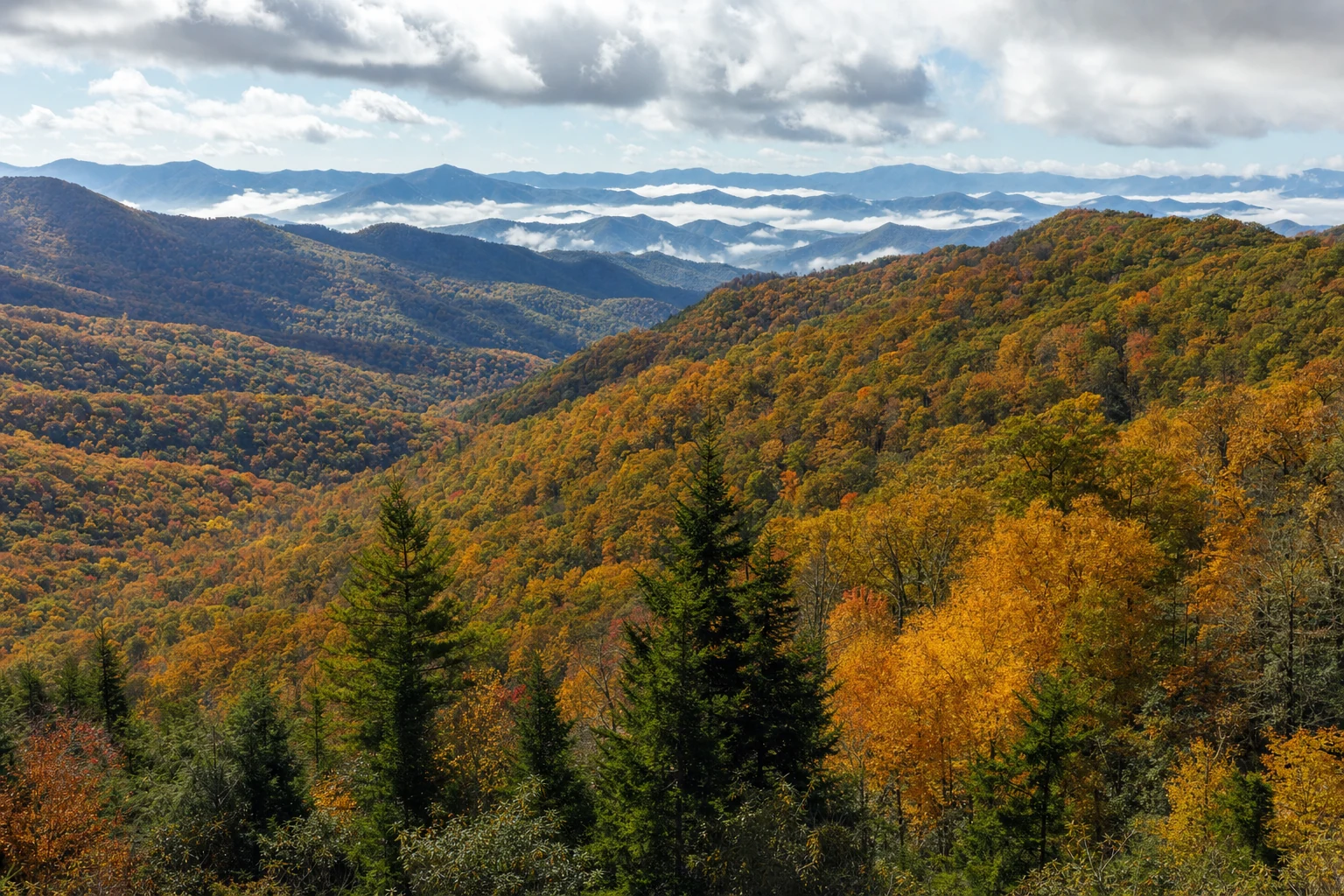

About Various Unnamed Pullouts (Throughout Foothills Parkway)
The Foothills Parkway threads along ridgelines above the Tennessee foothills, and between its named overlooks with their formal pullouts and interpretive signs, dozens of informal stops appear with almost no warning. Most hold one car, occasionally two; no historical plaque marks them, no milepost label tells you what you're facing or what named peak sits on the horizon. What they offer instead is something the bigger designated stops can't quite provide: quiet, and whatever the ridge happens to be showing that day.
What You'll Actually See
The views at these pullouts are genuinely inconsistent — which is the honest reality, and also the point. Some face north toward the Tennessee Valley, giving you forested slopes dropping away into distance. Others open briefly south toward the Smokies proper, offering a slant of distant ridgeline before the road curves back under canopy. A few catch valley glimpses that require you to stop at exactly the right moment, because thirty seconds later the trees close back in.
The Wears Valley connector section of the Foothills Parkway has some of the parkway's most interesting informal stops. The main valley spreads out below at certain points, and on clear mornings the mist settles into the low ground while the ridge above stays lit. You won't know which specific pullout will give you that angle until you're already there. That unpredictability is what makes driving this road slowly, with time to stop, the only sensible approach.
The Named Overlooks as Reference Points
To use the unnamed pullouts well, it helps to understand what anchors the road. The Foothills Parkway's formal overlooks mark the spots where the NPS has confirmed that something consistently worth seeing is there: Look Rock at MP 43, where a short trail leads to a fire tower with 360-degree views of the Smokies, the Tennessee Valley, and the Cumberland Plateau; Chilhowee Mountain Overlook at MP 39 for lake and mountain compositions; Little River Gorge Overlook at MP 35 with its steep drop down to the river below; Wears Valley Overlook at MP 28, which gives one of the parkway's broadest open spreads of valley with the main Smoky Mountain range behind it.
The unnamed pullouts sit between all of these. They're not inferior stops; they're just unmarked ones. Photographers who've driven this road multiple times often find their best angle not at a designated overlook but at some anonymous widening of the shoulder where a tree gap happens to align with the light in a way the park never bothered to sign.
Timing and Light
Which direction any given pullout faces is impossible to know without driving the road yourself, and that determines everything about optimal timing. The broad rules: the Wears Valley connector section tends to favor early morning, when mist fills the valley below and first light rakes the ridgeline from the east. Pullouts facing west along the older western section will catch late-afternoon color more reliably.
Midday produces flat light but also the clearest air of the day. If you want to see distant ridges rather than silhouettes against haze, midday sometimes wins over the more dramatic golden hours. Heavily overcast conditions also suit this road well; the moody gray-green of a Smoky Mountain forest in soft diffuse light has its own distinct character that photographers with experience here actively seek out, particularly in late October when the fall color is muted rather than at peak.
For the unnamed pullouts near the Wears Valley connector, the same light patterns documented at the formal overlook there apply directionally: morning mist in the valley, late-afternoon golden light on the mountains. You're experimenting rather than following a known playbook, but the underlying conditions are the same.
Crowd Levels and On-Road Etiquette
Low crowd levels here are genuine and consistent. The named overlooks absorb most traffic, so the informal stops stay quiet except during fall color weekends, when every parking surface along the parkway fills up. Because a pullout that holds one car genuinely holds one car, the etiquette is self-enforcing: if someone's already there, you move on. There's no space to crowd in alongside someone parked at a single-width shoulder widening.
Don't stop in the travel lane to shoot through the window if no pullout is available. The Foothills Parkway carries enough local and visitor traffic that blocking the road creates real problems, especially on curves where sight lines are short.
Practical Logistics
The Park-It-Forward parking fee applies to stays over 15 minutes on National Park Service lands: $5 daily, $15 weekly, or $40 for an annual pass, purchased via recreation.gov or at park kiosks. Pull in for a quick photo and leave within a couple of minutes, and you're likely below the threshold. Plan to stop often and linger? Get the pass before you start driving.
No services exist along the Foothills Parkway itself: no restrooms, no food concessions, nothing along the road. Walland and Wears Valley are the nearest towns with gas and food. Handle all of that before you get on the road; the parkway is beautiful but it doesn't reward being in a hurry to leave.
High-elevation sections can close after ice storms, typically from November through March. The NPS posts road status updates covering the parkway; check before making a special trip in winter. Individual unnamed pullouts won't appear in any closure notice, but if the road is open, they're accessible.
How to Approach the Drive
The unnamed pullouts reward a specific kind of traveler: someone driving at 30 mph or below, stopping whenever something catches their eye, not trying to tick a list. If you're coming to the Foothills Parkway for the first time and have only a few hours, focus on the formal overlooks and use any unnamed stops as bonuses. If you've been here before and want to find your own angle on a familiar ridge, the informal pullouts are where that kind of discovery actually happens.
A solid day pairs a slow drive along the full available parkway section with a stop at Look Rock for the fire tower walk, then down into Wears Valley for a mid-morning break before an afternoon back along the connector toward the Wears Valley Overlook. The unnamed stops fit naturally into any version of that itinerary without planning; the road surfaces them on its own schedule.