
About Waterrock Knob (MP 451.2)
The Blue Ridge Parkway climbs to some of its highest terrain in this southern stretch, and Waterrock Knob at milepost 451.2 is near the top of it all. At this elevation you're above the cloud line on certain mornings, looking down into valleys while the rest of the world is still gray. The visitor center here, open seasonally, is the highest on the entire Parkway; a short trail to the summit adds a reason to do more than slow-roll through.
What you'll see from the top
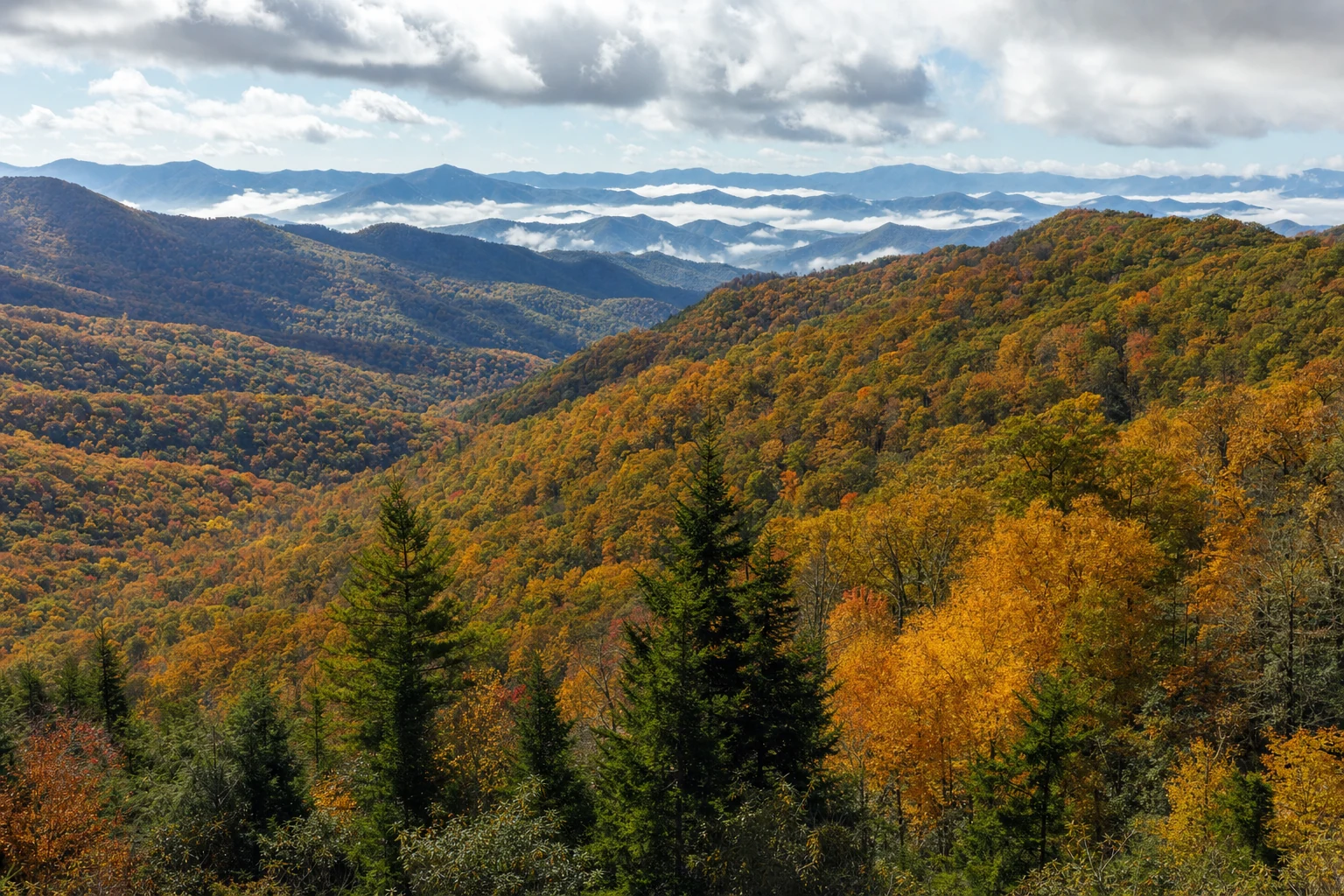
The summit delivers a true 360-degree view. To the south and west, the Plott Balsam Mountains dominate the near landscape, their rounded ridges stacked in receding layers. Further out, depending on visibility, you can pick out distant peaks across the Southern Appalachians; on clear days this extends for dozens of miles in multiple directions. It's the kind of view that makes you stay longer than you planned.
Sunrise and sunset are when this place earns its reputation. The Plott Balsams face west across a long valley, so late-afternoon light hits the ridges at an angle that turns the whole scene gold and orange. Mornings can be more dramatic still: the valley below fills with fog while the summit stays above it, and the light comes up across a sea of clouds. Neither effect is guaranteed, but both happen often enough that this overlook has a dedicated following of photographers who arrive before dawn.
The trail
Getting to the summit requires a short hike, not a stroll. The trail gains elevation quickly over rocky terrain and is genuinely strenuous for anyone not accustomed to high-altitude hiking. Most reasonably fit adults can manage it, and the payoff is a summit view that no roadside pullout can match.
Conditions change fast at this elevation. The summit is exposed, and afternoon thunderstorms build quickly in summer. If you're timing a sunset hike, check the weather before heading up and plan to be back at the car before storms develop. In colder months the trail can stay icy well into spring.
When to go
Fall is the prime season. The high elevation means color arrives early here, typically reaching full peak in early October while Gatlinburg and the lower elevations are still mostly green. This makes Waterrock Knob one of the better spots in the region to catch early foliage, and the Parkway section from Richland Balsam (MP 431, the highest point on the entire Blue Ridge Parkway at 6,047 feet) through here to Soco Gap (MP 455.7) makes a solid half-day drive with multiple stops.
Expect crowds at sunrise and sunset, especially on fall weekends. The parking lot is large relative to most Parkway overlooks, but it fills up fast. Arriving 45 minutes before sunrise gives you a reasonable shot at a space; arriving 20 minutes before is a gamble.
Summer mornings are generally less crowded and can offer the fog-sea effect described above. Midday in summer is the least interesting time to visit, flat light with little drama at the horizon, but the views are still real and crowds are manageable.
Getting there
From Gatlinburg, drive south through the park on Newfound Gap Road (US-441) to Cherokee, NC, then head west on US-19 toward Maggie Valley. The Blue Ridge Parkway entrance near Cherokee puts you on the southernmost stretch of the Parkway; drive north from there, gaining elevation through the Balsam Mountain section to reach milepost 451.2.
Plan for the road itself to take time. The Parkway has a 45 mph speed limit, and the turns and overlooks between Cherokee and Waterrock Knob invite stops. If you're coming for sunrise, calculate backwards from your target time — the Parkway stretch takes longer than the map suggests.
The Park-It-Forward parking program applies within Great Smoky Mountains National Park proper. The Blue Ridge Parkway is a separate National Park Service unit; there's no fee to park at Waterrock Knob. If your drive combines Parkway stops with time inside GSMNP, you'll need the Park-It-Forward tag for any stop over 15 minutes inside park boundaries. It's available at recreation.gov or at kiosks near the park entrances.
Practical notes
Restrooms are available at the Waterrock Knob pullout. That matters more than it sounds on a long drive through remote high-country terrain.
The visitor center opens seasonally. Don't count on it being staffed outside summer; the overlook itself is accessible year-round, weather permitting.
High-elevation Parkway sections close in winter when ice or snow makes them impassable. Closures can start as early as November and linger into April. Check the NPS Parkway road status the morning of your trip if there's any chance of frost; driving 90 minutes to a closed gate is the kind of thing that happens to people who skip that step.
Pairing with nearby stops
Richland Balsam Overlook at MP 431.4 sits about 20 miles south and is the highest point on the entire Blue Ridge Parkway (6,047 feet). If you're driving this section, stopping there first gives the drive a sense of progression from that peak elevation down to Waterrock Knob, then on toward Soco Gap and Maggie Valley.
Maggie Valley, a few miles from the Parkway on US-19, is the nearest town with lodging and restaurants. It's a compact mountain community, practical rather than polished, with motels and cabin rentals covering most budgets. From there, Cataloochee Valley is accessible via a narrow but drivable road and offers one of the best elk viewing opportunities in the eastern US. A Waterrock Knob sunrise paired with a Cataloochee morning makes a legitimate two-for-one.