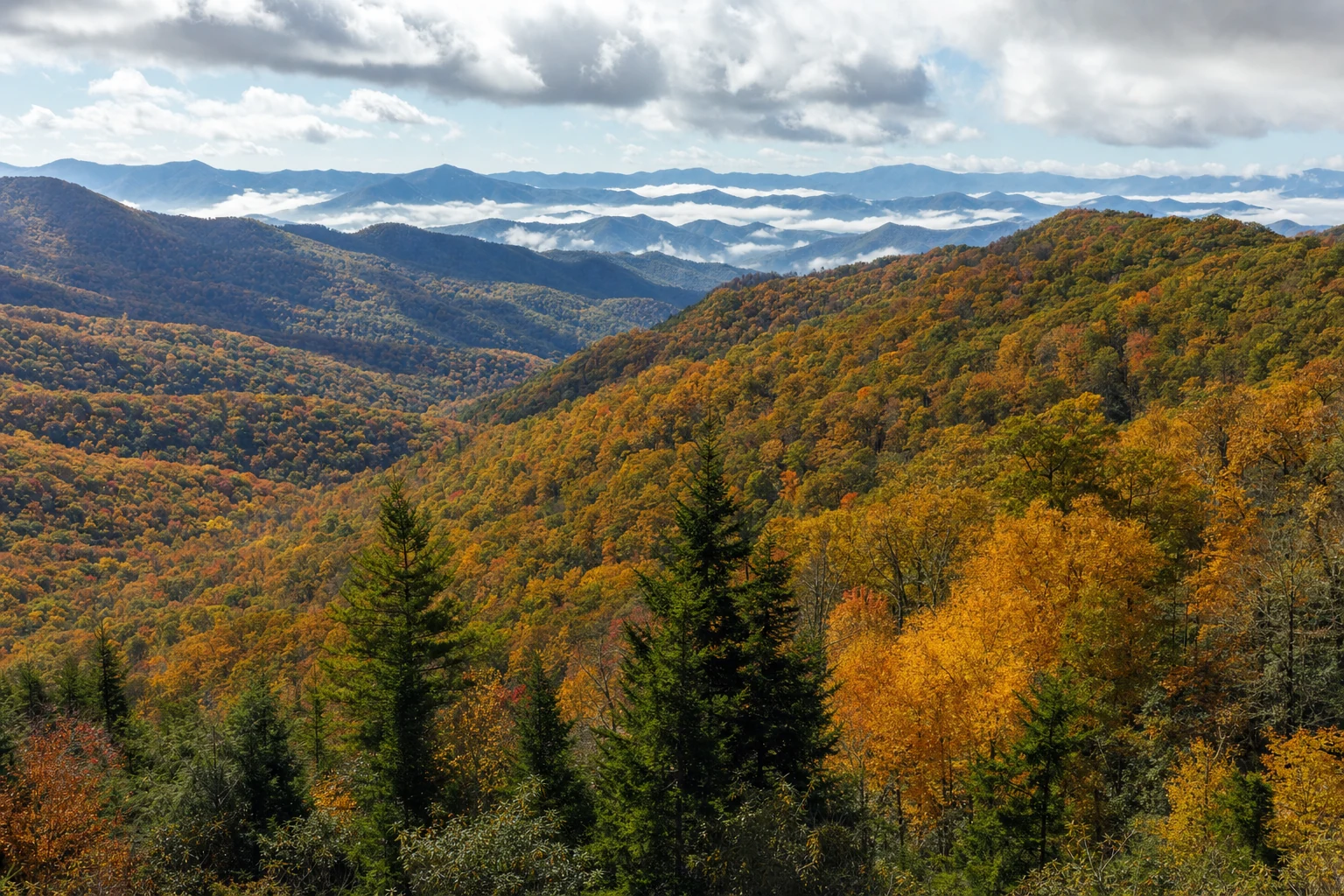

About Andrews Bald Trail (via Forney Ridge Trail)
Andrews Bald sits at the southern end of Forney Ridge, accessible only via the Kuwohi (Clingmans Dome) parking area at the summit of the park's highest paved road. The 1.8-mile route to the bald is rated moderate, but the elevation profile surprises first-timers: you descend on the way out, which means the 300 feet of gain comes on the return trip. What waits at the end is an open grassy clearing with long views south toward Fontana Lake, and in late May and early June, one of the most concentrated natural displays of Flame Azalea and Catawba Rhododendron anywhere in the national park.
Trail at a glance
- Distance: 1.8 miles one-way, 3.6 miles round-trip
- Elevation change: 300 feet; you descend to the bald on the outbound leg, gain it back on return
- Difficulty: Moderate
- Route type: Out-and-back on the Forney Ridge Trail
- Trailhead: Kuwohi (Clingmans Dome) parking area, 35.5562° N, 83.4764° W
- Parking: Park-It-Forward tag required — $5 daily, $15 weekly, $40 annual (recreation.gov or park kiosks)
What the hike is actually like
The trail leaves the Kuwohi parking area heading southwest on the Forney Ridge Trail, almost immediately entering high-elevation spruce-fir forest. This ecosystem exists only on the highest Appalachian peaks; it's cold even in July and often wrapped in cloud, with an understory dense with ferns and mosses that looks nothing like the lower-elevation forest most visitors to the Smokies encounter. The canopy is tighter and darker up here, and the shift happens fast.
Because the route descends on the outbound leg, effort distributes unevenly. The walk to the bald is deceptively comfortable; the real work comes on the return, climbing back out to the parking area. Trail surface alternates between packed dirt and rocky, root-crossed sections — trekking poles are genuinely useful, particularly after rain when the slope back toward the lot gets slick.
The Forney Ridge Trail continues past Andrews Bald heading deeper into the backcountry toward Fontana Lake far below. Most day hikers treat the bald as the turnaround point, and the route out-and-back is complete on its own.
At the bald, the forest opens abruptly. Rhododendron grows thick around the perimeter; the grassy expanse inside is wide and relatively flat, and the contrast with the tight forest you just walked through is stark. Views extend south across layered ridgelines toward Fontana Lake. No developed overlook, no interpretive sign directing you toward the best angle — walk the full perimeter before settling. The bald's southern edge offers the clearest sightlines.
When to go
Late May and early June are when this trail earns its specific reputation. Flame Azalea and Catawba Rhododendron bloom in sequence through these weeks, and Andrews Bald carries a disproportionate concentration of both species. The clearing's perimeter turns shades of orange and deep rose-pink; the effect is more dramatic here than almost anywhere else in the park during the same period. If you can plan around bloom timing, this is the trail where it pays off most.
Outside of peak bloom, the trail holds up. The high-elevation forest stays cool through summer, making this a solid option when temperatures in the valley push high and lower-elevation trails get crowded and hot. Fall color generally peaks at this elevation in mid-October; the forested descent on Forney Ridge colors earlier and more vividly than the bald itself, so the whole walk becomes a foliage experience rather than just a destination.
Summer weekends and October weekdays both see heavy traffic at Kuwohi. Arriving early — before the parking lot fills, which can happen by mid-morning on busy days — matters more here than at most Smokies trailheads. There are no alternative parking areas and no park shuttle to this location.
Kuwohi Road closes seasonally in the colder months, making this trailhead completely inaccessible until spring conditions allow reopening; exact dates vary year to year. Check the park's road and trail conditions page before planning any late-fall or winter visit.
Getting there
The trailhead is at the top of Kuwohi (Clingmans Dome) Road, which branches off Newfound Gap Road (US-441) at the Tennessee-North Carolina state line. From Gatlinburg, take US-441 south through the park to Newfound Gap, then turn onto Kuwohi Road. From Cherokee, North Carolina, take US-441 north to the same junction. GPS for the parking area: 35.5562° N, 83.4764° W.
A note on the name: the park officially renamed Clingmans Dome to Kuwohi, restoring the Cherokee name for the peak. Navigation apps and road signs may still show the older name; both refer to the same location.
Park-It-Forward parking tags are required for any stop over 15 minutes anywhere in Great Smoky Mountains National Park. Rates are $5 daily, $15 weekly, and $40 annually. Buy in advance via recreation.gov or at kiosks inside the park. There's no separate entrance fee for the park itself, so the parking tag is the only cost most visitors pay.
Know before you go
Pack for the mountain, not the valley forecast. The summit area and Forney Ridge sit well above Gatlinburg's elevation, and conditions diverge quickly. The weather can shift from clear to cold and wet with little warning even in midsummer — a rain layer and a warm layer belong in your pack on any visit, regardless of what the morning looked like driving up.
Carry enough water for the full round-trip; there are no water sources on the trail. Black bears range actively through this zone of the park, and the NPS requires maintaining at least 50 yards of distance at all times. Food storage rules apply from the parking lot forward — don't leave anything with a scent in an unattended vehicle.
Cell service on and near the trail is unreliable. Download the NPS app or note the current trail conditions before leaving your car. The official NPS page for Andrews Bald lists any active closures or route changes.
If you want to extend the day, the half-mile paved path to the Kuwohi observation tower starts from the same parking lot and delivers summit views in every direction. Most visitors do the tower and the bald as a pair; together they add up to a full morning.
Frequently asked questions
- How long is Andrews Bald Trail (via Forney Ridge Trail)?
- Andrews Bald Trail (via Forney Ridge Trail) is 1.8 miles one-way (3.6 miles round-trip), with 300 feet of elevation gain. It is rated moderate.
- Do I need a parking tag?
- Yes — a Park It Forward parking tag is required for vehicles parked more than 15 minutes anywhere inside Great Smoky Mountains National Park. Daily ($5), weekly ($15), or annual ($40) tags are available via recreation.gov or park kiosks.