
About Appalachian Trail (AT) - Various Sections
The Appalachian Trail runs 71 miles through Great Smoky Mountains National Park, more than any other national park along the entire 2,190-mile route. Most visitors never hike the whole corridor, nor should they — what makes the park's AT section worth understanding is that its best stretches are accessible as day hikes, each with a distinct character and a payoff that rewards careful planning over simply showing up.
The Charlies Bunion Route
Start here if you've got one day and want the AT's most iconic Smokies experience. The trailhead sits at Newfound Gap, where US-441 crosses the AT and a stone monument marks the spot where President Franklin D. Roosevelt dedicated the park in 1940. From that parking area, the trail heads northeast along the main ridgeline, climbing through spruce-fir forest toward Charlies Bunion — a distinctive bare rock outcrop jutting out from the ridge at roughly 5,375 feet.
The round trip covers about 8 miles with roughly 1,640 feet of elevation gain, which puts it in moderate-to-strenuous territory rather than outright punishing. Expect a steady climb on the way out, exposed rock near the top, real wind at the summit, and views that open across layer after layer of ridgeline. The section gets busy — Newfound Gap is one of the park's most accessible AT trailheads — but crowds thin considerably once you're past the first mile. Don't underestimate the exposure near the Bunion itself; the rock is uneven and the drop-offs are genuine.
Newfound Gap to Kuwohi
If Charlies Bunion is the obvious choice, the Newfound Gap to Kuwohi section is what serious hikers should consider instead. The route runs about 8 miles one way, climbing toward the park's highest point (Kuwohi, formerly called Clingmans Dome, renamed in 2024 to restore the Cherokee name). Do it as a 16-mile out-and-back with an early start, or arrange a car shuttle to finish at the Clingmans Dome Road parking area.
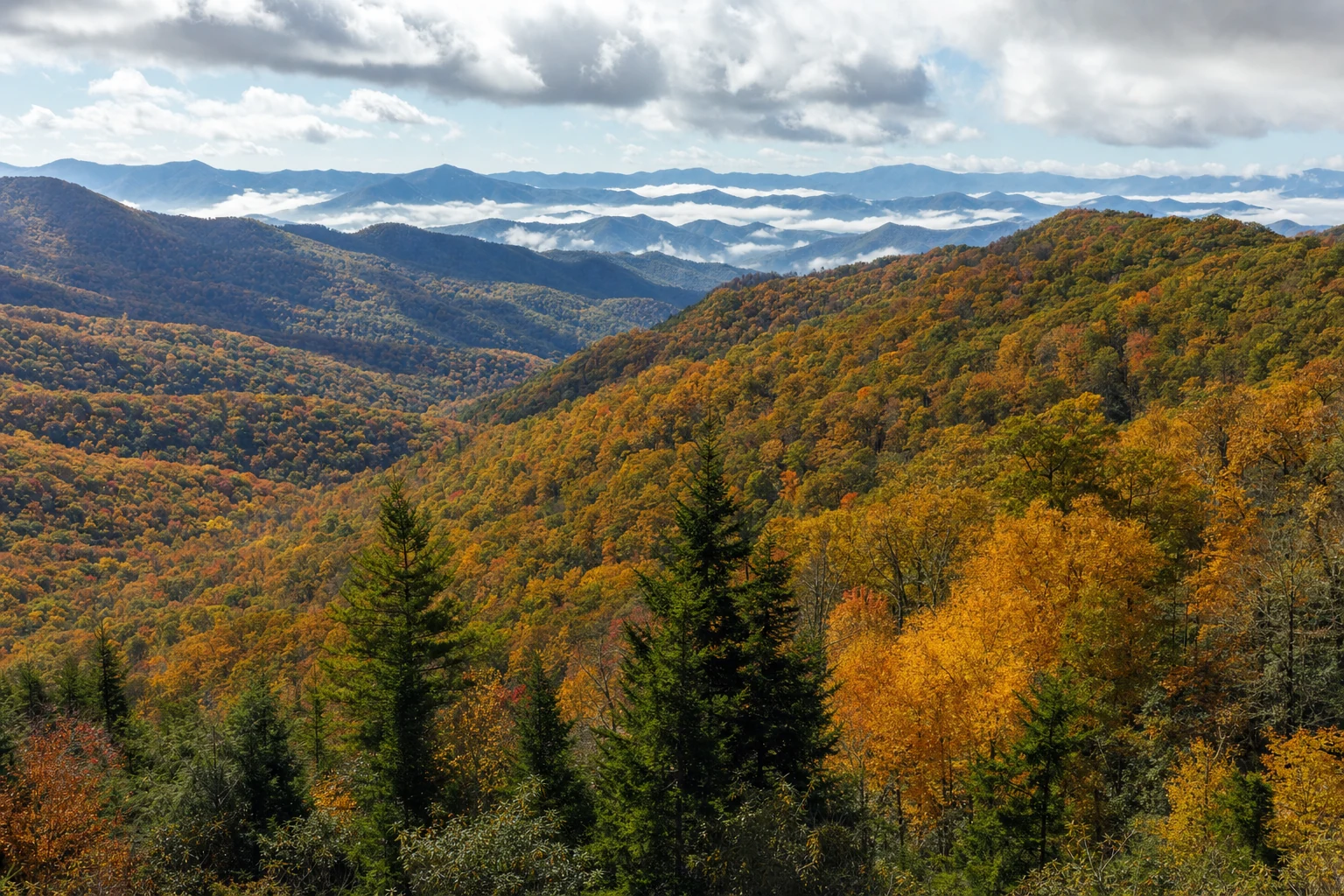
The elevation changes the forest entirely. The spruce-fir zone up here is gnarled, fog-wrapped, and carpeted in moss — nothing like the lower hardwood slopes. High-elevation fall color also arrives weeks ahead of the valleys: expect peak foliage along this corridor in late September to early October, when American beech and yellow birch turn gold well before Gatlinburg catches up.
The Eastern Corridor: Davenport Gap and Mount Cammerer
On the park's northeastern boundary, Davenport Gap opens the AT toward one of the more rewarding objectives in this section: Mount Cammerer and its restored 1930s stone fire tower. The most practical approach runs via the Low Gap Trail from the Cosby area, climbing roughly 3,000 feet over about 11 miles roundtrip. From the tower's catwalk on a clear day, you get 360-degree views of the Pigeon River Gorge and into multiple states. It's a full day and a hard one, but the crowds are nothing like Newfound Gap.
Cosby is the right base for this hike. It's a quiet section of the park with a large campground, genuine solitude, and far less parking pressure than the Sugarlands entrance. The area also provides trailhead access for the Gabes Mountain Trail and several other routes through less-trafficked terrain.
Fontana Dam and the Western Sections
The AT enters the park at Fontana Dam on the western end, where the trail meets the North Carolina shoreline of Fontana Lake. Day hikers use this access point to reach Shuckstack Fire Tower — a remote, challenging objective with expansive views over the lake and surrounding ridges. This is not a casual outing; the western AT sees far fewer people than Newfound Gap and the terrain demands experience.
Fontana also connects, via the AT, to the approach for Gregory Bald — though most hikers reach the bald via the Twentymile Trailhead in North Carolina rather than the AT proper. Gregory Bald's draw is the flame azalea bloom, typically mid-to-late June, when the open summit turns orange, red, and deep yellow. The hike from Twentymile runs about 11 miles roundtrip with roughly 3,000 feet of gain; the views are excellent well before azalea season.
Multi-Day Backpacking
The AT through the Smokies has more than 100 designated backcountry campsites and shelters. The shelters are three-sided Adirondack structures spaced roughly a day's walk apart along the main ridge; they fill fast in peak season. All overnight backcountry stays cost $8 per person per night and require advance reservations through Recreation.gov — walk-up permits don't exist here. Book well ahead for spring and fall weekends.
Planning a multi-day traverse means committing to real logistics. The ridge runs above 5,000 feet for long stretches, which means exposed conditions even in summer. Afternoon thunderstorms are common June through August; the ridge offers no shelter from lightning. Treat all water sources. Food storage requires a bear canister or proper hanging, and rangers enforce this actively. The Big Creek area, accessible from the park's northeastern edge, connects to the AT and offers a different starting point — with the added draw of old-growth forest and Big Creek Trail's relatively flat first few miles along an old railroad grade.
Timing
Spring on the ridge brings wildflowers at lower elevations and mud at higher ones; snowpack can linger into April above 5,000 feet. Summer is the busiest season, with humid but reliable weather and afternoon crowds at Newfound Gap. Fall is the most competitive window: high-elevation sections peak late September through early October, mid-elevation zones follow mid-to-late October, and lower approaches can still show good color into early November.
Winter hiking is possible and the long views through bare trees have real appeal. Clingmans Dome Road closes in winter (typically December through March or into April), eliminating one major access point. Newfound Gap stays open weather permitting, but snow and ice on the exposed ridgeline sections require traction devices — microspikes at minimum.
Parking and Logistics
The park charges no admission. A Park It Forward parking tag is required for any vehicle staying more than 15 minutes inside GSMNP: $5 daily, $15 weekly, or $40 annually, purchased via Recreation.gov or park kiosks. Newfound Gap fills fast on weekends; arrive before 9 a.m. or expect to wait. Davenport Gap and Fontana Dam have smaller lots with considerably less competition.
No reservation is required for day hiking. Cell service is poor to nonexistent on the ridge; download offline maps before you leave the trailhead.
Frequently asked questions
- How long is Appalachian Trail (AT) - Various Sections?
- Appalachian Trail (AT) - Various Sections is 71 miles one-way (142.0 miles round-trip), with modest feet of elevation gain. It is rated strenuous.
- Do I need a parking tag?
- Yes — a Park It Forward parking tag is required for vehicles parked more than 15 minutes anywhere inside Great Smoky Mountains National Park. Daily ($5), weekly ($15), or annual ($40) tags are available via recreation.gov or park kiosks.