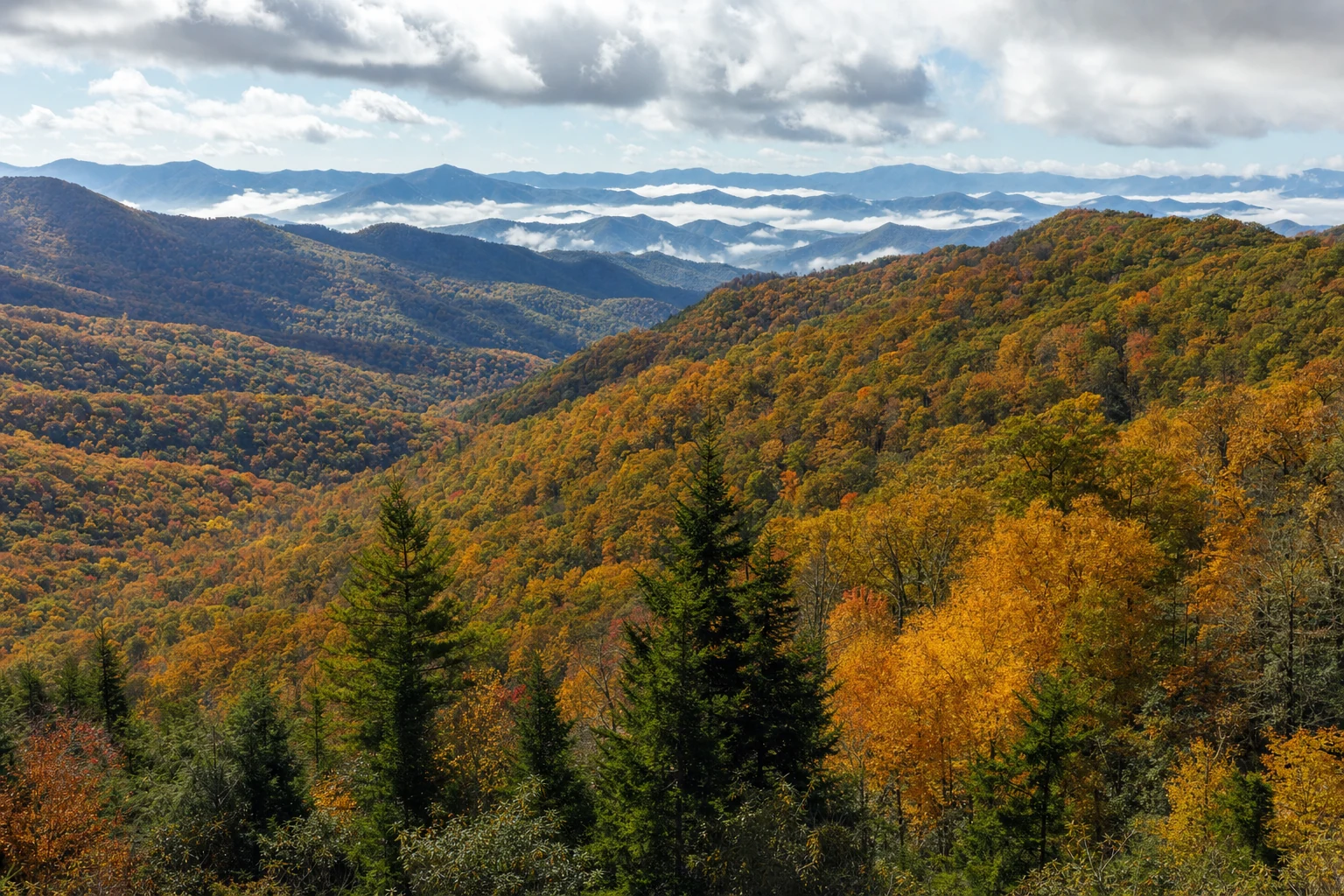

About Benton MacKaye Trail (BMAT) - Various Sections
The Benton MacKaye Trail was built to avoid the crowds. Named for the conservationist who proposed the Appalachian Trail in 1921, it runs 93 miles through Cherokee National Forest, connecting remote mountain terrain south to the Cohutta Wilderness. Unlike the AT, it rarely makes that connection feel simple; rated moderate to strenuous depending on the section, with access points scattered across the forest rather than concentrated at one trailhead, this is a trail for people who want actual solitude rather than the idea of it.
What the BMT is (and isn't)
The Benton MacKaye Trail shares its southern origin with the Appalachian Trail at Springer Mountain, Georgia, but the two diverge quickly in character. Where the AT draws thousands of thru-hikers annually and sees heavy foot traffic at shelters from Georgia to Maine, the BMT takes a more westerly route through territory that most of those hikers never see. The Cherokee National Forest section, 93 miles, runs through ridgelines and valleys where encounter rates with other hikers drop considerably once you're a few miles from a trailhead.
That's not appealing to everyone. If you want well-maintained infrastructure, reliable cell service, and reassurance that someone will notice if you don't show up, the AT and the developed trail network inside Great Smoky Mountains National Park are better fits. The BMT rewards self-sufficient hikers who can navigate with a map and manage multi-day logistics in terrain that doesn't do much hand-holding.
Terrain and forest character
The Cherokee NF section passes through forest that shifts noticeably with elevation: mixed hardwoods in the lower gaps giving way to hemlock and rhododendron along the drainages, with open ridge walking through oak and pine at higher elevations. The trail connects southward into the Cohutta Wilderness, one of the largest roadless areas in the eastern United States, giving the full route a sense of scale that most day hikes in the region don't approach.
Elevation gain varies considerably by section. Some stretches are genuinely moderate, with steady climbing at a manageable grade; others climb steeply off valley floors and qualify as strenuous. The trail doesn't build toward a single dramatic summit — it accumulates miles across rolling terrain where the physical demands come from sustained exertion rather than one sharp climb.
Water is generally available from streams and springs along the route, but filtration is required. In several sections you can go long stretches without crossing a paved road. That kind of sustained remoteness is the whole point for many hikers; for others, it's the detail that sends them back toward the park's front-country trails.
Section hiking vs. thru-hiking
Ninety-three miles as a continuous point-to-point is a serious undertaking, typically requiring a week or more for fit hikers carrying full backcountry loads. Thru-hiking the Cherokee NF section is a commitment most Gatlinburg-area visitors won't make on a standard trip.
Section hiking is more practical. The multiple access points through Cherokee National Forest let you cover a 15 or 20-mile segment over two days, shuttling a car to the far end of your intended stretch, without committing to the full distance. Individual sections can also work as day hikes if the trailhead is accessible from your base, though the remoteness means longer approach drives than you'd face on the park's more developed trail network.
The Benton MacKaye Trail Association at bmta.org maintains the most current resources for access points, water sources, and any reroutes. On 93 miles of backcountry terrain that changes seasonally, their information is more reliable than general-purpose hiking apps.
When to go
Spring is the strongest season for the lower forest sections. Wildflowers run through late April and streams are still full; temperatures stay comfortable for multi-day hiking. The trail's remoteness also means you get the seasonal displays without competition for parking at most access points.
Summer works for the higher ridge sections, where tree cover keeps conditions tolerable and afternoon thunderstorms are consistent enough to plan around: start early, be off exposed ridges before early afternoon. Lower elevations in July and August get hot and humid. It's manageable, but not the season's strongest case for this trail.
Fall from late September through early November delivers the best foliage along the Cherokee NF section. Colors run from the ridges downward over several weeks, with mid-October typically near peak at higher elevations. Expect more company at trailheads during this window than at any other point in the year, though "more company" on the BMT rarely means what it means on the AT.
Winter belongs to a small number of experienced cold-weather backpackers. Exposed ridges are severe in high winds; valley sections stay more sheltered. Some forest roads that provide trailhead access close seasonally, so check current conditions with the Cherokee National Forest ranger districts before planning a winter approach.
Getting there
Most approaches from Gatlinburg run south or southwest through the national forest, depending on which section of the trail you're targeting. Specific access points and accurate trail maps are essential before you leave; the approach roads don't lend themselves to being navigated from memory or from a general parks app. Download the relevant USGS topo maps or the official BMT maps from bmta.org while you still have reliable signal.
Parking at access points along Cherokee National Forest is generally free, but facilities vary widely by location. Many trailheads are primitive pull-offs on gravel forest roads. Some sections require high-clearance vehicles in wet conditions, so factor that into your logistics if you're working from a low-clearance rental.
Backcountry permit requirements depend on which land you're camping on. Overnight stays inside Great Smoky Mountains National Park require a free permit through recreation.gov; the Cherokee NF sections outside the park boundary operate under different regulations. Know which land you're camping on before you set out.
Before you leave the car
Cell coverage across most of the BMT route is poor to nonexistent. Download offline maps and leave a detailed trip plan with someone reliable before you go; carry a personal locator beacon or satellite communicator for any multi-day section.
Black bears are active throughout this region. Store food in a bear canister or with a proper hang, maintain at least 50 yards of distance from any bear you encounter, and never leave food or scented items unattended near camp. Encounter rates on remote backcountry routes tend to be higher than in front-country areas partly because there's less sustained human activity to keep bears wary of the trail corridor.
Mountain weather moves fast at elevation. Pack a rain layer and a warm layer regardless of the forecast; carry more water capacity than you think you'll need. Then plan for conditions that could shift significantly between the trailhead and your first night's camp.
Frequently asked questions
- How long is Benton MacKaye Trail (BMAT) - Various Sections?
- Benton MacKaye Trail (BMAT) - Various Sections is 93 miles one-way, with modest feet of elevation gain. It is rated moderate.
- Do I need a parking tag?
- Yes — a Park It Forward parking tag is required for vehicles parked more than 15 minutes anywhere inside Great Smoky Mountains National Park. Daily ($5), weekly ($15), or annual ($40) tags are available via recreation.gov or park kiosks.