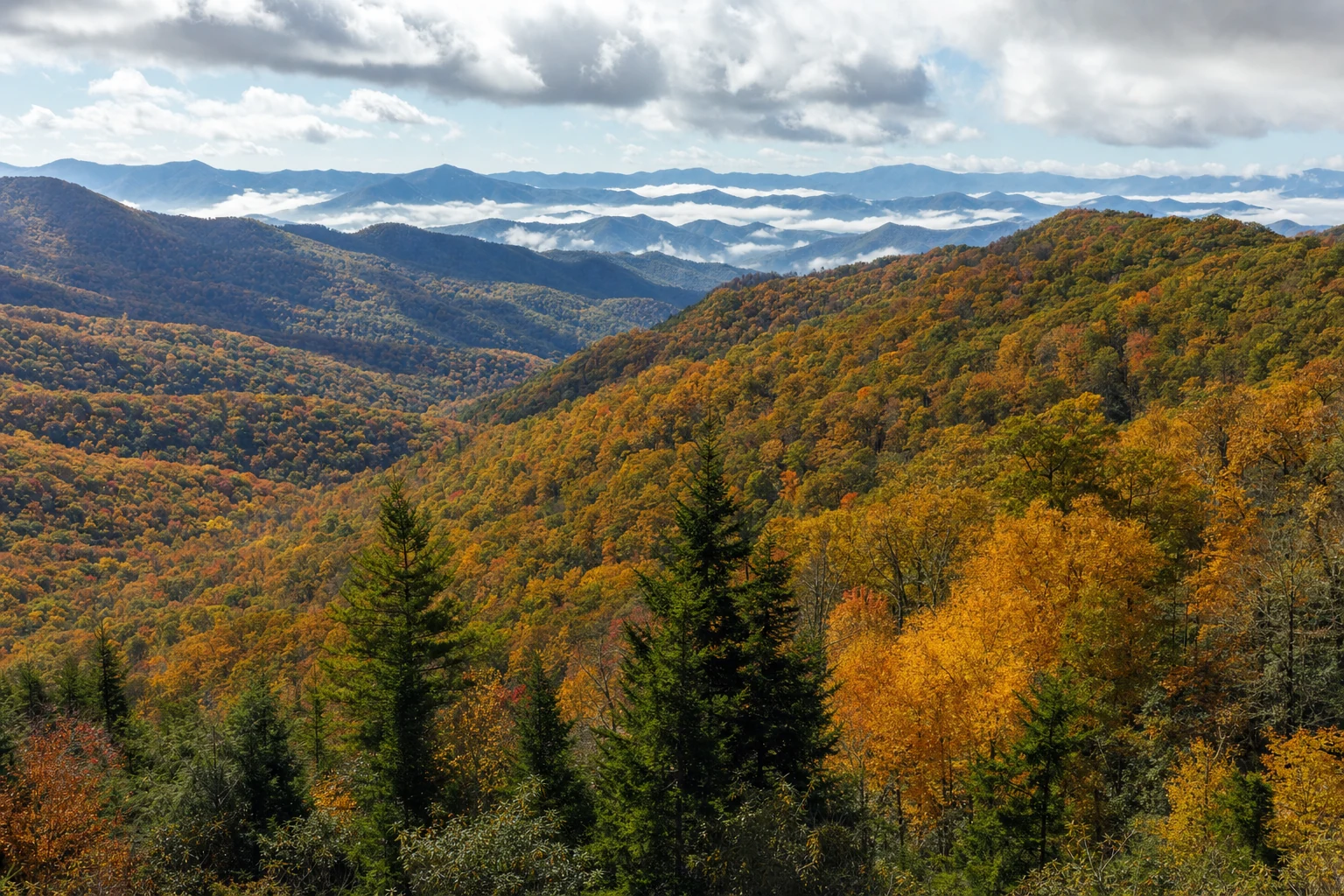

About Boogerman Trail (Cataloochee Valley)
Boogerman Trail runs 7.1 miles through some of the best-preserved old-growth forest in Great Smoky Mountains National Park, looping back via the Caldwell Fork Trail through terrain that feels genuinely remote even by Smokies standards. The strenuous rating reflects both the trail conditions and the approach: Cataloochee Valley, where the trailhead sits on Palmer Chapel Road, requires a commitment to reach that most day visitors don't make. That self-selecting dynamic keeps the crowds thin and the experience intact.
What the Hike Is Actually Like
The loop connects Boogerman Trail with the Caldwell Fork Trail, both starting from the same Palmer Chapel Road trailhead at 35.6366° N, 83.0805° W. At 7.1 miles with 1,000 feet of elevation gain, the full loop takes most hikers four to six hours, longer if you linger at the historic cabin site or spend time watching elk in the valley beforehand.
The defining quality of the trail is the forest itself. Sections of this loop hold old-growth hemlocks and hardwoods that survived the logging era, producing a canopy density and tree scale you don't encounter on most Smokies trails. The understory closes in, light shifts, and Caldwell Fork runs alongside the lower section with enough presence to make the route feel far from anything. These aren't just big trees in an otherwise ordinary forest; they're the kind of stand that makes you aware of how altered the surrounding landscape actually is by comparison.
Stream crossings on the Caldwell Fork section are genuine obstacles, not photogenic stepping-stone crossings. No bridges, multiple fords, and water levels that vary considerably with recent rainfall. In spring or after a significant storm, these run knee-deep. Waterproof trail shoes or gaiters earn their cost here in a way they don't on drier routes. The trail surface throughout is rooted and rocky, with descent sections that demand attention even in good conditions.
Getting to Cataloochee Valley
Cataloochee Valley sits on the North Carolina side of the park, accessed via winding, narrow roads that GPS navigation sometimes handles poorly or routes around entirely. Download trail maps offline before you leave cell coverage, which disappears well before the trailhead. The NPS recommends checking road conditions during winter months; the access road closes intermittently due to snow and ice, typically between December and February, with exact dates depending on weather.
Budget more driving time than the raw distance suggests. Part of what makes this loop feel remote is that Cataloochee genuinely is, and the access road is a significant contributor to why visitor counts here stay low compared to the park's main corridors. That's not a drawback; it's the condition of entry.
GSMNP requires a Park It Forward parking tag for any stay over 15 minutes inside park boundaries: $5 daily, $15 weekly, $40 annually. Purchase in advance through recreation.gov or at park kiosks. Confirm kiosk availability near Cataloochee before treating one as your backup plan.
Elk in the Valley
Cataloochee is the primary location in GSMNP for elk observation. The park reintroduced the herd in 2001, and they now graze the open meadows at the valley floor with enough regularity that sightings are common, particularly at dawn and dusk when the animals are most active. Park rangers are frequently present during peak viewing periods to provide information and keep people at a safe distance.
The required minimum separation from elk is 150 feet. During the fall rut, when bulls are most active and least predictable, that distance matters more than it might appear. These are large animals operating on instinct, not posing for photographs.
Many visitors structure their Cataloochee day around the timing: arrive at first light to watch elk in the meadows, then start the Boogerman loop mid-morning once the light improves. The two activities don't compete for time; meadow watching happens at the valley floor while the trail climbs into the forest above.
A Settlement's Remains
Cataloochee Valley holds one of the park's most significant collections of intact Appalachian settlement structures. The Palmer House, the Caldwell House, a schoolhouse, and several churches, most built in the late 19th and early 20th centuries, line the valley road in various states of preservation. The communities that built them were established enough to maintain schools and multiple congregations; the park's creation in the 1930s displaced them, and the structures left standing give the valley a historical weight that most park landscapes don't carry.
The Boogerman cabin site sits mid-loop, accessible only on foot. The cabin itself is gone, but the site rests in the old-growth forest that survived intact, and reaching it requires the better part of a morning's hiking. For visitors interested in the settlement history, pairing the trail with a walk through the valley's road-accessible structures makes for a complete day. Self-guided tours of the valley buildings are available, with NPS signage at each explaining its history and condition.
Seasonal Timing
Fall is the strongest season for this combination of hiking and wildlife. The elk rut peaks in early fall, foliage peaks around mid-October, and the valley's open meadows frame autumn color better than most enclosed forest settings. Crowds are significantly lighter here than at the park's main scenic overlooks and drives, even on peak-foliage weekends.
Spring brings wildflowers through the creek sections of the trail and reliable water volume at the stream crossings. Trail mud from snowmelt can persist into April, but solitude in the valley is genuine and reliable. Summer works if you start early; afternoon thunderstorms build quickly at elevation, the trail offers limited natural shelter, and the humidity inside a closed-canopy old-growth forest in July is considerable. Get off the trail before early afternoon if storms are forecast. Winter carries the road-closure risk, so check conditions through the park's official site before making the drive.
Before You Leave the Car
Cell coverage in Cataloochee Valley is essentially zero. Download trail maps offline before leaving service, and know how to use your phone's offline navigation. The trailhead coordinates (35.6366° N, 83.0805° W) plug directly into most mapping apps for pre-trip download.
Carry at least two liters of water per person. Caldwell Fork runs throughout the route, but the creek is not a reliable drinking source without a filter. Trekking poles pay dividends on the wet stream crossings and on the rocky descent sections, particularly after rain.
Black bears range throughout the park, and the Boogerman Trail's remote, dense forest makes an encounter more plausible than on high-traffic routes. Make noise while hiking, store food in a bear canister or hang it properly if camping overnight in the backcountry, and never leave a pack with food unattended. Bear spray is worth carrying; the instructions take ten minutes to read and are worth reading before you need them.
Frequently asked questions
- How long is Boogerman Trail (Cataloochee Valley)?
- Boogerman Trail (Cataloochee Valley) is 7.1 miles one-way, with 1,000 feet of elevation gain. It is rated strenuous.
- Do I need a parking tag?
- Yes — a Park It Forward parking tag is required for vehicles parked more than 15 minutes anywhere inside Great Smoky Mountains National Park. Daily ($5), weekly ($15), or annual ($40) tags are available via recreation.gov or park kiosks.