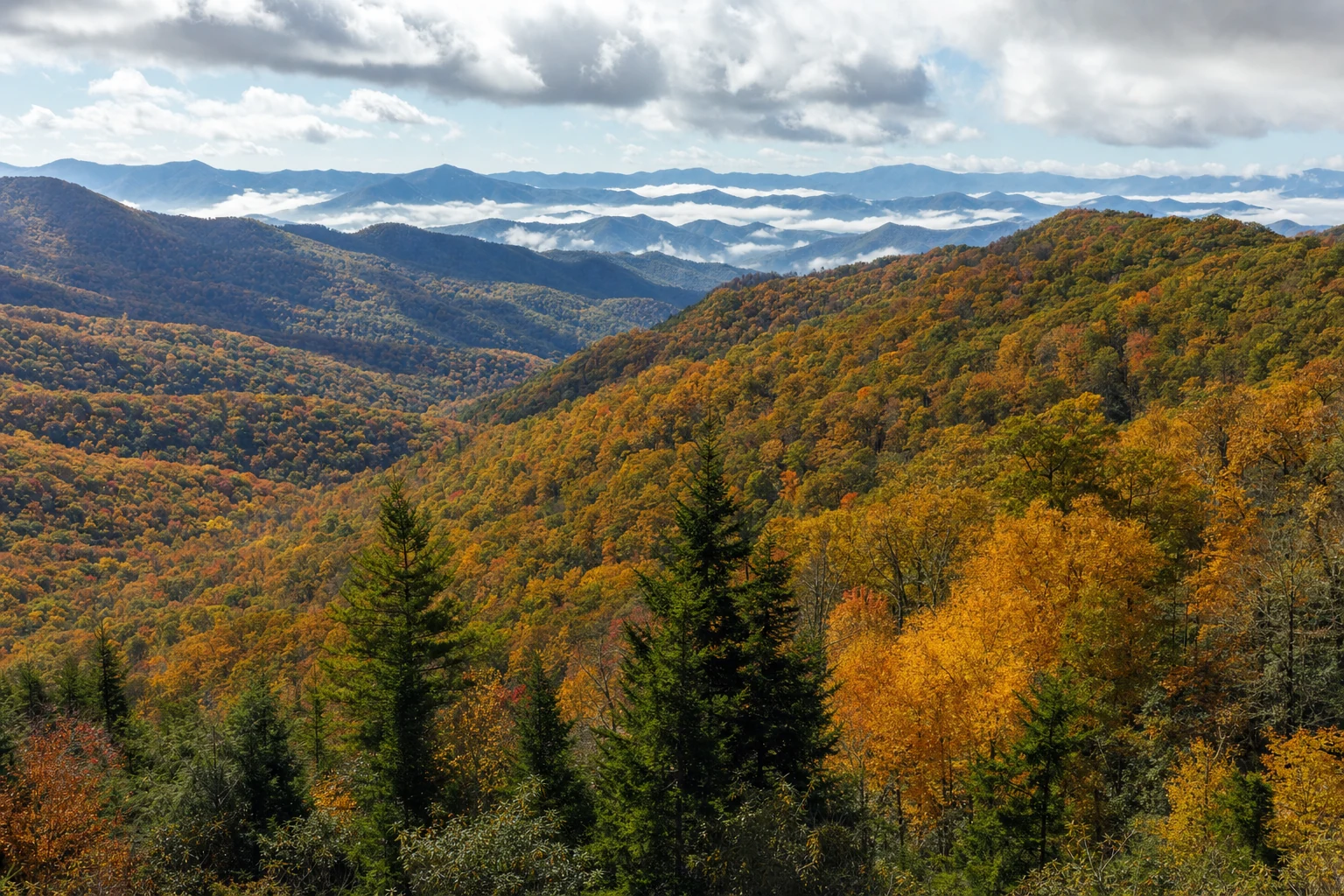

About Caldwell Fork Trail (Cataloochee Valley)
Cataloochee Valley sits at the far eastern edge of Great Smoky Mountains National Park, reached by a winding gravel road that filters out most of the crowds before you even arrive at the trailhead. Caldwell Fork Trail runs 5.7 miles one-way through old-growth cove forest, crossing and re-crossing its namesake stream, with an optional connection to Boogerman Trail that turns the whole thing into a longer loop. It's a moderate hike by Smokies standards, 1,000 feet of gain spread across the full 5.7 miles, but the route earns its "remote" reputation honestly; you're unlikely to encounter more than a handful of other hikers once you're past the first mile.
Trail at a glance
- Distance: 5.7 miles one-way; 7.1 miles as a full loop with Boogerman Trail
- Elevation gain: 1,000 feet
- Difficulty: Moderate (strenuous as the full Boogerman loop)
- Route type: Point-to-point, or loop via Boogerman Trail
- Trailhead: Palmer Chapel Road, Cataloochee Valley (35.6366° N, 83.0805° W)
The trailhead sits off Palmer Chapel Road inside Cataloochee Valley, a location that requires some commitment to reach. The access road is unpaved and narrow, and Cataloochee doesn't have the obvious highway entrance that most GSMNP trailheads do; you navigate through Maggie Valley and follow signs up into the mountains, with the valley floor revealing itself gradually as the road drops in.
What the trail is actually like
Caldwell Fork Trail follows its namesake creek for most of the route, and the stream crossings are a defining feature of the experience rather than a minor nuisance. Several have no footbridge, so plan for wet feet if water levels are up, which is most of the year outside of late-summer dry spells. The creek runs cold and clear, threading through a corridor of old hemlocks and tulip poplars that haven't been logged in a very long time; the canopy density and sheer age of the trees here are uncommon even by Smokies standards.
The 1,000-foot gain distributes well across the full 5.7 miles rather than concentrating in one steep push, which means the terrain doesn't dominate your attention throughout. That matters, because the forest floor rewards watching. Wildflower coverage in the cove hardwood sections peaks in spring, with trillium and wild geraniums appearing before the canopy has fully leafed out. Later in the season, the understory fills in dense and green, and the creek becomes audible long before you can see it through the leaves.
The overall character of the trail is enclosure rather than panorama. This isn't a ridge walk with views; it's a creek corridor with depth and age. If that trade sounds worthwhile, it is. Wildlife is part of the draw in Cataloochee generally, and the valley holds an elk population; you may see or hear elk near the trailhead before you've started hiking, particularly in early morning when they move through the open meadow areas.
Pairing with Boogerman Trail
The most natural extension of a Caldwell Fork hike is to complete the full loop via Boogerman Trail, which shares the same Palmer Chapel Road trailhead. The combined route runs 7.1 miles total and carries a strenuous rating, earned by the added distance and some steeper climbing on the Boogerman section. Boogerman adds two things Caldwell Fork doesn't offer on its own: the site of a historic cabin from the valley's former settlement era, and higher-elevation terrain with longer sightlines as the trees thin.
If you want the full Cataloochee experience in a single day, take Caldwell Fork out first for the creek corridor and cove forest, then return via Boogerman. Budget a solid half-day for the complete loop. Both trails begin and end at the same trailhead, so the logistics are clean.
Best time to visit
Fall is when Cataloochee is hardest to argue against. Peak foliage typically arrives in mid-October at this elevation, and the timing overlaps with the elk rut: bulls bugling at dawn, visible in the valley's open meadows before you've pulled on your boots. If you're making one fall trip into the Smokies, this is a legitimate case for sending it here rather than to the more trafficked viewpoints along Newfound Gap Road.
Spring is genuinely competitive. The creek runs full, wildflowers peak before visitor numbers climb, and the cove forest has a particular quality when new leaves are still translucent and light filters through green. Summer brings more pressure park-wide, but Cataloochee sees far less of it than Gatlinburg-side trailheads; start before 8 a.m. and you'll have the trail largely to yourself.
Winter opens up the understory and extends sightlines considerably through the bare trees. The stream crossings become more technical when rocks are icy. The trail stays open, but Cataloochee Road can close after significant snowfall, so check road conditions before committing to the drive.
Getting there
From Maggie Valley, follow the signs toward Cataloochee Valley. The route takes you through Cove Creek Road, which turns to gravel and climbs before descending into the valley floor. Google Maps can handle the navigation but occasionally suggests alternatives; stick with the official Cataloochee entrance signage posted along the way. Allow extra time for the approach road, and don't be surprised if elk are standing in it.
Trailhead GPS: 35.6366° N, 83.0805° W. Parking is at the Cataloochee lot off Palmer Chapel Road.
A Park It Forward parking tag is required for any stop inside Great Smoky Mountains National Park lasting more than 15 minutes. Tags cost $5 daily, $15 weekly, or $40 annually, available through recreation.gov or at park kiosks. Purchase before you arrive; cell service in Cataloochee Valley is unreliable, and completing a mobile transaction once you're in the valley isn't guaranteed.
Before you go
Water levels on Caldwell Fork vary considerably by season. Crossings that sit ankle-deep in late summer can run knee-deep or higher in April and after heavy rain. Trekking poles help significantly on the slicker rock surfaces, and waterproof boots will earn their cost here in a way they don't on many Smokies hikes. If you're planning the Boogerman loop, pace yourself on Caldwell Fork; the back half of the combined route is where the strenuous rating starts to make sense.
Bears are active throughout the park and particularly visible in Cataloochee, where open meadows create more sighting opportunities than dense forest terrain. Keep 50 yards of distance, store food in a bear canister or with a proper hang, and don't leave anything scented in your vehicle at the trailhead. Park regulations require 150 yards of distance from elk.
Cell coverage is poor to nonexistent in the valley; download offline maps before leaving home. The park's current road and trailhead conditions are posted at nps.gov/grsm/planyourvisit/cataloochee-valley.htm. For this entrance specifically, checking conditions in advance matters more than it does for most GSMNP trailheads.
Frequently asked questions
- How long is Caldwell Fork Trail (Cataloochee Valley)?
- Caldwell Fork Trail (Cataloochee Valley) is 5.7 miles one-way, with 1,000 feet of elevation gain. It is rated moderate.
- Do I need a parking tag?
- Yes — a Park It Forward parking tag is required for vehicles parked more than 15 minutes anywhere inside Great Smoky Mountains National Park. Daily ($5), weekly ($15), or annual ($40) tags are available via recreation.gov or park kiosks.