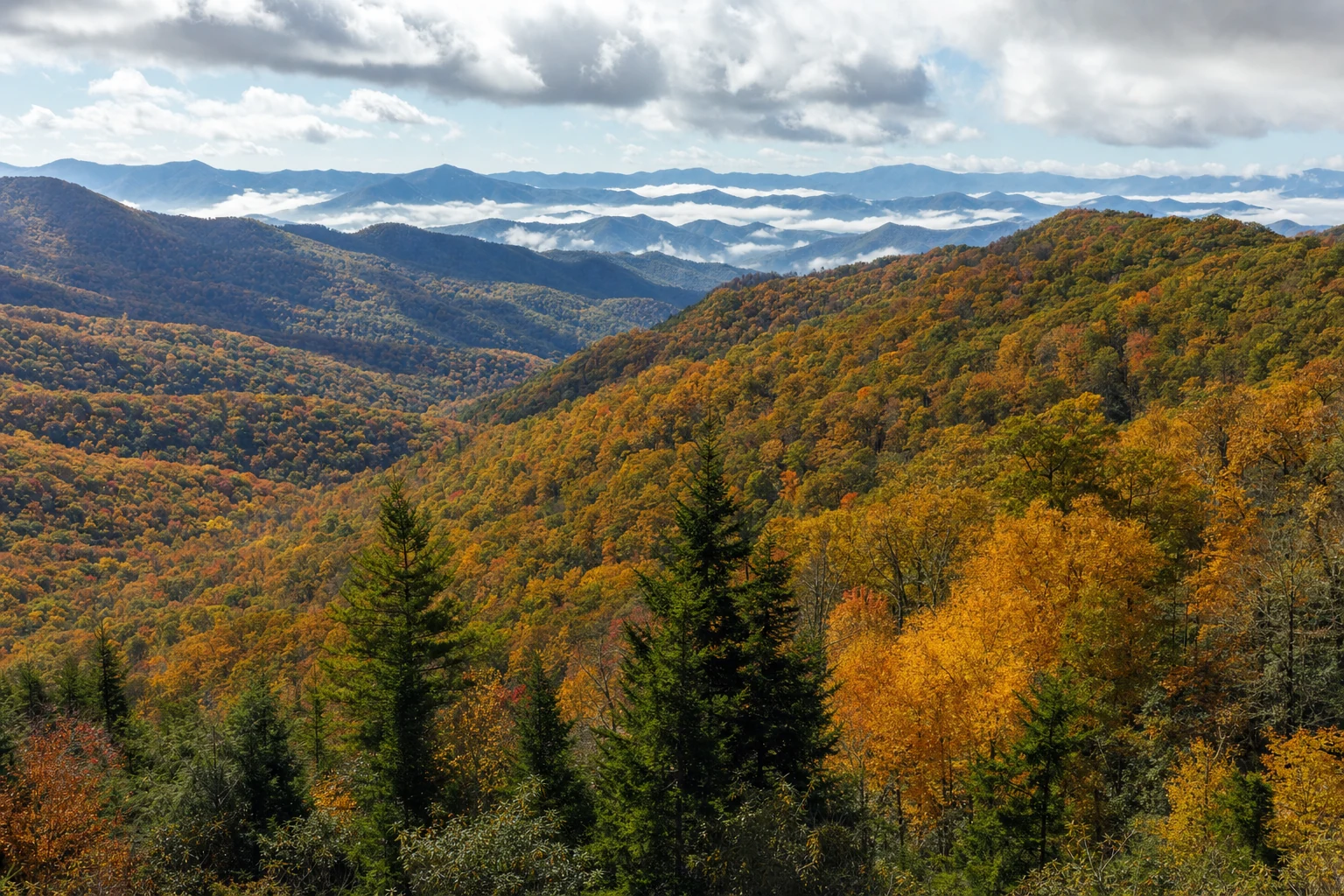

About Cherokee Orchard Road Trail (closed to vehicles):
Cherokee Orchard Road Trail offers one of the more unusual easy walks in Great Smoky Mountains National Park — a 3.4-mile one-way route along a former vehicle road that now belongs entirely to foot traffic. Because the surface was built for cars, the grade stays gentle, the path is wide, and the whole experience sits firmly in the Easy category. It's a logical choice when you want forest and solitude without committing to a strenuous climb.
Trail Basics
Distance: 3.4 miles one-way (6.8 miles out-and-back if you return the same way) Difficulty: Easy Surface: Paved road, closed to vehicles Managed by: National Park Service
The trail runs from the Gatlinburg side of the park, accessible via the Historic Nature Trail / Cherokee Orchard Road corridor. Because it follows what was once an auto route, the footbed is firm and well-defined — no scrambling over roots or navigating rocky creek crossings. That makes it appealing for walkers who want a forest experience without technical terrain, including families with older children and hikers who prefer a steady surface underfoot.
What the Walk Is Like
Walking a closed road is a distinct experience from a singletrack trail. The canopy closes overhead but the corridor stays open enough that you move through light rather than dense tunnel-like forest. Mountain laurel and second-growth hardwoods line most of the route. In spring the understory greens up fast, and the absence of engine noise makes the bird sounds and creek sounds carry further than they would outside the park.
The gentle gradient means most people can walk this at a comfortable pace without stopping for breath. At 3.4 miles one-way, the full out-and-back is under 7 miles — a half-day commitment for most hikers, shorter if you turn around early. There are no exposed ridgelines, no extreme weather exposure points, and no sections that require route-finding. For first-time GSMNP visitors, it's a reasonable way to get into the park without being overwhelmed.
One thing to keep in mind: "Easy" in a national park context means easier than the alternatives, not effortless. Even a gentle grade accumulates over several miles. Carry water.
Cherokee Orchard: The History Behind the Name
The Cherokee Orchard area was once a commercial apple orchard operation before the land became part of Great Smoky Mountains National Park. The orchard history is part of a broader pattern in this section of the park — the land near Gatlinburg was heavily used and farmed before the park's establishment, and traces of that human history persist in place names, stone walls, and cleared areas that forest has since reclaimed. Walking this road, you're traveling a route that served working land, not wilderness, within living memory of the park's founding generation.
The name "Cherokee" in this context refers to the area's local name, not the town of Cherokee on the North Carolina side of the park. The trailhead is on the Tennessee side, near Gatlinburg.
Best Time to Visit
Spring is the strongest season for this trail. Wildflowers emerge early at lower elevations in the Smokies, and the roadsides along the Cherokee Orchard corridor see good wildflower displays before the canopy fully leafs out. Waterfalls fed by snowmelt and spring rain run loudest in March and April.
Summer is busy in this part of the park — the Gatlinburg-side trailheads see heavy use, and parking fills by mid-morning on weekends. The trail itself stays relatively cool under tree cover, but expect company.
Fall draws the largest crowds overall to the Smokies, with mid-October typically the peak for color. Lower-elevation trails like this one show turning hardwoods but the drama is usually strongest higher up. Still, an October walk here is pleasant if you go on a weekday or arrive early.
Winter brings genuine quiet. This trail stays accessible in most winter conditions because it doesn't reach high elevation — snow and ice are possible but less common than on ridge trails. Cold-weather visits can be the most rewarding in terms of having the forest to yourself.
Getting There and Parking
The trailhead is accessible from Gatlinburg via the Cherokee Orchard Road / Historic Nature Trail corridor. From downtown Gatlinburg, follow Airport Road and then the signs toward Cherokee Orchard / Rainbow Falls — the route is signed from the edge of town.
A Park It Forward parking tag is required anywhere inside Great Smoky Mountains National Park for stays over 15 minutes. Daily tags cost $5, weekly $15, and an annual pass runs $40. Tags are available at recreation.gov or at park kiosks. This is separate from any other park pass — the America the Beautiful pass does not cover the Park It Forward parking fee.
Arrive early, especially on summer and fall weekends. The Gatlinburg-side trailheads fill quickly, and the parking areas serving the Cherokee Orchard corridor are not large.
Know Before You Go
Carry more water than you expect to need. Even on an easy, paved trail, the elevation and humidity of the Smokies in summer can catch people off guard. A water filter or purification tablets are useful if you're going deep into the park on a connector trail, though for this trail most hikers don't need them.
Mountain weather shifts fast. A rain layer and a light insulating layer are worth carrying even in summer — afternoon thunderstorms are common from June through August, and temperatures drop noticeably when clouds roll in.
Black bears are active throughout Great Smoky Mountains National Park, including lower-elevation areas near Gatlinburg. Maintain at least 50 yards of distance, never approach or feed bears, and store food properly. The NPS enforces food storage regulations strictly, and fines for violations are real.
Cell coverage along this trail is poor to nonexistent in places. Download an offline map before you leave — the Gaia GPS and AllTrails apps both work offline. Tell someone where you're going and when to expect you back.
Frequently asked questions
- Do I need a parking tag?
- Yes — a Park It Forward parking tag is required for vehicles parked more than 15 minutes anywhere inside Great Smoky Mountains National Park. Daily ($5), weekly ($15), or annual ($40) tags are available via recreation.gov or park kiosks.