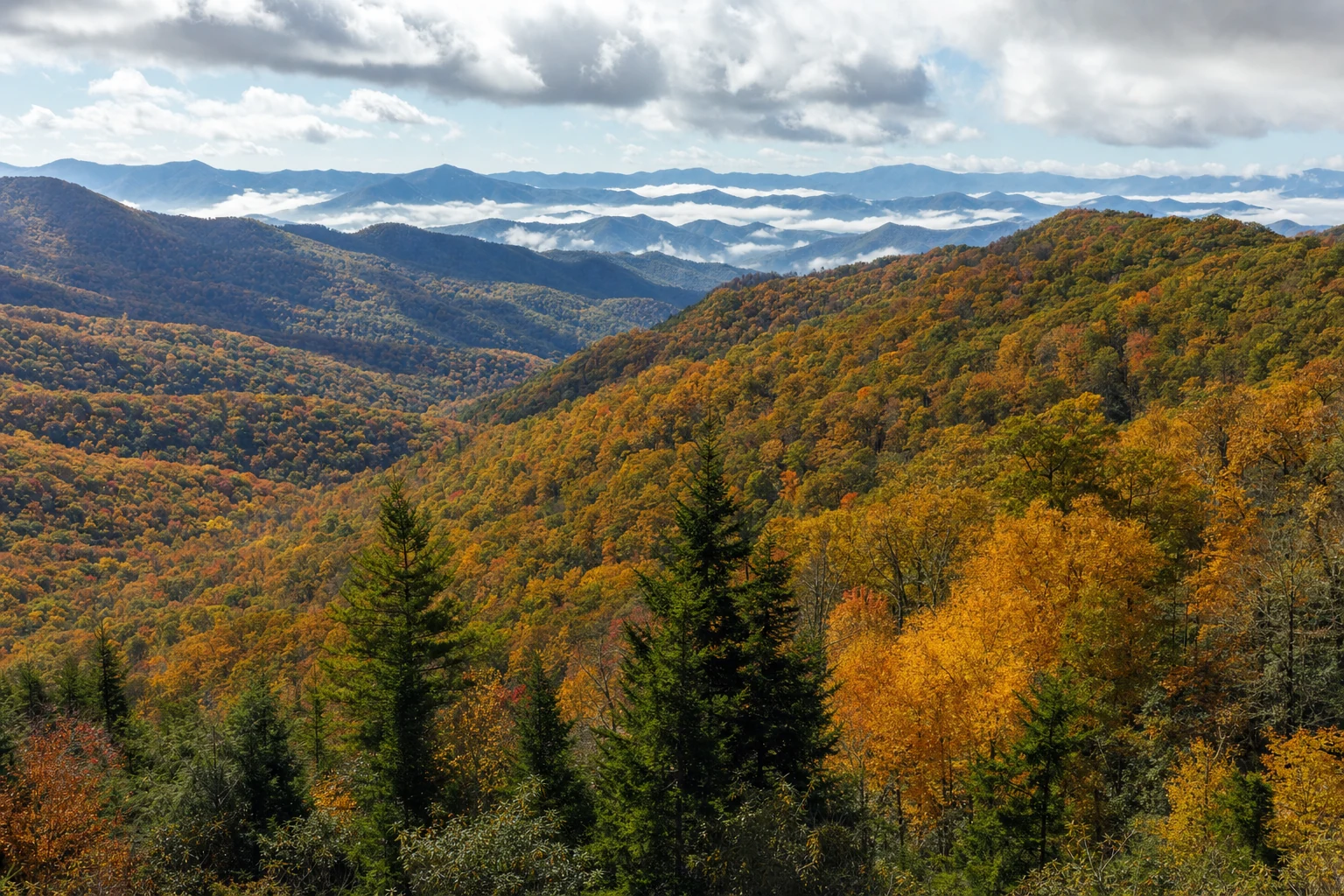

About Chimney Tops Trail
Now I'll write the page copy following the skill's rules.
---
Chimney Tops is one of the most-climbed trails in Great Smoky Mountains National Park, which makes it worth stating clearly upfront: the summit is closed, and has been since the 2016 wildfires damaged the pinnacles badly enough that the NPS restricted access above a lower overlook. Since 2017 the trail has been open to that overlook, roughly 1.75 miles from the trailhead, and that's where the day ends. You still get 1,400 feet of elevation gain in 3.6 miles round-trip, and the views of the twin rock chimneys from below are worth the effort. Arrive knowing what you're signing up for.
What you're actually climbing toward
The two rock peaks that give this trail its name jut up from the ridgeline and come into full view as you approach the overlook. From the observation platform you can see them close; close enough to understand why people climbed to the top before the closure made that impossible. The surrounding ridges spread out to the south and west on clear days. It's a real payoff for a real climb, even if it's not the summit experience the trail's reputation was built on.
The closure is not a temporary measure waiting on clearance. NPS trail status language on the official Chimney Tops page describes ongoing safety concerns tied to structural instability at the pinnacles themselves, with no posted reopening date. Before you go, check nps.gov/grsm/planyourvisit/chimney-tops-trail.htm for current status; conditions can shift due to weather and ongoing recovery work from the wildfire.
The climb
Steep is the accurate word. The trail gains 1,400 feet in about 1.75 miles of ascent, and the middle section doesn't relent; switchbacks ease the grade slightly but there's no long flat stretch where tired legs actually recover. Road Prong creek runs alongside the lower section, pleasant company while your lungs adjust, and then the path climbs away from the water into forest that opens as you gain elevation. The upper section is rocky underfoot, and wet rock there is genuinely slippery after rain. Most people moving at a steady pace finish the round-trip in two to three hours. The descent is harder on knees than the approach.
Children who are experienced on rocky terrain can handle this trail. Anyone expecting a nature walk will find it more demanding than they bargained for well before the halfway point.
Getting there and parking
The trailhead sits on Newfound Gap Road (US-441) at 35.6178° N, 83.4862° W, roughly seven miles south of Gatlinburg through the Sugarlands entrance. The parking lot fills fast on weekends between April and October; on fall-foliage weekends it can be gone before 9 a.m. Mid-morning is often too late. Arriving early is the only reliable solution.
Parking anywhere inside GSMNP for more than 15 minutes requires a Park-It-Forward tag: $5 per day, $15 per week, or $40 for an annual pass. Buy it through Recreation.gov online before you arrive, or at kiosks inside the park; the trailhead kiosk works but draws a line at peak times.
The Chimney Tops Picnic Area, 6.7 miles south of Sugarlands Visitor Center on the same road, is worth knowing about even if you're not stopping for lunch. Road Prong Trail departs from the picnic area and offers a quieter route through the same drainage if the main trailhead lot is already packed when you arrive.
When to go
Mid-October is when the mid-elevation forest along this corridor colors up most fully: oaks and maples shift first, then hickories and birches follow in the days after. The views from the lower overlook look directly into the terrain most affected, which is part of why the parking lot is impossible on fall weekends. If fall foliage is the goal, weekdays are substantially less chaotic than Saturdays.
Spring is an underused window. The creek runs high through April, wildflowers cover the forest floor in late April and early May, and the trail is measurably less crowded than it gets from June onward. Summer means heat at lower elevations, though the trail climbs high enough that temperatures cool near the overlook; the summer problem is sheer volume of people rather than the weather itself.
Winter is possible when Newfound Gap Road stays open, which isn't guaranteed: high-elevation sections close for ice and snow events without much advance notice. A cold clear day up there gives you sharper long views than any other season, ice-rimed rock faces in December and January, and a trailhead that may be nearly empty.
What to bring
Pack at least 1.5 liters of water per person for the round-trip, more in summer when the ascent is sweaty enough to run through it faster than expected. Trekking poles earn their weight on the descent, where knees absorb the most punishment. Cell service is poor to nonexistent once you're off the trailhead, so download an offline map before leaving the car. Mountain weather in the Smokies moves faster than most lowland visitors account for; a rain layer and a light warm layer belong in the pack regardless of what the morning looks like.
Black bears are active throughout the park year-round. The NPS guideline is 50 yards of distance from any bear you encounter; food and anything scented should stay in your car or a bear canister, never left unattended at the trailhead or on the trail. Stay on the marked route throughout the hike, not just because the terrain above the closure line is unstable, but because the surrounding forest is still in active ecological recovery from the 2016 fire.
The fire and what came after
The 2016 Chimney Tops 2 Fire caused serious damage across parts of GSMNP and the areas around Gatlinburg. The trail took direct damage, the summit became genuinely unsafe, and the NPS closed the entire route before reopening the lower section in 2017 after rebuilding portions of the trail infrastructure.
The recovery visible from the trail now is real. Younger growth has come up through the burn zones, and in sections where the fire ran hot, you can see the succession process in plain view: pioneer species coming in low while remnant older trees stand above them. It reads differently than the uniform mature canopy on trails that weren't burned. For some visitors that contrast makes the hike more interesting, not less; it's an ecological process unfolding on a timeline you can actually observe rather than one that happened before anyone came to look.
Frequently asked questions
- How long is Chimney Tops Trail?
- Chimney Tops Trail is 3.6 miles one-way (7.2 miles round-trip), with 1,400 feet of elevation gain. It is rated strenuous.
- Do I need a parking tag?
- Yes — a Park It Forward parking tag is required for vehicles parked more than 15 minutes anywhere inside Great Smoky Mountains National Park. Daily ($5), weekly ($15), or annual ($40) tags are available via recreation.gov or park kiosks.