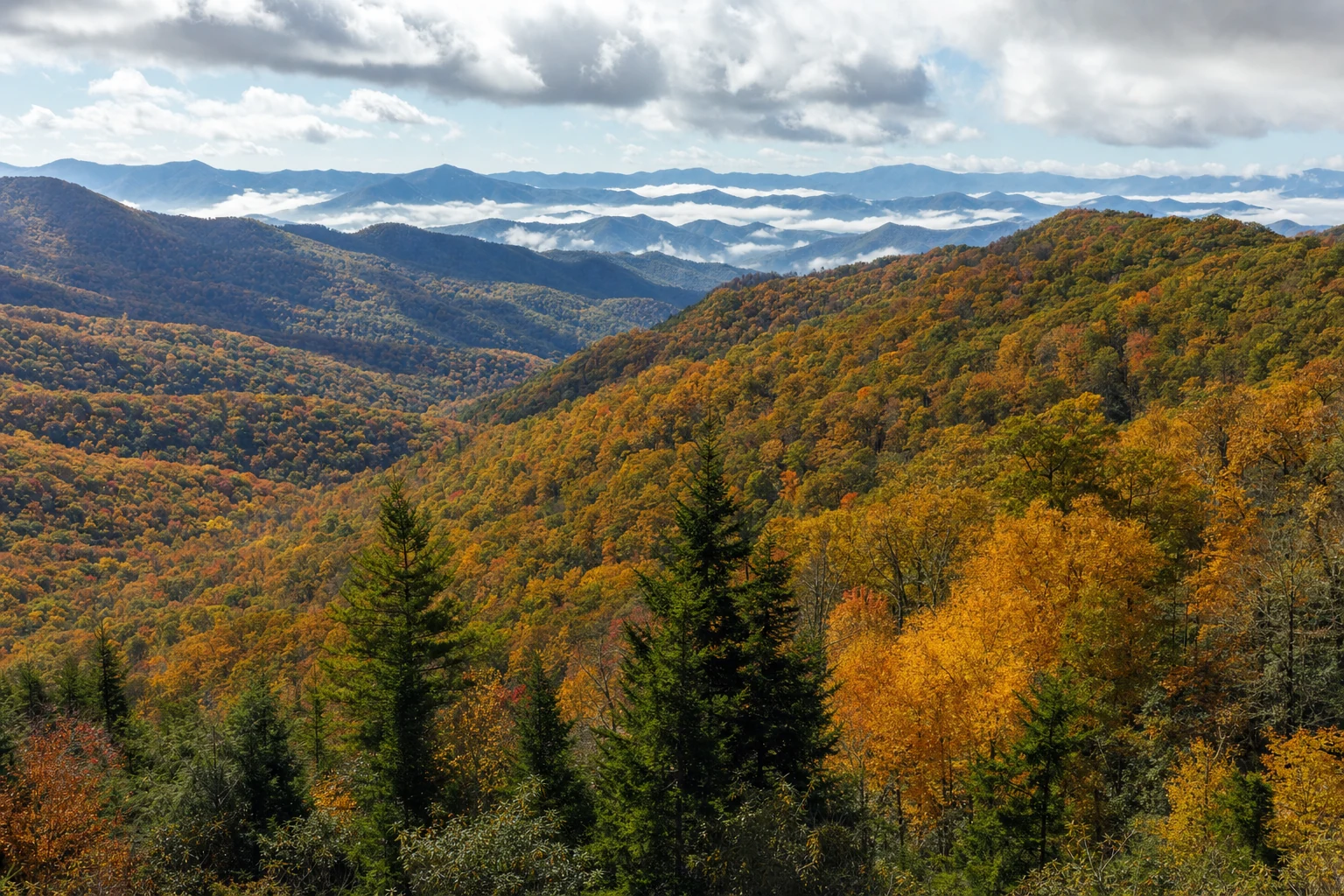

About Cove Hardwood Nature Trail
Sugarlands Visitor Center sits at the park boundary two miles from downtown Gatlinburg, and most visitors use it as a logistics stop: maps, restrooms, a quick ranger conversation before pushing deeper into the park. The Cove Hardwood Nature Trail starts right there, easy to miss if you're not looking, and it rewards anyone who does stop. Running 0.75 miles as a loop with minimal elevation gain, it passes through old-growth hardwood forest alongside a small stream, with interpretive signs marking notable trees and ecological features throughout. Late March through early May, it becomes one of the better wildflower experiences at this elevation anywhere in the park.
What the Trail Is Actually Like
The loop takes most people 30 to 45 minutes at a relaxed pace, and the terrain gives no real reason to rush. Elevation change is minimal; this isn't a climb. The hardwood canopy is genuinely old, the kind that requires no marketing language to sell: large trunks, complex bark, the particular quality of light that filters through a mature forest in ways a younger stand doesn't produce. A stream runs alongside part of the route, audible before it's visible, and the interpretive signs do actual interpretive work rather than stating obvious facts. You can move through quickly if you want, but this trail is built to slow you down.
The path loops, so you won't retrace your steps; start in either direction and you end where you began. It's well-maintained and genuinely appropriate for families with young children or anyone who can't commit to elevation or distance. The packed-dirt surface can get muddy after rain, so footwear that can handle some moisture is worth planning for. Because it starts at the visitor center, you can pair it with a restroom stop, a map pickup, or a conversation with a ranger about current conditions before you set out.
Wildflowers: Timing and What to Expect
Great Smoky Mountains National Park supports over 1,500 species of flowering plants, and Cove Hardwood Nature Trail sits at an elevation that positions it well for the spring bloom. Late March through early May is the prime window for wildflowers at lower elevations: trillium, phacelia, and various violets are well-represented in the hardwood understory during that stretch. The display isn't guaranteed on any specific date and varies meaningfully from year to year depending on winter conditions and spring temperatures, but an April visit during a normal year has high odds of encountering something worth stopping for.
Higher elevations in the park follow a different schedule, with rhododendron, mountain laurel, and late-summer asters running from June through August. Cove Hardwood, sitting lower and closer to the valley, tends to peak earlier. If maximum flower density on this trail is the goal, late April is generally the right window. The Gatlinburg Trail, which also starts near the Sugarlands Visitor Center, is another lower-elevation option worth knowing about if you want to extend the day with a second wildflower walk in the same area.
Photographing the Trail
For anyone with a serious interest in photography, this loop has real draw beyond casual sightseeing. Macro work is the obvious application: the wildflower display during spring provides close-up subjects, and shade from the hardwood canopy keeps light more manageable than open meadows would. A dedicated macro lens handles the extreme close-up work well. A tripod or monopod improves stability considerably when shooting at low shutter speeds in dim forest light; a small diffuser or reflector helps manage contrast even on overcast days.
Timing matters as much as gear. Early morning, after dew has settled on petals, adds texture and visual interest that midday shooting can't replicate. The trail is short enough that you can arrive at dawn, work it slowly for an hour or two, and finish before the Sugarlands parking area gets crowded. On busy spring weekends, that's not a small advantage.
Getting There and Parking
The trailhead is at Sugarlands Visitor Center (35.6811° N, 83.5604° W). From downtown Gatlinburg, head south on U.S. 441 toward the park entrance; the visitor center appears on your right approximately two miles in, with a parking lot adjacent to the building. Navigation is simple: there's only one main road in from the Gatlinburg side.
A Park It Forward parking tag is required for any stay over 15 minutes inside the park. Tags run $5 per day, $15 per week, or $40 for an annual pass; they're available at recreation.gov before your trip or at kiosks inside the park. Rangers do enforce this. Buying online beforehand saves time at the kiosk, which can back up on busy spring weekends.
Sugarlands is one of the park's most-visited access points. The lot fills on spring weekends, fall foliage weekends, and essentially any summer day with decent weather. An early arrival, before 9 a.m., is a reliable strategy for avoiding that problem. Midweek visits are noticeably less crowded across the board.
Know Before You Go
Carry more water than you expect to need; the Smokies' humidity in spring and summer can catch people off guard even on short trails. Mountain weather shifts fast, so a rain layer is worth keeping accessible even when the morning looks clear. This applies year-round.
Black bears are active throughout the park. Keep 50 yards of distance, make noise on the trail, and store food locked in your vehicle. Cell service inside the park is unreliable; download an offline map before you leave rather than counting on a signal when you need it.
Stay on the marked trail. The park's plant communities include fragile species that recover slowly from off-trail foot traffic, and the interpretive signs along Cove Hardwood explain some of that context directly. They're worth reading, not skipping.
Frequently asked questions
- How long is Cove Hardwood Nature Trail?
- Cove Hardwood Nature Trail is 0.75 miles one-way, with modest feet of elevation gain. It is rated easy.
- Do I need a parking tag?
- Yes — a Park It Forward parking tag is required for vehicles parked more than 15 minutes anywhere inside Great Smoky Mountains National Park. Daily ($5), weekly ($15), or annual ($40) tags are available via recreation.gov or park kiosks.