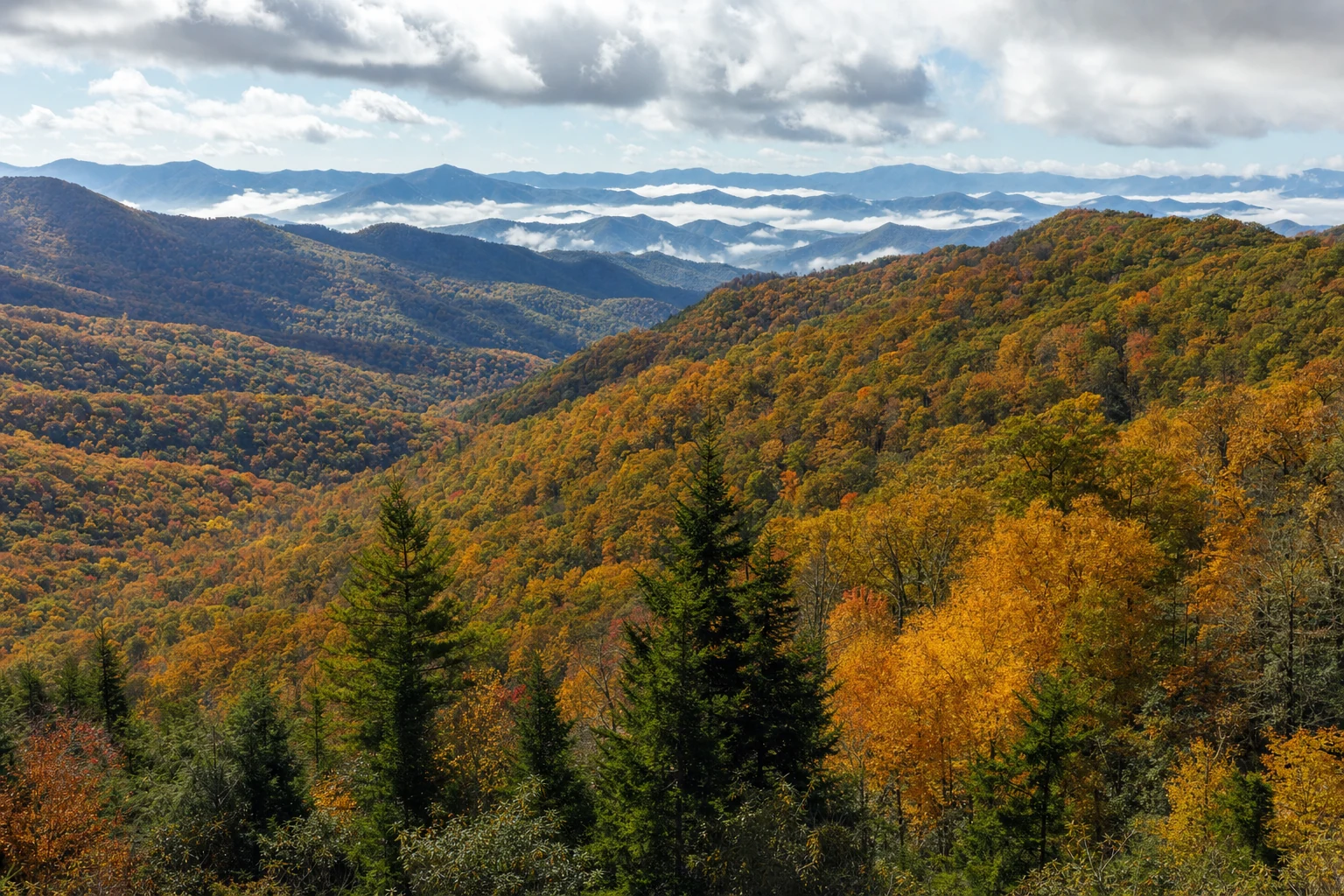

About Forney Ridge Trail
The Forney Ridge Trail starts at 6,643 feet and descends from there, which makes it unusual among Smokies hikes and creates a physical reality that catches unprepared visitors off guard: the hard climbing comes on the return. From the Kuwohi (Clingmans Dome) parking area, you drop steadily through one of the oldest high-elevation spruce-fir forests in the Appalachians, eventually reaching Andrews Bald after roughly 1.8 miles. The full trail continues to Springhouse Branch for a total one-way distance of 5.5 miles, but most day visitors treat the bald as the turnaround point.
Trail at a Glance
- Distance: 5.5 miles one-way (point-to-point); roughly 3.6 miles out-and-back to Andrews Bald
- Difficulty: Moderate
- Trailhead: Kuwohi (Clingmans Dome) parking area, 35.5562° N, 83.4764° W, elevation 6,643 ft
- Elevation change: Descends from trailhead to Andrews Bald; elevation is regained on the return
- Route type: Point-to-point for the full trail; out-and-back if Andrews Bald is your destination
Forney Ridge isn't the only trail that begins at Kuwohi. The short paved path to the observation tower starts from the same parking lot and draws far larger crowds. Head down Forney Ridge and you'll leave most of that traffic behind within the first half mile.
The Route
The trail begins just past the Kuwohi observation tower path and enters the spruce-fir forest almost immediately. Fraser firs and red spruces grow dense here; their canopy keeps the understory dim even on bright days, and moss hangs from branches in long strands. This forest type exists at elevation in only a handful of places across the eastern US. The character is noticeably different from the cove hardwood forests lower in the park, cooler and quieter, with the particular quality of high-altitude air that changes how the light looks in the late afternoon.
The grades are steady but manageable. Because you begin high and descend to the bald, the trail gives you nothing difficult early; all the climbing comes when you turn back. Hikers who don't account for that fact arrive at Andrews Bald low on water and energy, then face a sustained uphill return to the parking area. Plan accordingly. The trail is well-marked and generally in good condition, though roots and rocks are constant underfoot, and sections can be muddy after rain at this elevation.
Andrews Bald
At roughly 1.8 miles from the Kuwohi trailhead, the forest opens into Andrews Bald, a grassy clearing sitting in the middle of otherwise unbroken forest. Grassy balds in the Smokies are geologically unusual; no one fully agrees on why they exist at these elevations, but they've persisted for centuries and the National Park Service actively maintains them to prevent reforestation. Andrews Bald is one of the park's more accessible examples of the type.
From the clearing you get open views toward Fontana Lake to the south, with Smokies ridgelines extending in both directions. In late spring, typically late May through June, rhododendron and azalea blooms ring the bald's edges in dense masses of color. The timing is consistent enough to plan a specific trip around. On clear days the bald rewards lingering; even on foggy days it's a genuinely unusual place, with the spruce-fir canopy behind you and open sky ahead. Bring something to sit on. Most people don't and regret it.
Best Time to Visit
Late spring makes the strongest case for this particular hike. The rhododendrons and azaleas on Andrews Bald peak roughly late May into mid-June, and temperatures at elevation stay cool enough that the round trip doesn't become a slog. Wildflowers also appear along the trail through April and May, though the spruce-fir understory is sparser than lower-elevation routes and the display is more subtle.
Fall pulls the heaviest overall park crowds, and the Kuwohi lot fills early on weekends from late September through mid-October. Fall color at 6,000-plus feet turns earlier than the valley overlooks below, so peak foliage here may arrive before the main autumn rush lower in the park. Arrive before 8 a.m. or plan for significant parking delays.
Clingmans Dome Road closes to vehicles December through March, and sometimes earlier if ice arrives; that closure takes this trailhead off the table without a long approach on foot. Check road status on the NPS website before planning any late-fall or early-spring visit. Summer works fine if you arrive early enough to find parking; high elevation keeps temperatures lower than the towns below, though afternoon thunderstorms build quickly at altitude and conditions can shift in under an hour.
Getting There
From downtown Gatlinburg, follow US-441 south into the park to Sugarlands Visitor Center, continue to Newfound Gap Road, and at Newfound Gap turn onto Clingmans Dome Road. Follow it approximately 7 miles to the parking area at the end. The GPS coordinates for the trailhead are 35.5562° N, 83.4764° W.
For the full 5.5-mile point-to-point route you'll need a car shuttle or a second vehicle at the far terminus. Most visitors skip the logistics problem by doing the Andrews Bald out-and-back instead.
A Park-It-Forward parking tag is required for any stay over 15 minutes inside Great Smoky Mountains National Park. Passes run $5 daily, $15 weekly, or $40 annually; buy them through recreation.gov or at park entrance kiosks. There's no vehicle entrance fee to GSMNP, but parking enforcement is active.
Know Before You Go
Water is the most common planning failure on this trail. You start at elevation with cool air, don't feel thirst the way you would on a hot valley hike, and then discover on the uphill return that you've run through your supply. Carry at least two liters per person for the round trip to Andrews Bald.
Mountain weather at 6,600 feet accelerates past what valley forecasts suggest. A storm two hours away in Gatlinburg may be overhead in forty minutes. Pack a waterproof layer and something warm regardless of season; this is not a summer-only precaution.
Black bears are present throughout the park and active at all elevations. Keep 50 yards of distance from any bear, store food in your vehicle or a bear canister, and don't leave a pack unattended with food inside. Cell coverage along the trail is unreliable and may drop out entirely. Download an offline map before leaving the parking area.
The Kuwohi lot serves both the observation tower crowds and Forney Ridge hikers, so it gets congested fast. On fall weekends it can fill by 8 a.m. If you arrive to a full lot, the road doesn't have meaningful overflow capacity nearby.
Frequently asked questions
- How long is Forney Ridge Trail?
- Forney Ridge Trail is 5.5 miles one-way, with modest feet of elevation gain. It is rated moderate.
- Do I need a parking tag?
- Yes — a Park It Forward parking tag is required for vehicles parked more than 15 minutes anywhere inside Great Smoky Mountains National Park. Daily ($5), weekly ($15), or annual ($40) tags are available via recreation.gov or park kiosks.