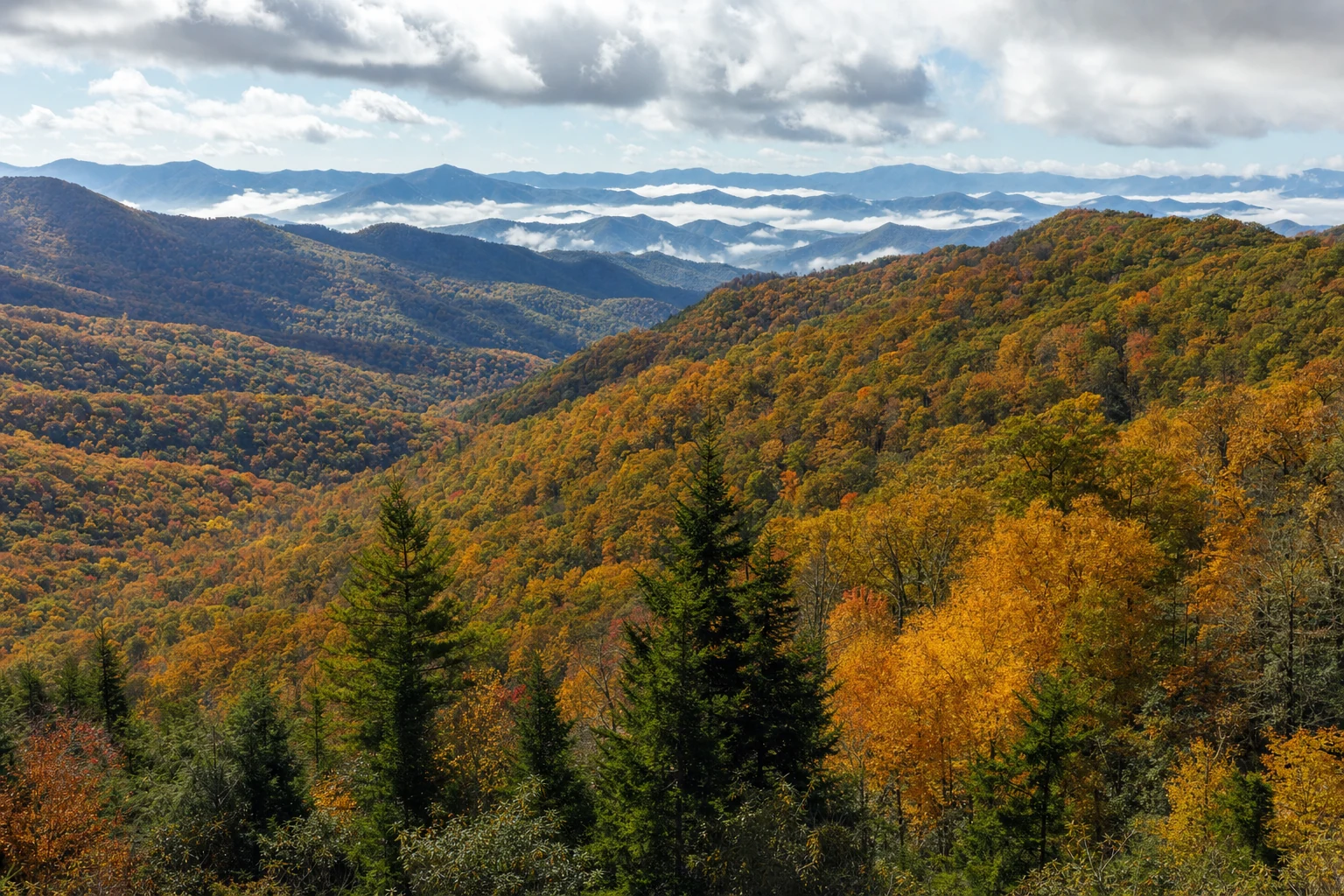

About Gatlinburg Trail
Now I have everything I need. Writing the guide with all constraints applied.
---
Few trails in Great Smoky Mountains National Park allow dogs. The ones that do are worth knowing. The Gatlinburg Trail runs 3.8 miles one-way along the West Prong of the Little Pigeon River, connecting the Gatlinburg city limits to Sugarlands Visitor Center on nearly flat, mostly paved or compacted gravel terrain. Along with the Oconaluftee River Trail near Cherokee, it's one of only two trails in the park where leashed dogs and bicycles are both permitted — a practical distinction for anyone traveling with either.
What the walk is actually like
The trail begins at the Gatlinburg city limits trailhead (35.7060° N, 83.5280° W) and ends 3.8 miles later at Sugarlands Visitor Center (35.6811° N, 83.5604° W). Since it's an out-and-back route, the full trip is 7.6 miles. Elevation change is minimal throughout; the Smokies are famously steep, so the rarity of a flat, river-following trail matters more here than it would in gentler terrain.
The West Prong stays close for nearly the entire route, moving fast and loud in April and May when snowmelt pushes the volume up, calmer and clearer by late summer. Benches appear at intervals. The surface is mostly paved or hard-packed gravel, though roots and natural settling have introduced minor unevenness in spots — nothing that demands serious footwear, but enough that flip-flops will slow you down. The full out-and-back takes two to three hours at a relaxed pace, more if you stop often at the water.
This isn't a dramatic trail. There's no summit view, no waterfall payoff at the turnaround point. What it offers is sustained contact with the river and a genuine walk inside the national park without any of the physical commitment most Smokies trails demand. That's a real service to a wide range of visitors.
Dogs, bikes, and accessibility
The standing rule in GSMNP is no pets beyond designated areas, no bicycles on hiking trails. The Gatlinburg Trail is an explicit exception to both. Dogs must remain leashed; rangers do patrol this trail and the rule is enforced. Cyclists should anticipate steady pedestrian traffic on summer weekends and adjust their pace accordingly. In practice, both groups share the trail without much friction.
The trail's flat grade and mostly firm surface also make it one of the more accessible options in the park for visitors who can't manage rough or steeply graded terrain. Park accessibility resources identify it alongside the Sugarlands Valley Nature Trail as among the more inclusive choices in GSMNP — with the honest caveat that some surface irregularities exist that can present real challenges for wheelchair users. If accessibility requirements are specific, contact the Sugarlands Visitor Center directly before the visit.
Historic foundations along the route
Scattered across the trailside forest are stone foundations, chimney remnants, and terracing left by families who farmed this land before the park's establishment. The park acquired this land across several decades in the early-to-mid 20th century, displacing communities that had worked the Smokies for generations, and the evidence of their presence hasn't disappeared: cellar walls, stone outlines of outbuildings, deliberate grade cuts into hillsides where crops once grew. Decades of forest regrowth have come back thickly around all of it, so the structures read more as geological features than as ruins until you look with intention.
The trail doesn't post interpretive markers at every site. A guide to Smoky Mountains cultural history will give you the context the trail itself won't supply. The foundations are most visible in late fall and winter, when leaf cover drops.
Wildflowers in spring
The Gatlinburg Trail isn't the park's primary wildflower destination — that designation belongs to Porters Creek Trail in the Greenbrier area, about six miles east of Gatlinburg, where trillium and fringed phacelia carpet the forest floor in late March and early April. But the West Prong corridor supports its own reliable spring display. The damp soil near the river favors early bloomers: trillium, fringed phacelia, and various violets appear from late March through early May at this elevation. The section near Sugarlands Visitor Center is particularly good for spring flowers given the moisture and light conditions along the creek banks.
For photography, morning light before 9 a.m. works best when dew still sits on the petals. A tripod helps with the low-angle work that wildflower macro requires. The trail's proximity to the parking area at Sugarlands means you can get in early without a long approach.
Getting there and parking
You can start from either end. Starting at the Gatlinburg city limits trailhead keeps you in town until the moment you step onto the path — useful if you're walking over from a hotel or parking in town and want to avoid the park fee. Starting from Sugarlands Visitor Center makes sense if you're already heading into the park; the visitor center has restrooms, a bookstore, and rangers available for questions about current conditions.
If you park anywhere inside Great Smoky Mountains National Park for more than 15 minutes, the Park-It-Forward program requires a parking tag. Daily tags are $5, weekly $15, annual $40 — available at recreation.gov or at kiosks near the main park entrances. The program funds maintenance directly. Parking in Gatlinburg and walking to the city-limits trailhead sidesteps this requirement entirely, though Gatlinburg's own parking in summer is competitive. Arriving before 9 a.m. resolves that problem more reliably than any other strategy.
How it fits into a longer day
The Gatlinburg Trail slots well as the flat, low-effort piece in a day that includes something more demanding. Sugarlands Visitor Center makes a natural hub: stop for maps and current conditions, do the Gatlinburg Trail as a morning walk, then drive the Little River Road toward Elkmont Campground, which sits along the Little River and provides trailheads into deeper backcountry. The Roaring Fork Motor Nature Trail, accessible seasonally from Gatlinburg, adds historic structures and waterfall stops for the afternoon.
For visitors who won't hike anything else during their trip, the Gatlinburg Trail is enough to constitute a real park experience: a few hours inside the forest, the river audible the whole way, and the particular quiet that exists just past the point where the town falls behind you.
Frequently asked questions
- How long is Gatlinburg Trail?
- Gatlinburg Trail is 3.8 miles one-way (7.6 miles round-trip), with modest feet of elevation gain. It is rated easy.
- Do I need a parking tag?
- Yes — a Park It Forward parking tag is required for vehicles parked more than 15 minutes anywhere inside Great Smoky Mountains National Park. Daily ($5), weekly ($15), or annual ($40) tags are available via recreation.gov or park kiosks.