
About Indian Creek Trail (Deep Creek)
The tubing crowds at Deep Creek have a hard edge: once they fill the launch point near the campground, the noise carries. Indian Creek Trail is the quiet answer. A 1.6-mile out-and-back on the creek's side fork, it runs to a solid waterfall and past the remnants of farms that predate the park's creation, then turns you around before anything gets strenuous.
Trail at a Glance
The trailhead sits at Deep Creek Campground in Bryson City, North Carolina (35.4540° N, 83.4240° W). This is the North Carolina side of Great Smoky Mountains National Park, not the Tennessee side. If your GPS routes you from Gatlinburg, expect significant drive time through or around the park via US-441 south to US-19 west; there's no shortcut.
The route runs 1.6 miles one-way to Indian Creek Falls and returns the same way. Elevation gain is minimal; the grade stays gentle throughout. Families with older children handle it comfortably, and there's no technical terrain to navigate. That said, easy doesn't mean featureless. The creek keeps you company the entire way.
What the Walk Feels Like
You share the parking area with tubers, but the separation happens fast. The creek narrows quickly, the tube crowd thins to nothing, and you're left with water noise and dense second-growth forest that's had decades to recover from the farmland it once was.
The trail surface mixes packed dirt with root-laced sections near the bank. Wet rocks and occasional creek crossings show up depending on recent rainfall, so trail shoes with actual grip are worth wearing. Water levels vary considerably by season; after a wet spring, the creek runs fast and cold, and wading spots that make this trail appealing to children become less predictable. In summer low-water periods, those same sections become perfect cool-off stops on a hot afternoon.
The further you walk from the campground, the more ambient noise drops away. The forest changes character alongside it: light filters differently through the canopy, the creek banks grow steeper and more defined, and the trail feels genuinely separate from the campground scene you started in.
Indian Creek Falls
The falls are 1.6 miles from the trailhead. They're not a roaring cataract; the drop is wide and layered, spreading water across a broad rock face in multiple channels before collecting in a pool at the base. The appeal isn't raw scale. It's the relative quiet when you get there and the way the water spreads rather than plunges, which makes it photogenic in a way that straight-drop falls often aren't.
On busy summer weekends you might share the viewpoint with a handful of other hikers. On a weekday in late October, solitude is realistic. The rocks near the base get slippery; getting close to photograph is fine, but scrambling onto the wet ledges is how people get hurt at spots like this.
The Old Homesites
The trail passes through land that was settled before the park's establishment in 1934. Evidence of that occupation persists: stone foundations, ridge lines where walls once ran, the subtle flattening of terrain where someone had a cleared yard or garden. The park hasn't installed interpretive signage along this section of trail; the sites are simply there, deteriorating back into the hillside at their own pace.
That absence turns out to be part of what makes them interesting to find. You're reading the landscape rather than a placard. Tree species shift around former clearings, and older-growth pockets tend to cluster on slopes that were too steep to work. The transition from forest-as-forest to forest-as-recovered-farmland is visible once you know to look for it.
Getting There
From Bryson City, take Ramseur Street south and follow signs toward Deep Creek. The road leads to the campground entrance; park at the designated trailhead area near the campground rather than along the entrance road.
Every vehicle left inside Great Smoky Mountains National Park for more than 15 minutes needs a Park It Forward parking tag. Rates are $5 per day, $15 per week, or $40 annually, available through recreation.gov or at self-service kiosks at major trailheads. This applies to the Deep Creek trailhead lot.
If you're driving from Gatlinburg, there's no direct route through the park to this trailhead. Plan to exit Sugarlands, head south on US-441 through Cherokee, then west on US-19 into Bryson City. Travelers staying in Cherokee or Bryson City will find this trailhead far more convenient than anything on the Tennessee side.
Best Time to Go
Spring is strong here: wildflowers come in along the creek banks, the falls run at volume, and temperatures stay comfortable for a shaded creek-side walk. The downside is mud after rain, and the creek crossings get unpredictable when runoff is high.
Summer means crowds near the campground and a parking lot that can fill by mid-morning on weekends. The tubing operation draws large numbers on warm afternoons. An early start handles most of this; the lot also tends to clear by late afternoon, making early evening walks viable while daylight holds. The creek is at its most swimmable in summer, which is part of the draw.
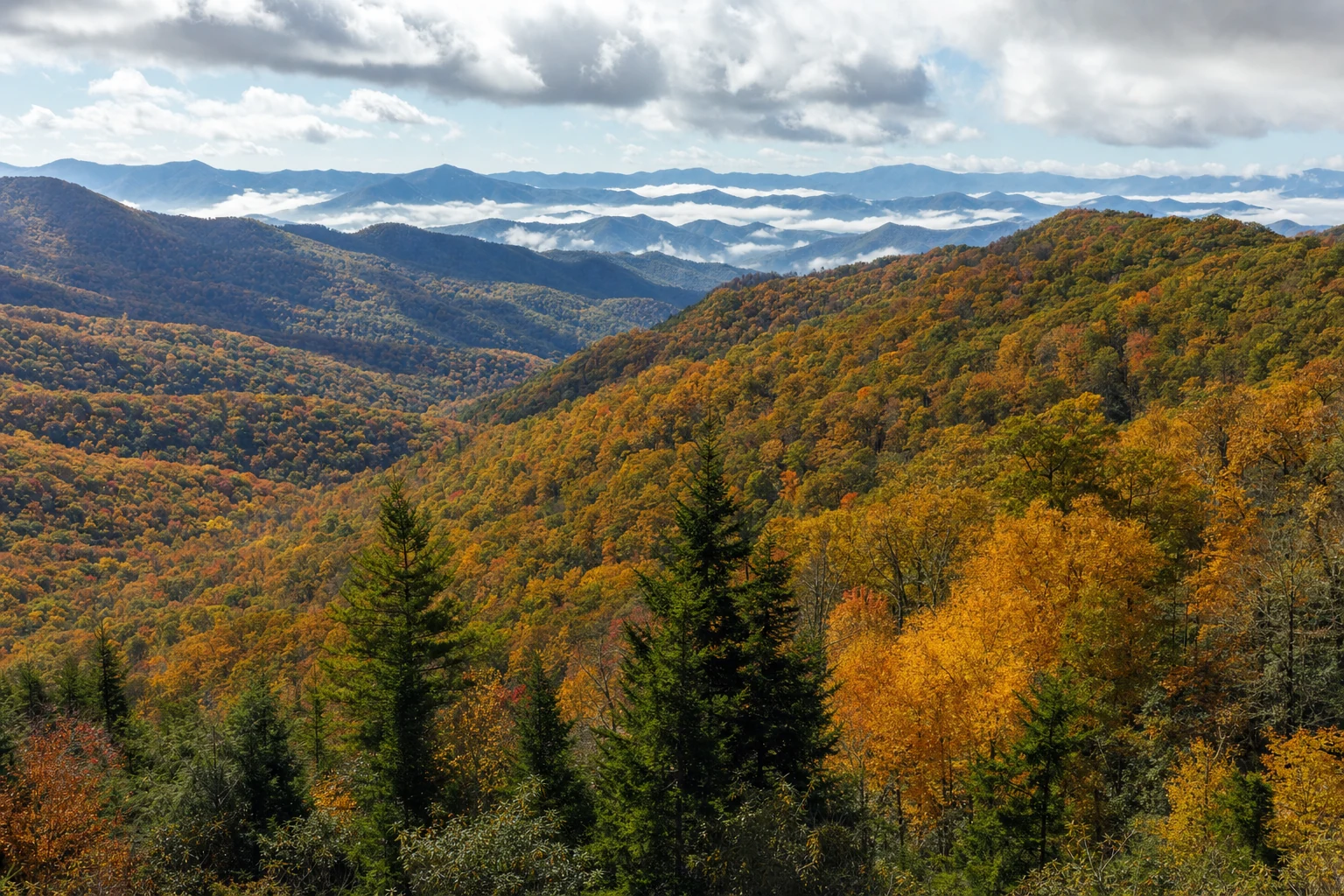
Fall offers the best mix: foliage typically peaks around mid-October at this elevation, temperatures drop to something comfortable for moving, and the creek runs cleaner and slower than it did in spring. Late October into early November gets quieter as the season winds down.
Winter is an acquired taste. Check the park website before going; the campground closes seasonally, but the trail itself typically stays accessible. Bare trees open up sight lines through the forest that summer canopy blocks entirely, and the falls look different under cold conditions. Expect solitude. Cold water means no wading, but for anyone who finds off-season parks more interesting than peak-season ones, this trail rewards a January morning.
Know Before You Go
Cell service goes unreliable once you leave Bryson City. Download offline maps before you leave.
Creek water looks clean throughout; it isn't safe to drink without treatment. The watershed above is large and has heavy animal activity, and nothing visible at the trailhead tells you what's upstream. Carry more water than you think you'll need, particularly in warm months.
Black bears range through the Deep Creek corridor and the campground proximity tends to draw bears that have learned to associate people with food. Store food and anything scented in your vehicle or in the campground bear boxes. If you meet a bear on the trail, don't run; give it space and make your presence clear.
There are no facilities past the campground. Use the restrooms before you start. The turnaround at the falls is just the falls: no shelter, no services, and if weather moves in fast (which it does in these mountains), you've got creek crossings and several miles of open trail between you and the parking lot.
Frequently asked questions
- How long is Indian Creek Trail (Deep Creek)?
- Indian Creek Trail (Deep Creek) is 1.6 miles one-way (3.2 miles round-trip), with modest feet of elevation gain. It is rated easy.
- Do I need a parking tag?
- Yes — a Park It Forward parking tag is required for vehicles parked more than 15 minutes anywhere inside Great Smoky Mountains National Park. Daily ($5), weekly ($15), or annual ($40) tags are available via recreation.gov or park kiosks.