
About Joyce Kilmer Memorial Forest Trails
What stops most people on this trail isn't the grade or the distance. It's the trees. The old-growth poplars and hemlocks filling Joyce Kilmer Memorial Forest grow to a scale that takes a moment to calibrate once you're standing among them. The 2.2-mile loop is one of the more accessible encounters with genuine old-growth forest in the Smokies region, and the easy terrain means you can spend your attention looking up rather than watching your footing.
What the trail is like
The Big Trees Trail runs as a loop, keeping elevation gain minimal throughout. For a trail rated easy, it delivers something harder to replicate: old-growth forest this intact is rare in the Eastern U.S., and the walk reflects that. The canopy here is old enough that light filtering through on a clear day reads differently than what you'd encounter in younger forest; darker, more filtered, cooler even in summer.
The loop format means you trace a single circuit rather than retracing your steps. The trail surface is soft and rooted, typical of a mature Appalachian forest floor, and the path stays well-defined throughout. This works for most fitness levels and age groups; the minimal elevation change and solid footing make it genuinely easy rather than just comparatively so. Plan for the walk to take longer than the mileage suggests. The trees invite stopping.
The old growth
Old-growth designation is uncommon in the Eastern U.S. Most of the Appalachian forest was logged by the early 20th century; what survived here was preserved, and it shows. The poplars reach dimensions you don't encounter on most mountain trails, and the hemlocks add a density to the canopy that younger forests can't replicate.
Ecologically, old-growth forests behave differently than secondary forest. The understory structure, the layered canopy, the decomposing logs that have been building mass for decades — all of this accumulates over centuries and creates conditions that younger stands simply don't have. Walking through it has a sensory quality that's distinct from walking through standard parkland: sound carries differently and the canopy shifts in how much sky it allows depending on where you're standing.
The wilderness area designation reinforces the experience. No motorized equipment, no bikes, minimal development beyond the trail itself. The quiet here isn't manufactured.
Best time to visit
Spring is the best light in the forest. Before the canopy fully closes overhead, sunlight reaches the floor and activates wildflowers in April and early May. If you're there primarily for photography or to catch the forest floor in bloom, spring is the clear answer.
Summer is the busiest stretch. Parking fills early on weekends from late June through August, and trail traffic rises accordingly. The canopy provides real shade, cutting the heat considerably compared to exposed ridges elsewhere in the park. Arriving before 9 a.m. on weekends makes a noticeable difference.
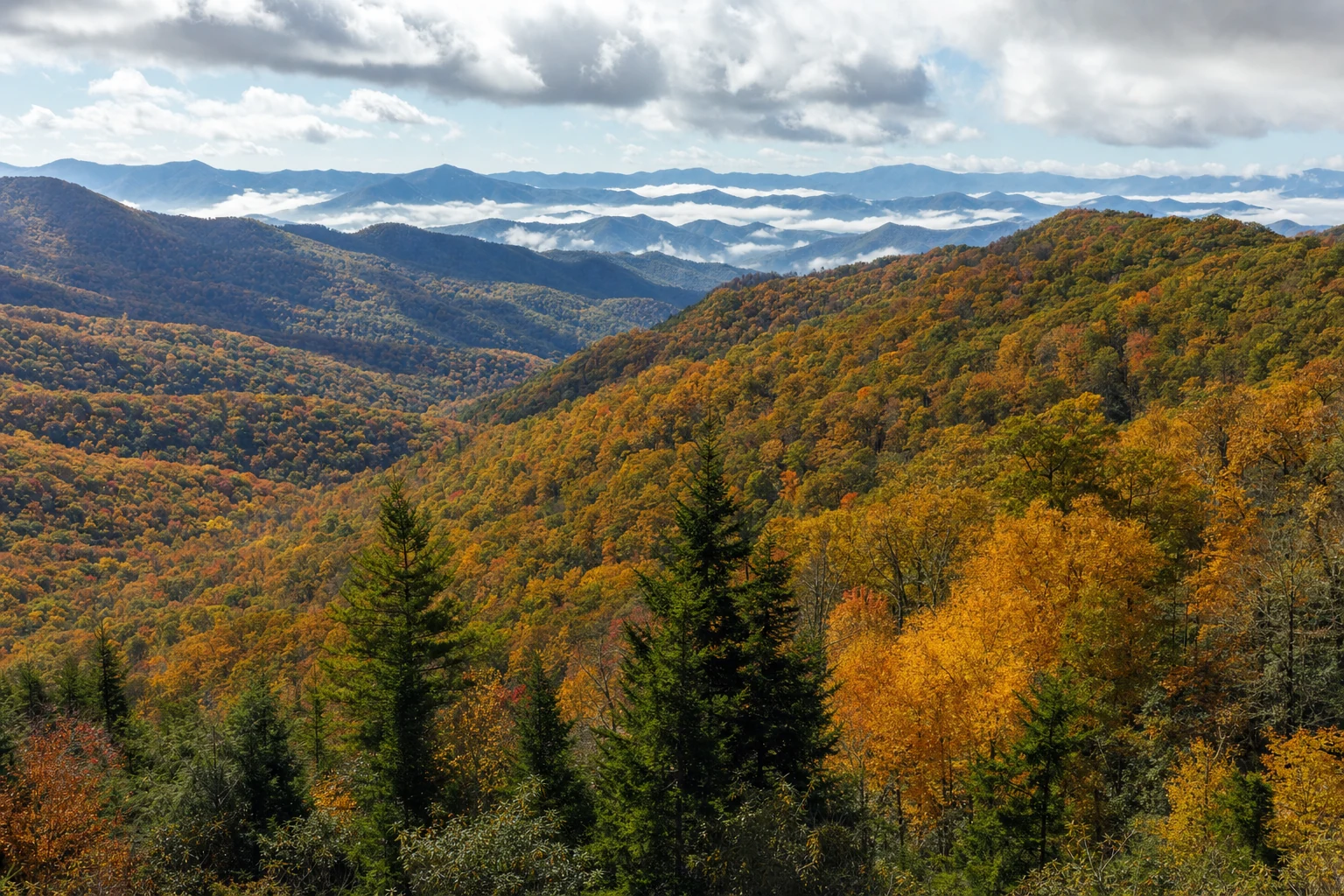
Fall is when the old-growth shows strongest. Foliage in a mixed forest this old and dense tends to run deeper in color than what you'd see in younger stands. Peak color across the Smokies typically lands around mid-October, though it shifts year to year and by elevation.
Winter is quiet. The bare canopy opens up views into the forest structure that aren't visible in warmer months: the full height of the trees, the architecture of the limbs, the distances between trunks. Ice on the bark and understory plants can be striking. Expect solitude, and expect some road closures at higher elevations elsewhere in the park.
Getting there and parking
From Gatlinburg, the two main corridors into the park are the Sugarlands entrance on the Gatlinburg side and Oconaluftee on the Cherokee side. The trailhead is at the Joyce Kilmer Memorial Forest parking area, at coordinates 35.3500° N, 83.9400° W.
A Park It Forward parking tag is required anywhere inside Great Smoky Mountains National Park for stays over 15 minutes. Tags are available at recreation.gov or at park entrance kiosks: daily $5, weekly $15, or annual $40. If you're planning more than a few days in the park, the annual pass covers itself quickly.
Before you go
Even on a short, easy trail, carry more water than you expect to need. Mountain weather in the Smokies moves fast. Clear mornings regularly produce afternoon thunderstorms, so a rain layer in your pack earns its weight year-round; a warm layer is worth including even in summer at elevation.
Black bears are active throughout the park. Keep at least 50 yards of distance, never leave food unattended, and store food in bear canisters or at designated bear boxes at the trailhead rather than in your car. Encounters aren't unusual and aren't dangerous if you handle them correctly.
Cell coverage is poor in most of the forest; download offline maps before you drive in. The trail is well-marked, but losing signal here is a reliable occurrence, not a possibility.
Pairing this with other stops
The loop completes quickly enough that most visitors arrive with time to spare. The broader wilderness area has additional trail connections for those who want more elevation or distance beyond the main loop; the information board at the trailhead will have current conditions on connecting routes before you head further into the backcountry. Given its easy rating and short distance, Joyce Kilmer Memorial Forest fits naturally as either an opening stop or a late-day wind-down on a longer day in the park.
Frequently asked questions
- How long is Joyce Kilmer Memorial Forest Trails?
- Joyce Kilmer Memorial Forest Trails is 2.2 miles one-way, with modest feet of elevation gain. It is rated easy.
- Do I need a parking tag?
- Yes — a Park It Forward parking tag is required for vehicles parked more than 15 minutes anywhere inside Great Smoky Mountains National Park. Daily ($5), weekly ($15), or annual ($40) tags are available via recreation.gov or park kiosks.