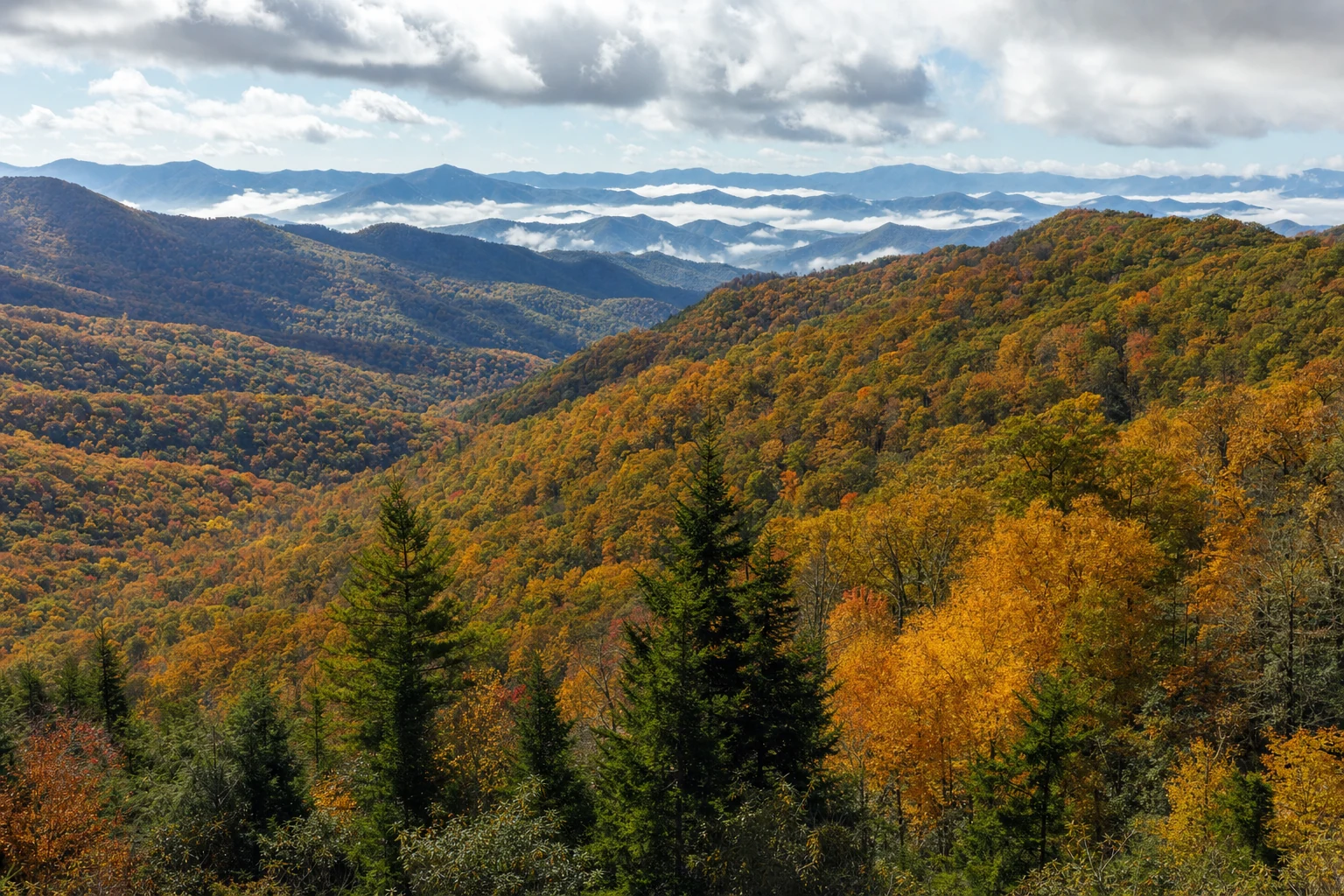

About Kephart Prong Trail:
The Kephart Prong Trail follows its namesake stream for 4.2 miles round-trip off Newfound Gap Road, ending at the ruins of a Civilian Conservation Corps work camp from the New Deal era. Difficulty is moderate — steady climbing without the lung-burning grades of nearby routes like Sweat Heifer Creek or Road Prong. For a GSMNP hike, the history at the turnaround point is unusually tangible: actual structures you can stand next to and photograph, not just a clearing with a sign.
What the Trail Is Like
The trailhead sits on Newfound Gap Road, the main artery connecting Gatlinburg to Cherokee across the ridge of the Smokies. From the parking pullout, the trail drops toward Kephart Prong and then follows the creek upstream through recovering second-growth forest. The CCC cleared and worked this drainage in the 1930s, and the vegetation reflects that history — the canopy is mature but not old-growth, with tulip poplars prominent in the mix.
Stream crossings come early and often. The log footbridges hold up in normal conditions, but high water after heavy rain can make some crossings more interesting than they look on a dry summer morning. The trail gains elevation gradually, with most of the climbing concentrated in the upper half. Nothing on Kephart Prong will surprise anyone who's hiked moderate terrain in the Appalachians; the challenge is footing over wet rocks and roots rather than sustained steep grades.
The CCC Camp
The Civilian Conservation Corps built camps throughout Great Smoky Mountains National Park as the park was being established in the 1930s. The Kephart Prong camp was one of them, and its remains — stone walls, concrete foundations, and other structures from the work camp's infrastructure — survive at the trail's end in reasonable condition. They don't advertise themselves from a distance; you walk into the site and realize you're surrounded by what's left of it.
The trail bears the name of Horace Kephart, the writer and outdoorsman whose advocacy was central to getting the park created. The connection between his name, this creek, and this camp is specific to the southeastern Smokies drainage and not found on the more-visited north-facing trails out of Gatlinburg. That layered history gives the hike a shape and purpose beyond the round-trip mileage.
At the far end of the camp, the Sweat Heifer Creek Trail branches off and climbs steeply toward the Appalachian Trail — a separate, strenuous undertaking that adds miles and serious elevation to any itinerary. The junction is clear and marked.
Getting There and Parking
The trailhead is on Newfound Gap Road (US-441), roughly midway between Gatlinburg and the Oconaluftee Visitor Center near Cherokee. From Gatlinburg, you'll drive through Sugarlands and over the state line before reaching the pullout. From Cherokee, it's a shorter drive on the same road heading north.
A Park It Forward tag is required for any vehicle parked inside Great Smoky Mountains National Park for more than 15 minutes. Rates are $5/day, $15/week, or $40/year; purchase at park entrance kiosks or through recreation.gov before you arrive. The pullout along Newfound Gap Road is small — early arrival matters, especially on summer weekends. If the lot is full, legal overflow options on this stretch of road are limited, so plan for 8 a.m. or earlier during peak months.
Cell coverage on Newfound Gap Road drops out in stretches and disappears entirely in some sections. Download an offline map or carry a paper one before you leave the signal zone around Gatlinburg or Cherokee.
Best Time to Go
Spring makes the strongest case for this trail. Wildflowers push through the leaf litter from late March through May, and Kephart Prong runs full with snowmelt and spring rain, making the stream crossings lively and the sound of moving water constant. The CCC stonework photographs well against the still-bare lower canopy of early spring.
Summer crowds Newfound Gap Road heavily because it leads to the Kuwohi (Clingmans Dome) summit, pulling high visitation through the corridor. Early morning starts, before 9 a.m., get you on trail before parking deteriorates. The full forest canopy provides shade that matters on warm afternoons.
Fall is worth the traffic. Mid-October is the typical foliage peak at middle elevations along this section of road, though the window shifts year to year with temperature patterns. Arrive before 8 a.m. on a peak weekend if you want a spot without circling.
Winter drops crowds almost entirely and opens the forest enough to see terrain and creek from farther off-trail. Ice forms on the log bridges and wet rock sections after cold nights; traction devices are worth bringing from November through March. Newfound Gap Road stays open in most winter weather but closes temporarily for snow clearing and ice treatment, so check road conditions through the park's alert system before driving up.
Pairing with Nearby Trails
Newfound Gap Road is the most trail-dense corridor in the park for its length. Kephart Prong pairs naturally with a second hike rather than driving back to town mid-day.
Road Prong Trail (2.7 miles one-way, strenuous) starts nearby on the same road and climbs through old-growth forest to the Appalachian Trail near Indian Gap. Dry Sluice Gap Trail (2.5 miles one-way, strenuous) offers another option in the same zone; both are meaningfully harder than Kephart Prong and suit people who want to experience what a real climb in the Smokies feels like after an easier morning hike. Charlies Bunion, reached from Newfound Gap at 8 miles out-and-back and rated strenuous, is the full-day option for strong hikers; pair it with Kephart Prong only if your group can handle the cumulative mileage and elevation without rushing.
None of these pairings require significant driving. The concentration of trailheads along this one road is one of the practical reasons to plan a full day in the Newfound Gap corridor rather than treating it as a quick stop.
What to Bring
Water is non-negotiable — carry at least two liters per person, more in summer. The stream running alongside the trail is not safe to drink without filtration; Giardia is present in backcountry water throughout GSMNP.
A rain layer belongs in your pack regardless of the morning forecast. Weather on this ridge builds quickly, and a dry start can turn wet by early afternoon without much warning from a valley-level weather check. Hiking poles help on the wet rock and root sections near the creek; they're not required, but tired legs on the return make the footing less forgiving and poles earn their weight.
Black bears are active throughout this section of the park. Maintain at least 50 yards of distance from any bear you see, never leave food unattended, and store snacks in your pack or a bear canister while stopped at the CCC camp. The camp area, with its history of human activity, draws wildlife that has learned to associate the site with people. Keep a clean stop at the turnaround point and pack out everything you brought in.
Frequently asked questions
- Do I need a parking tag?
- Yes — a Park It Forward parking tag is required for vehicles parked more than 15 minutes anywhere inside Great Smoky Mountains National Park. Daily ($5), weekly ($15), or annual ($40) tags are available via recreation.gov or park kiosks.