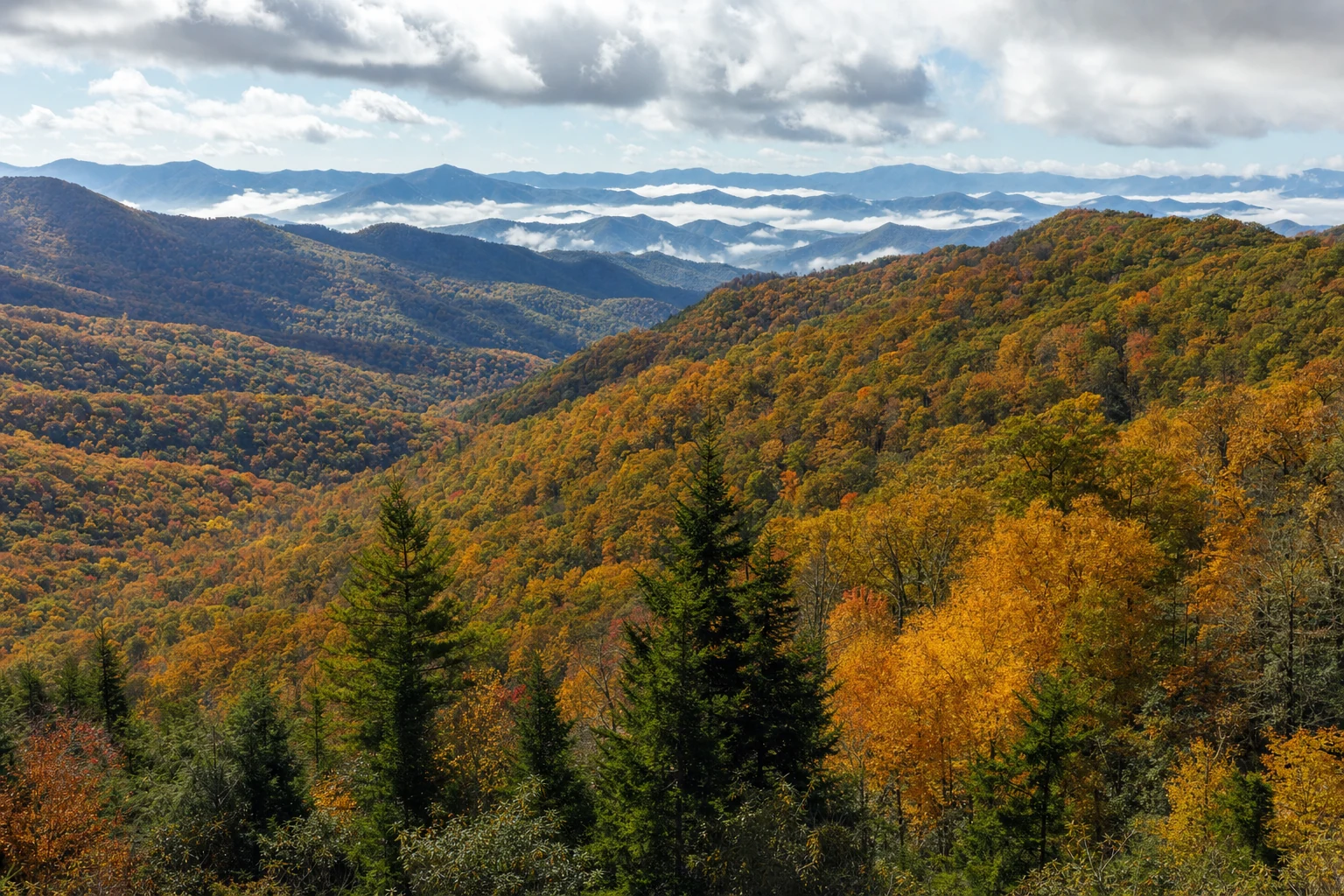

About Kuwohi (Clingmans Dome) Paved Trail
The highest point in Great Smoky Mountains National Park sits at 6,643 feet, and the half-mile paved trail to its observation tower is one of the most physically demanding short walks in the Southern Appalachians. Despite a modest one-mile round trip, the combination of altitude and unrelenting grade earns this trail its strenuous rating — and the views from the top, when skies cooperate, stretch across five states.
The Name, and What It Means
In September 2024, the mountain was officially renamed Kuwohi, restoring the ancestral Cherokee designation for the peak. The Eastern Band of Cherokee Indians (EBCI) initiated the change; Kuwohi translates roughly as "mulberry place," reflecting a site of genuine cultural and spiritual significance within the Cherokee homeland. Maps, signs, and NPS materials now use this name, and Clingmans Dome — the designation given by 19th-century surveyors after a Confederate general — is the former name. The renaming is part of a wider effort to acknowledge indigenous heritage across the Southern Appalachians, and Cherokee, North Carolina, the seat of the EBCI, lies just over the state line on the other side of the ridge. Visitors who have searched for this trail under the old name will find the same trailhead, the same tower, and the same views — just a name that more honestly reflects whose land this has always been.
What the Trail Actually Involves
The trailhead sits at the Kuwohi parking area (35.5562° N, 83.4764° W), already at high elevation. From there, a paved ramp climbs 330 feet over half a mile to the observation tower. That works out to roughly a 12-to-13 percent average grade — similar to a steep urban hill but sustained for the full distance without any flat relief. The pavement is intentional: the alpine zone atop Kuwohi is fragile, and off-trail movement damages the soil crust and rare high-elevation vegetation. Stay on the path.
The strenuous rating surprises visitors who associate short trails with easy outings. Altitude is the main factor. At 6,000-plus feet, oxygen is meaningfully thinner than at park entrances. People who live at low elevations and are unaccustomed to exertion at altitude may find themselves breathing harder than expected within the first 200 yards. Children, older adults, and anyone with cardiovascular concerns should take it slow, stop when needed, and not feel obligated to reach the top if they're struggling. The descent is easy, so the goal isn't efficiency — it's making the climb at a pace that lets you actually enjoy it.
The Observation Tower
The ramp-style observation tower at the summit provides 360-degree views when conditions allow. On clear days, the visible range is extraordinary — the mountains recede in layers across Tennessee, North Carolina, Georgia, South Carolina, and Virginia. Kuwohi is the third-highest peak east of the Mississippi River, and the topography makes that rank visible: the surrounding ridgeline drops away steeply in every direction.
Conditions, though, vary sharply. The summit sits above the cloud layer on many days, especially in summer, which means you're just as likely to walk into a white wall of fog as you are to a clear panorama. Early mornings on clear-weather days offer the best odds for visibility, both meteorologically and practically (fewer people). Sunrise visits require arriving before the lot fills. Sunset is equally popular, and the light on the distant ridges at that hour is worth planning around — but the parking situation is the same: competitive.
The Forney Ridge Trail begins near the tower and continues into the backcountry, connecting eventually to Andrews Bald, an open grassy summit roughly 1.8 miles from the tower. Andrews Bald is one of the few balds in GSMNP that remains open naturally, and the views from it are less obstructed than from the tower. That extension adds significant distance and elevation change, so treat it as a separate hike rather than a quick side trip.
Getting to the Trailhead
Kuwohi Dome Road branches off Newfound Gap Road and runs approximately seven miles to the parking area. The road is typically open from April 1 through November 30, though the NPS closes it earlier during significant snowstorms or ice events. Winter visits are not possible by road — the summit frequently receives snow and ice starting in late autumn, and the road gate closes accordingly. Check the NPS website or call the park before driving up if there's any doubt about conditions.
From Gatlinburg, the most direct route follows Highway 441 (the Parkway) into the park toward Newfound Gap, then turns onto Kuwohi Dome Road. The drive from Gatlinburg to the parking area takes roughly 45 minutes under normal conditions, longer during peak season when Newfound Gap Road traffic backs up. There is no shuttle service to the summit from Gatlinburg; this is a self-drive trailhead.
Parking fee: The Park-It-Forward program requires a parking tag for any vehicle stopped for more than 15 minutes inside the park. Tags cost $5 per day, $15 per week, or $40 for an annual pass. Purchase them online through recreation.gov, at park visitor centers, or at designated kiosks. The Kuwohi parking area does not have an on-site kiosk, so buy your tag before you arrive or download the digital version. Arriving without one can result in a citation.
The parking lot at Kuwohi is large but fills fast on weekends and during peak foliage season (mid-October). On busy days, a line of cars queues down the road waiting for spaces to open. Arrive by 8 a.m. to avoid the worst of it, or accept that midday arrival may mean waiting.
Seasonal Considerations
Spring (April–May): The road typically opens April 1, and wildflowers are at their best in the lower and mid elevations on the approach. The summit itself may still show remnants of winter — temperatures at 6,643 feet can be 20 degrees or more cooler than in Gatlinburg. Crowds are moderate early in spring and build toward Memorial Day.
Summer (June–August): The busiest period. Morning fog is common but can burn off by midday. Even in July and August, bring a jacket — summit temperatures regularly sit in the 50s Fahrenheit, and wind chill at the tower drops it further. Afternoon thunderstorms are frequent; plan to be off exposed ridgeline by early afternoon.
Fall (September–October): Peak season coincides with foliage color, which typically peaks at summit elevations in early-to-mid October and moves down the mountain through the end of the month. Parking demand is highest during this window. Fall air tends to produce the sharpest long-distance visibility of any season.
Winter (November–March): Kuwohi Dome Road closes, so the summit is inaccessible by vehicle. Backcountry access on foot is possible for experienced hikers, but that is an entirely different undertaking.
Practical Notes Before You Go
Pack layers regardless of the season — the temperature difference between the parking lot and the tower can feel significant on any exposed stretch of the trail, and wind at the summit is common. Rain gear is worth carrying even on mornings that start clear.
The paved surface can become slick when wet or when ice forms on cold mornings in spring or fall shoulder season. Traction devices (microspikes) are worth packing if there's any chance of ice.
Restrooms are available at the parking area. There are no food or water services at the trailhead — carry what you need. Cell coverage is unreliable throughout this elevation.
Black bears range throughout GSMNP, including at and above the Kuwohi trailhead. Maintain at least 50 yards of distance from any bear, store food in bear-proof containers or the trunk of your car (never leave food in a visible spot inside a vehicle), and make your presence known on the trail. The crowds at Kuwohi tend to discourage bear encounters near the trailhead, but the Forney Ridge extension is a different story.
This trail suits most visitors who can handle a sustained uphill walk, even if they're not regular hikers, provided they take it at their own pace. For families with young children, it's doable but plan more time than the distance suggests. For older adults or anyone with joint concerns, the descent is gentle on knees despite the grade. The main variables are altitude tolerance and weather — account for both, and Kuwohi delivers one of the most compelling summit experiences in the eastern United States.
Frequently asked questions
- How long is Kuwohi (Clingmans Dome) Paved Trail?
- Kuwohi (Clingmans Dome) Paved Trail is 1 miles one-way (2.0 miles round-trip), with 330 feet of elevation gain. It is rated strenuous.
- Do I need a parking tag?
- Yes — a Park It Forward parking tag is required for vehicles parked more than 15 minutes anywhere inside Great Smoky Mountains National Park. Daily ($5), weekly ($15), or annual ($40) tags are available via recreation.gov or park kiosks.