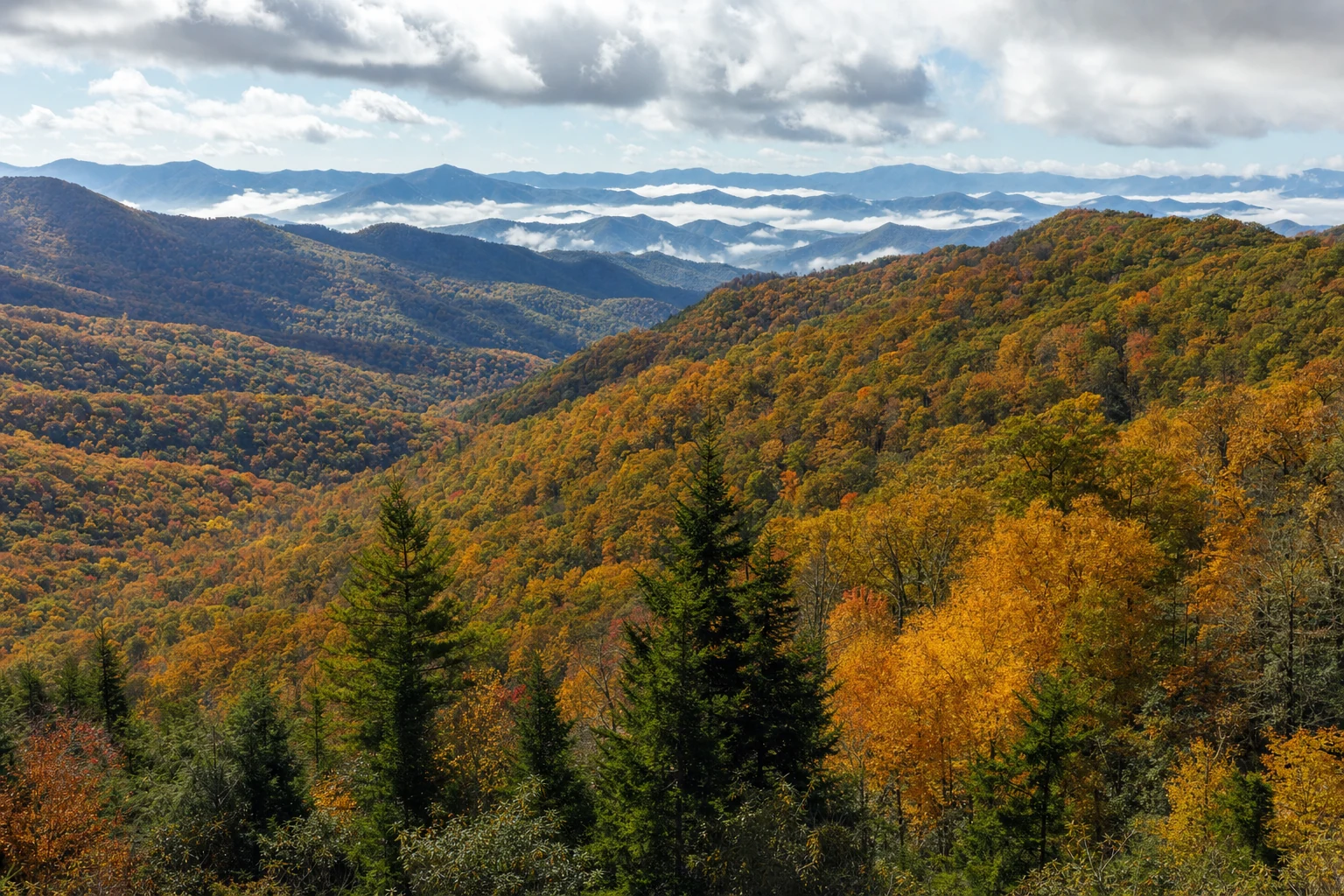

About Little Cataloochee Trail
Most visitors to Cataloochee Valley stop at the main historic structures, take their photos, and leave. Little Cataloochee Trail goes somewhere else: a 6-mile point-to-point route into a more secluded arm of the valley where the remnants of 19th-century Appalachian life feel genuinely remote rather than curated. It's strenuous, logistically demanding because you need a car shuttle or a return hike, and worth the planning if what you want is a trail that delivers both physical effort and genuine quiet.
What the trail is and isn't
The route runs point-to-point with no loop option, which means you start at one end and finish at another. That's the first planning fact to internalize: two vehicles or a shuttle arrangement, because hiking 12 miles out and back on a trail rated strenuous is a different commitment than the 6-mile through-hike most people do.
The 1,000 feet of elevation gain spreads across the full 6 miles, so you're not facing a brutal ascent right out of the gate. The strenuous rating comes partly from the accumulated distance and partly from terrain that includes stream crossings, rooted trail sections, and the kind of forest floor that demands attention underfoot. Plan on a full day.
The focal point is the Little Cataloochee Baptist Church, which sits in a more secluded reach of the valley than the historic buildings visible from the main road. Getting there on foot changes something about how you perceive the place; you read the landscape differently when you've walked into it past old homestead traces and through forest that closed back over cleared farmland decades ago.
The history this trail carries
Cataloochee was a thriving Appalachian community before the National Park Service relocated its residents during park formation in the 1930s. The valley holds more intact 19th-century structures than almost anywhere else in the park, and Little Cataloochee's portion of the trail leads to the quieter ones: the church, old homesites, a schoolhouse, and homes the park service has maintained without turning into museum exhibits.
These aren't attractions in the formal sense. They're objects left in a landscape that has largely reverted to wilderness, which gives them a different weight than a site with interpretive signage and a parking lot. You pass them because you walked to them, and the effort of arrival is part of what makes them land. Old-growth forest along sections of the trail adds another layer; these are trees that survived the logging operations that stripped much of the southern Appalachians in the early 20th century.
Getting there
The trailhead sits in Cataloochee Valley near the Little Cataloochee Baptist Church, at coordinates 35.6560° N, 83.0030° W. Getting there takes some doing before you even start hiking. Cataloochee Valley occupies the far eastern end of Great Smoky Mountains National Park, accessed via a narrow, unpaved road that descends from I-40 near exit 20. The drive from the highway runs about 25 minutes on a road that requires patience; trailers and large RVs have real difficulty with it.
For the shuttle logistics, plan your route before you leave cell coverage. The two trailheads aren't adjacent, and sorting it out in the valley without reliable service wastes time you could spend hiking.
The Park-It-Forward parking tag is required for any vehicle parked inside the park for more than 15 minutes: $5 daily, $15 weekly, or $40 annually, purchased through recreation.gov or at park kiosks. If you're running a shuttle with two cars, both need tags. Buy them before the drive in.
When to go
Fall pulls visitors to Cataloochee for elk rut, which tends to peak in October. The trail sees less congestion than the main elk-viewing meadows in the valley, but fall weekends are busier than you might expect for a route this remote. If foliage and elk are both priorities, plan for a weekday.
Spring is the underrated window. Wildflowers sequence through from late March into May, and the old-growth forest has a quality in early leaf-out that full summer canopy obscures. Creek levels run high in spring, which affects some crossings, so check recent trail conditions before you go.
Summer works if you start early. Cataloochee draws fewer visitors than the Gatlinburg-side trails simply because getting there demands more effort, but it isn't empty. Heat and humidity build through the afternoon, and thunderstorms develop quickly in the mountains; starting by 7 a.m. gives you a real buffer.
Winter empties the trail almost completely, but the unpaved access road becomes the variable. Snow and ice can close it entirely, and you should check road status with the park before making the drive.
Wildlife
Cataloochee holds an elk herd that lives in the valley year-round following a park-managed reintroduction. Spotting elk is realistic, especially in the open meadow sections at dawn and dusk before you head up the trail. Once you're in the forest, sightings become less likely, but the early morning light in the valley before departure is worth building into your schedule regardless.
Black bears are active throughout the park year-round. Keep 50 yards of distance, make noise on the trail, and treat food storage seriously; don't leave anything scented in your vehicle at the trailhead, and carry food in appropriate containers on the hike. Cataloochee is genuine bear country.
What to carry
Cell coverage is poor to nonexistent in the valley and worse on the trail. Download offline maps before you leave, and bring a paper version as backup. The NPS distributes free paper maps at entrance stations and visitor centers.
Water is the thing people consistently underestimate on a 6-mile route with no services in the valley. Carry more than you think you need. The trail crosses streams, so waterproof footwear or dry bags for your socks are worth considering. A rain layer and a warm layer go in the pack regardless of how the morning looks, because mountain weather in the Smokies can shift inside of an hour.
For overnight trips, backcountry camping requires a permit through the NPS reservation system. Spots at popular backcountry sites book out well in advance during spring and fall.
Pairing this hike with other trails nearby
The Boogerman Loop, a 7.4-mile strenuous route through old-growth forest, starts from the same general area of Cataloochee Valley and makes a logical companion for a multi-day visit. Pretty Hollow Gap Trail and Rough Fork Trail both connect to longer backcountry routes deeper into the surrounding mountains, with Cataloochee as the access point. Two full days in the valley, Little Cataloochee one day and Boogerman the next, is a serious combination that most fit hikers can manage without burning out.
The valley also rewards time that has nothing to do with hiking. The elk viewing from the main road at first light, the historic structures accessible by car, the particular quality of the place before crowds arrive: these things stand on their own. The trail amplifies what's already here.
Frequently asked questions
- How long is Little Cataloochee Trail?
- Little Cataloochee Trail is 6 miles one-way, with 1,000 feet of elevation gain. It is rated strenuous.
- Do I need a parking tag?
- Yes — a Park It Forward parking tag is required for vehicles parked more than 15 minutes anywhere inside Great Smoky Mountains National Park. Daily ($5), weekly ($15), or annual ($40) tags are available via recreation.gov or park kiosks.