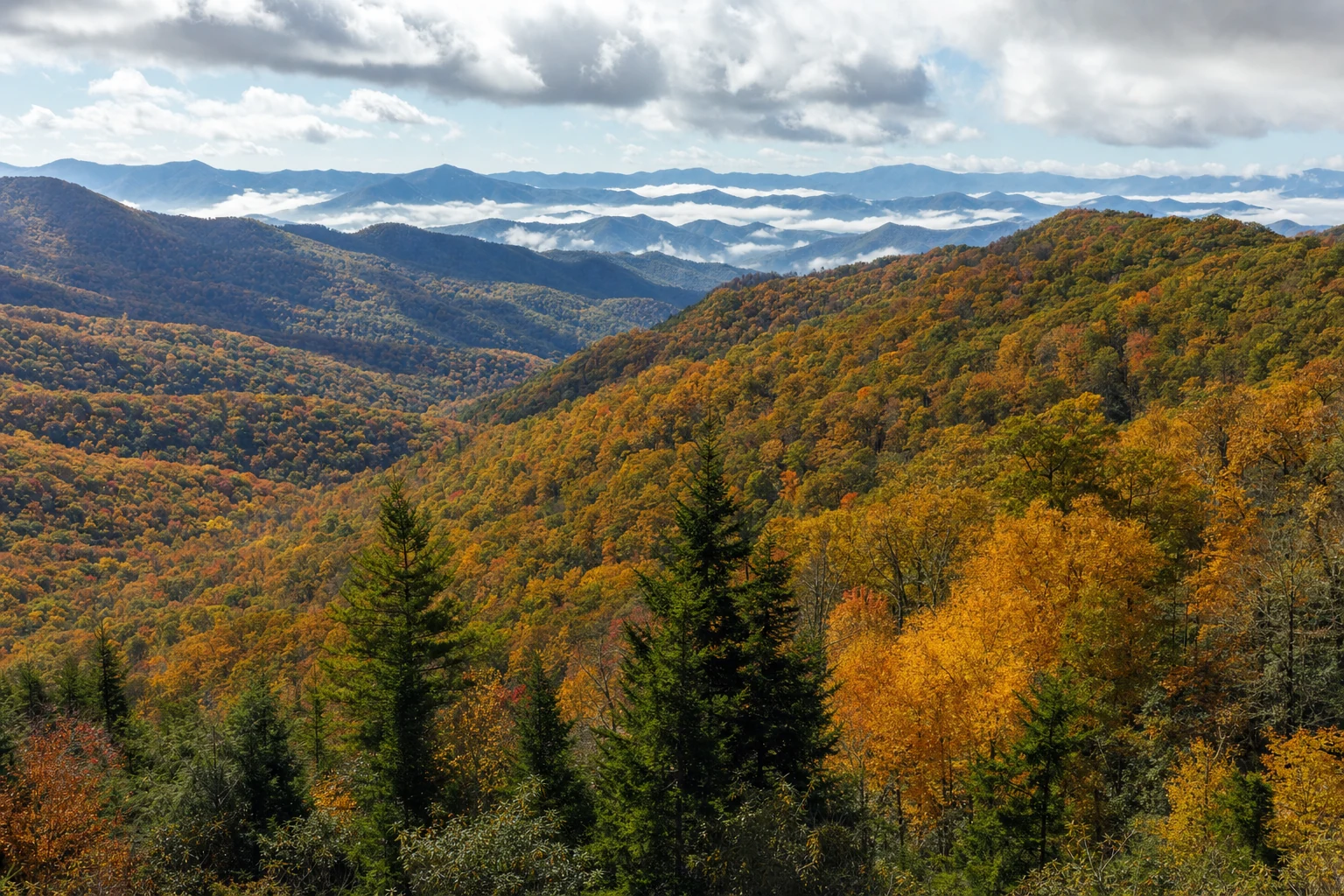

About Longstreet Trail:
The Longstreet Trail is a one-mile loop at Elkmont — one of GSMNP's most historically layered corners — and it earns its "easy" designation without apology. First-time park visitors, families with young children, and anyone who wants a genuine forest walk without committing to a strenuous climb will find this loop useful. It also serves as a natural starting point before tackling longer options that leave from the same trailhead complex.
What to expect on the trail
At 1.0 miles, the Longstreet Trail completes a loop through the second-growth forest characteristic of the Elkmont area. The terrain is gentle, the footing generally good, and the shade is substantial. This is deciduous lowland woodland — tulip poplar, basswood, hemlock where they still stand — rather than the high-elevation spruce-fir you find on the ridgelines. You're walking through the kind of forest that frames the Little River corridor, where the valley floor is broad and the air carries the sound of moving water most of the year.
The loop format means no out-and-back retracing. You end where you started, which works well with children or with visitors who want a predictable, fixed outing. Signage at Elkmont is generally clear, though picking up a trail map at Sugarlands Visitor Center before you head out is worth the stop — cell coverage inside the park is limited, and offline navigation is worth having even on a short walk.
Elkmont: the wider context
Elkmont is not just a trailhead. It was a resort community beginning in the early twentieth century, and dozens of historic cabin structures still stand in various states of preservation scattered through the area. The NPS manages these as a historic district. Walking through the Elkmont area, you're moving through a landscape that was privately held, then leased, then eventually absorbed into the national park — a process that left behind tangible architectural evidence. The Longstreet Trail puts you in the middle of that layered history, even if the route itself is a quiet forest loop.
The Jakes Creek Trail also originates at Elkmont, running 3.3 miles one-way at moderate difficulty. If you complete the Longstreet loop and want more distance, Jakes Creek is the logical next step from the same parking area — no car shuffle required.
Synchronous fireflies and seasonal timing
Elkmont is one of the most famous locations in GSMNP for a specific annual event: the synchronous fireflies (Photinus carolinus), which produce a coordinated light display unlike anything else in the eastern United States. For roughly two weeks, typically in late May or early June, males flash in timed pulses visible through the dark forest. The NPS manages access via a lottery permit system during peak season — entry is not walk-up. If firefly season is part of your plan, check recreation.gov well in advance; permits move fast.
Outside of that window, Elkmont runs on standard park rhythms:
- Spring (April–May): Wildflowers peak in the lower elevations around Elkmont — trillium, bloodroot, wild geranium. Stream flow is high, and the forest is actively waking up.
- Summer (June–August): The campground fills early; hold a reservation or arrive before 9 a.m. The canopy provides good shade on the Longstreet loop, making it a reasonable midday option even in July.
- Fall (September–November): Hardwood foliage peaks around mid-October in the Elkmont valley. The combination of moving water, open meadow, and historic structures makes fall color here particularly good.
- Winter (December–March): Elkmont goes quiet. The campground may be partly or fully closed — check the NPS website before you go. The Longstreet loop itself is accessible most winters, though ice on the path is possible after hard freezes, and the trade-off is genuine solitude.
Getting there and parking
Elkmont is reached via Little River Road, which runs west from Sugarlands Visitor Center inside the park. From downtown Gatlinburg, enter at the main park entrance and continue to Sugarlands, then follow Little River Road. The Elkmont Campground and trailhead turnoff is well-marked.
A Park It Forward tag is required for any vehicle parked inside GSMNP for more than 15 minutes. Rates are $5 per day, $15 per week, or $40 annually. Purchase at recreation.gov before your visit or at park kiosks — the kiosk at Sugarlands Visitor Center is reliable and worth hitting anyway for a current trail map. During peak season, the Elkmont parking area fills early on weekend mornings. Arriving before 9 a.m. is a safe target from June through October.
What to bring
The Longstreet Trail is short, but standard GSMNP advice still applies. Water is the item hikers most consistently underestimate — carry more than you expect to need, particularly in summer. A rain layer and a light warm layer take minimal space and cover the fast-moving weather that characterizes mountain afternoons, especially from June through August.
Black bears are present throughout the park, including around Elkmont. The campground proximity means bear activity is part of the environment. Keep 50 yards of distance, make noise on the trail so bears hear you coming, and never leave food or scented items unattended or in a vehicle overnight. The park's concentrated foraging activity tends to increase in fall.
Pairing with nearby trails
Elkmont and the Little River Road corridor give you good options if one mile isn't enough:
- Jakes Creek Trail — Elkmont, 3.3 miles one-way, Moderate. Follows the creek drainage with a gradual climb into deeper forest. Starts from the same trailhead area as the Longstreet loop.
- Little Greenbrier Trail — Metcalf Bottoms (a short drive west on Little River Road), 3.0 miles one-way, Moderate. Passes a well-preserved historic schoolhouse and offers a different slice of park history.
- Meigs Creek Trail — Little River Road, 3.2 miles loop, Moderate. Multiple stream crossings make it one of the more tactile trails in the corridor — expect wet feet after rain, and plan accordingly.
Pairing the Longstreet loop with Jakes Creek from the same base makes for a complete morning in one of the park's most rewarding areas, without moving your car or overextending anyone in your group.
Frequently asked questions
- Do I need a parking tag?
- Yes — a Park It Forward parking tag is required for vehicles parked more than 15 minutes anywhere inside Great Smoky Mountains National Park. Daily ($5), weekly ($15), or annual ($40) tags are available via recreation.gov or park kiosks.