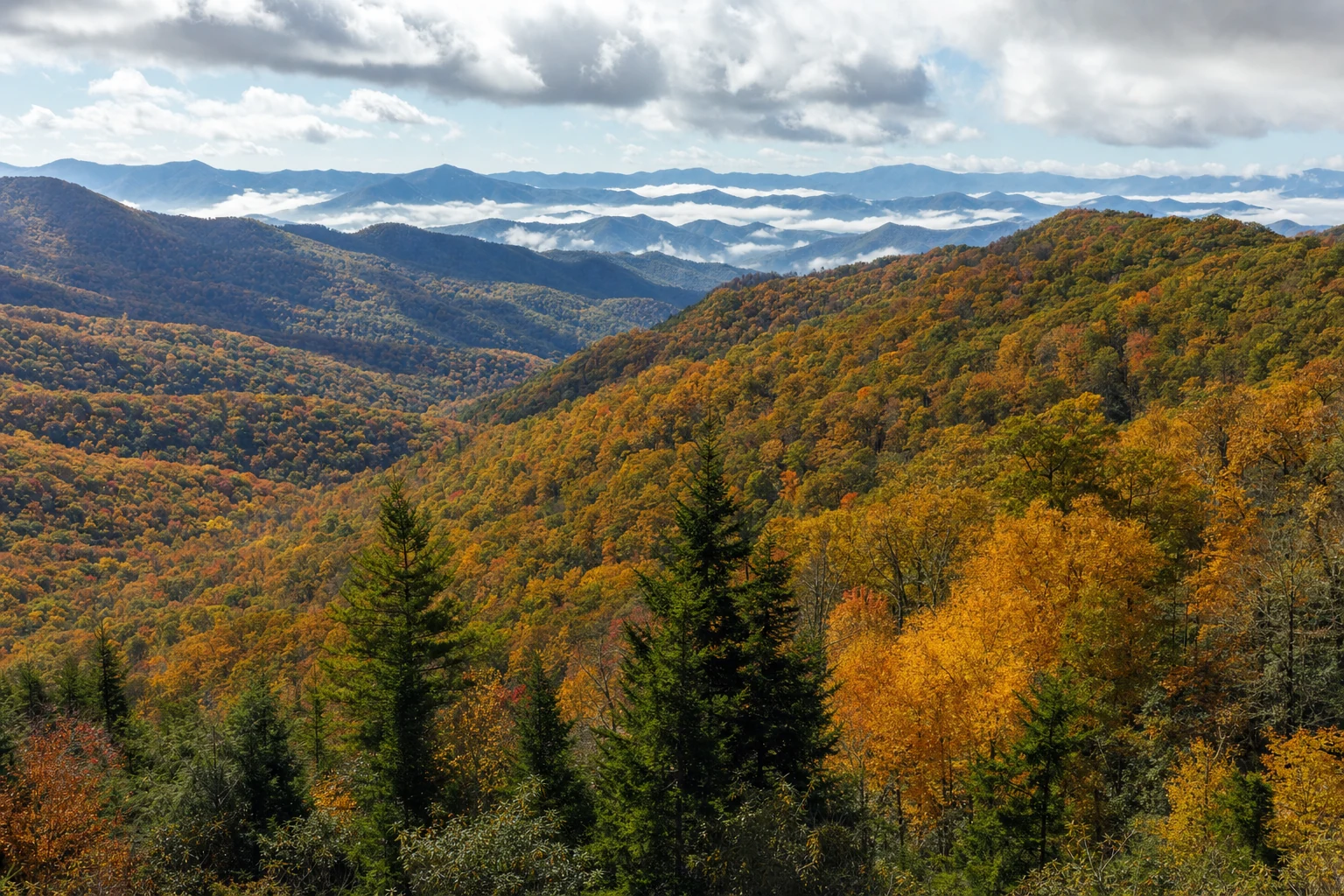

About Lower Mount Cammerer Trail
Mount Cammerer has one of the better payoffs in Great Smoky Mountains National Park: a stone fire lookout tower on a bare, rocky summit with views in every direction, Tennessee and North Carolina ridgelines stacking out to the horizon. Getting there takes work. The Lower Mount Cammerer Trail climbs 2,000 feet over 5.7 miles one-way, earns its strenuous rating fully, and connects at the top to the Appalachian Trail before the final push to the tower. Most hikers turn it into a loop by combining the Lower Mount Cammerer route with Low Gap Trail and a short stretch of the AT, which avoids retracing the full descent and makes the effort feel better paced.
The route
The trailhead sits at Cosby Campground, on the eastern edge of the park and one of the least-trafficked entry points in the Smokies. That's worth knowing upfront: the Cosby corridor draws a fraction of the crowds that back up near Gatlinburg or Clingmans Dome, so you'll start the day without the parking scramble that defines more popular corners of the park. The trail begins in mixed hardwood forest, climbs steadily, and doesn't flatten out meaningfully until the upper ridge. You'll cross small streams in the lower miles; these run clear and cold, and they're the last reliable water source before the summit area.
The grade is consistent rather than punishing in bursts. Two thousand feet over 5.7 miles works out to roughly 350 feet of gain per mile, which is manageable for fit hikers but accumulates over a long day. Don't pace yourself like a flat trail for the first two miles and run short on legs for the upper section. By the time you intersect the AT near the ridgeline, the forest thins and the rock starts showing through. The final approach to the tower involves open ground with limited tree cover, which means exposure to wind and weather even when the lower trail feels comfortable.
On the loop return, Low Gap Trail drops back down the Cosby side from the AT junction, rejoining near the campground. The loop adds total mileage compared to a strict out-and-back, but the route variety justifies it for most hikers.
The fire tower
The tower is a stone structure, historic and restored, and it's the real reason most people invest the climb. From the upper platform, you have unobstructed views in every compass direction: ridge after ridge, the Tennessee Valley to the north, the higher Smokies peaks to the south and west. On a clear day, the distance is striking. On a morning with low cloud, you'll be above it, watching fog fill the drainages below while standing in full sun.
The tower sits at an AT junction, which means you may share the summit with thru-hikers who have logged very different kinds of miles to get there. If the opportunity presents itself for a few minutes of conversation, take it; the perspective shift is worth something.
Best time to go
Spring, from late April through early June, brings wildflower bloom in the understory and cooler summit temperatures; stream crossings in the lower miles run high from snowmelt and rain. Summer mornings work if you're on the trail before 8 a.m., because afternoon thunderstorms build fast across the Smokies in July and August, and the exposed upper ridge has nowhere to shelter. Fall color peaks around mid-October on these north-facing slopes, and the views from the tower are at their sharpest then, though trailhead parking will reflect the season.
Winter hiking here is real hiking. The summit can be wind-scoured and icy from November through March; traction devices are worth carrying if there's been any recent freezing precipitation. What you get in return is solitude on a trail that sees steady summer and fall traffic, plus long-distance views unclouded by haze. Expect temperatures significantly colder at the summit than at the trailhead, regardless of what the forecast says for Gatlinburg.
Getting there
Cosby Campground is on the eastern edge of the park, accessed via Cosby, Tennessee. From Gatlinburg, head east on US-321 toward Cosby and follow signs south toward the campground entrance. GPS coordinates for the trailhead: 35.7730° N, 83.2180° W.
A Park It Forward parking tag is required for any vehicle staying more than 15 minutes inside GSMNP. Daily tags cost $5, weekly $15, annual $40, available through recreation.gov or park fee kiosks. Restrooms and water are available at the campground. Cell service at Cosby drops off quickly once you leave the campground area, so download an offline topographic map before you leave home.
What to bring
The 2,000-foot elevation change produces a real temperature gap between trailhead and summit. Pack a wind layer regardless of the forecast; the tower platform is fully exposed, and mid-summer days can be cold up top. Rain gear is non-negotiable from May through September given afternoon storm patterns across the range.
Carry two liters of water minimum for the day, three if it's warm or you run dry easily. The lower-mile streams are an option with a filter, but plan your supply from the trailhead rather than counting on them. Trail shoes or light hiking boots with ankle support handle the rocky upper sections better than road runners; trekking poles pay dividends on the descent, especially on the Low Gap return. Bears are active throughout the park and in the Cosby corridor, so maintain 50 yards of distance on the trail and store food in your car or a bear canister at the trailhead — don't leave a scented pack unattended at the summit.
Who this hike suits
Strenuous is the accurate rating, not a precautionary one. The sustained climb and total mileage require a real aerobic base and legs that can handle a full day. If you've completed Alum Cave Trail or a comparable Smokies climb without trouble, you can handle this one, though it's longer and the summit is more exposed. For newer Smokies hikers, spending a half-day on the lower section gives a genuine sense of the terrain before committing to the full ascent.
Families with older kids comfortable on long hikes can do this, but build in a conservative turnaround plan. Tired legs at mile seven look different than tired legs at mile two, and the return via Low Gap isn't a short stroll. Anyone staying at Cosby Campground has an obvious edge: a 7 a.m. start from the campsite puts you at the summit before midday heat or storm buildup, well ahead of the day-trip crowd making the drive from town.
Frequently asked questions
- How long is Lower Mount Cammerer Trail?
- Lower Mount Cammerer Trail is 5.7 miles one-way, with 2,000 feet of elevation gain. It is rated strenuous.
- Do I need a parking tag?
- Yes — a Park It Forward parking tag is required for vehicles parked more than 15 minutes anywhere inside Great Smoky Mountains National Park. Daily ($5), weekly ($15), or annual ($40) tags are available via recreation.gov or park kiosks.