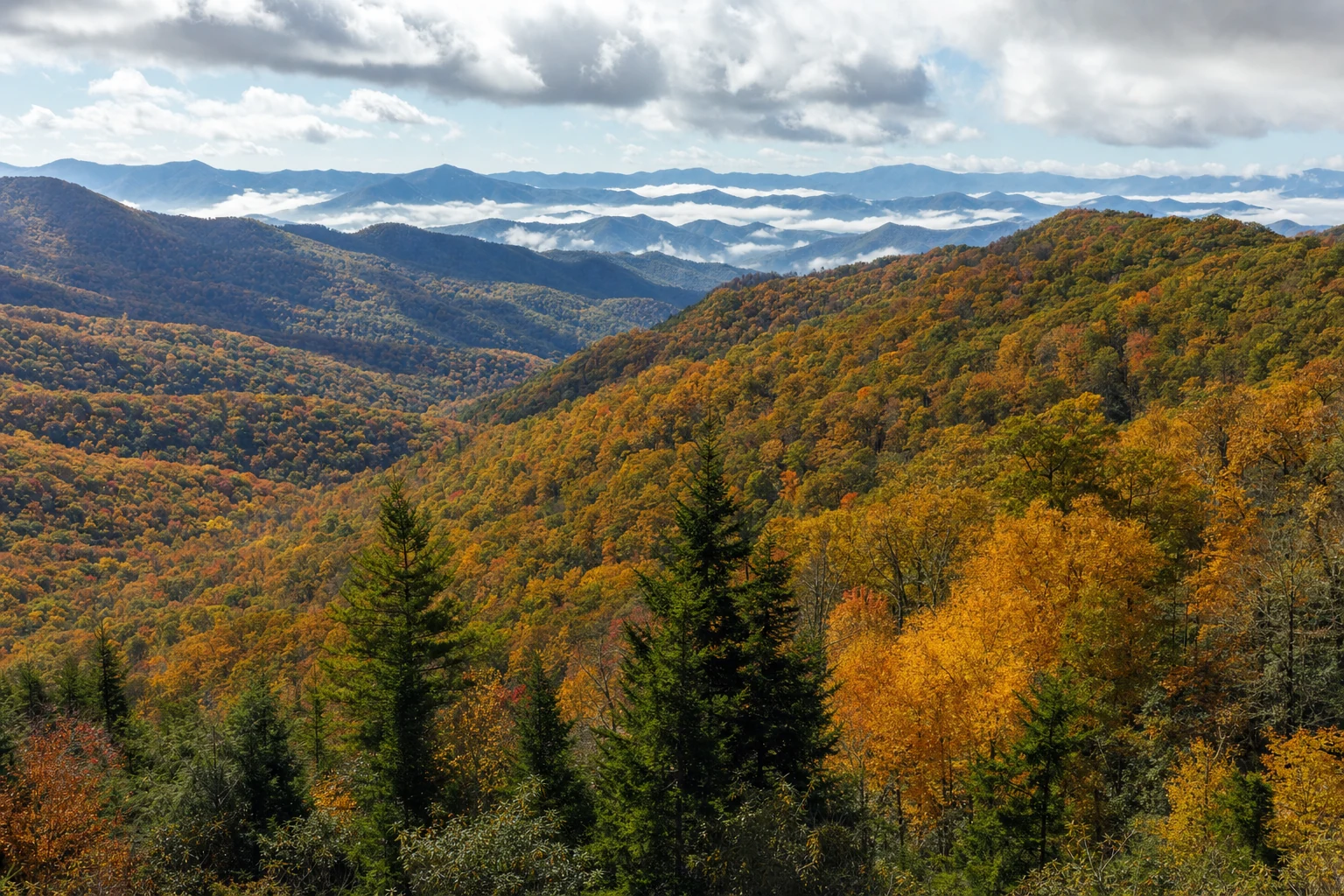

About Lumber Ridge Trail:
Lumber Ridge Trail is one of the genuinely demanding options in the Sugarlands corridor — 4.2 miles one-way, rated Strenuous by the NPS, and far quieter than the park's marquee names. It rewards hikers willing to put in real work for a ridge-line experience that most visitors driving through Sugarlands never find.
Trail at a Glance
- Distance: 4.2 miles one-way (8.4 miles out-and-back)
- Difficulty: Strenuous
- Trailhead area: Sugarlands, Great Smoky Mountains National Park
- Trail type: Out-and-back (point-to-point possible with a shuttle)
- Managed by: National Park Service
The strenuous rating is earned. Ridge trails in the Sugarlands zone start low and climb — count on sustained elevation gain that doesn't ease up quickly. If your recent hiking has been mostly flat or moderate, this trail will push you. Strong intermediate hikers who've handled 1,000-foot-plus climbs on other GSMNP trails will find the effort familiar, if not comfortable.
What the Hike Is Like
Lumber Ridge runs through the forest-covered ridges above the Sugarlands valley. The lower sections of any trail in this zone move through second-growth and mature hardwood mix — oak, tulip poplar, red maple — before the canopy shifts as elevation climbs. Ridge trails in this part of the park tend to offer filtered or open views at higher points, particularly after leaf-drop in fall and in winter when the understory thins.
Unlike the crowded waterfall loops closer to the visitor center, Lumber Ridge sees a fraction of the foot traffic. You're not going to be passing people every few minutes. The trade-off is that you're more on your own if something goes wrong — the trail is real backcountry in character despite its proximity to a busy park entrance. Cell service drops off fast inside the park.
The 8.4-mile round trip is a serious full-day commitment for most hikers, especially accounting for the climbing. Budget at least four to five hours on the trail itself, plus drive and parking time.
Getting to the Trailhead
The Sugarlands area sits just inside the main Gatlinburg park entrance on US-441. From downtown Gatlinburg, the Sugarlands Visitor Center is roughly two miles into the park. Trailheads in this zone are generally accessible from pullouts and small lots along the road network near the visitor center.
A Park It Forward parking tag is required for any stop inside Great Smoky Mountains National Park over 15 minutes. Daily tags run $5, weekly $15, and an annual pass is $40 — available through recreation.gov before your trip or at park entrance kiosks on arrival. The annual pass is worth it if you're spending several days in the park.
Arrive early on weekends and during peak season. Sugarlands is one of the park's highest-traffic zones, and parking near popular trailheads fills up by mid-morning in summer and fall.
Best Time to Hike
Spring is excellent for Lumber Ridge — the hardwoods are leafing out, wildflowers push up along the lower sections, and the spring rains keep the forest vivid without the oppressive summer humidity. Expect muddy conditions on steep sections through April.
Summer works but means heat and humidity that make strenuous climbs feel harder than the mileage suggests. Early starts (on trail by 7 or 8 a.m.) are genuinely important in July and August. The ridge elevation provides some relief, but you'll earn it getting there.
Fall is the most popular season across the park, with peak color in mid-October at mid-elevations. Lumber Ridge's relative obscurity helps — you're less likely to be fighting crowds at the trailhead even when the main corridors are slammed. The light through turning hardwoods on a ridge is specific to this time of year.
Winter brings the most solitude and the longest sightlines. Ice on steep sections is a real hazard — microspikes are worth carrying from late November through February. Several high-elevation roads in the park close seasonally, but the Sugarlands approach stays accessible.
What to Bring
Strenuous trails in GSMNP demand more preparation than the park's easy loops. A standard kit for Lumber Ridge:
- Water: at least two liters, more in summer; there's no reliable treated source on the trail
- Rain layer and mid-layer, even in warm weather — weather in the Smokies moves fast and temperature drops with elevation
- Traction (microspikes or similar) from late fall through early spring
- Snacks for at least a full day out
- Navigation: the NPS trails map for the Sugarlands area, downloaded offline before you leave cell range
- First aid basics
The trail is not recommended for young children or people with joint issues who struggle on steep descent — knees take the hardest work on the way back down.
Black Bear Country
The Sugarlands zone has some of the park's highest bear activity. This isn't a reason to skip the trail, but it requires a baseline of competence. Keep 50 yards of distance if you spot one. Store food and scented items in your car (not visible through windows) or in a bear canister if you're going deeper into the park. Make noise on blind corners on trail. Don't run.
Bear encounters on day hikes here are uncommon with standard precautions, but the park's bears are wild and habituated to human presence — they're not afraid of people the way backcountry bears elsewhere might be.
Nearby Trails to Pair
The Sugarlands area concentrates several other NPS trails worth considering if you're in the zone. The Sugarlands Ridge Trail (0.8 miles loop, Easy) offers a quick leg-stretcher near the visitor center. Cataract Falls Trail (0.25 miles, Easy) is a short out-and-back to a waterfall, good for a warmup or cooldown. Old Sugarlands Trail (3.0 miles one-way, Moderate) follows an older roadbed with historical character. All three are significantly less demanding than Lumber Ridge and suit mixed-ability groups who want to split the day.
For a full ridge experience elsewhere in the park, Charlies Bunion via the Appalachian Trail from Newfound Gap (8 miles out-and-back, Strenuous) is the high-profile comparison — more exposed, more dramatic views, and much busier.
Frequently asked questions
- Do I need a parking tag?
- Yes — a Park It Forward parking tag is required for vehicles parked more than 15 minutes anywhere inside Great Smoky Mountains National Park. Daily ($5), weekly ($15), or annual ($40) tags are available via recreation.gov or park kiosks.