
About Mingo Falls Trail (Qualla Boundary / EBCI Lands)
The 120-foot drop of Mingo Falls hits you fast. You walk less than half a mile, climb a flight of steep wooden stairs, and the reward is one of the tallest accessible waterfalls in the greater Smokies region, framed by hemlocks on land the Eastern Band of Cherokee Indians has held for generations. The hike is short; the payoff isn't small.
Trail at a Glance
The route is 0.5 miles one-way, out-and-back, with 150 feet of total elevation gain. Most of that gain concentrates in one staircase near the end rather than distributing gradually across the approach, so the "easy" rating holds for the majority of the walk and becomes less accurate for the stairs themselves. People with significant knee issues or difficulty with steps should weigh that before committing. The out-and-back format means you retrace down the same staircase on the return, which demands more attention than the uphill leg.
At the top of the stairs, the trail opens to a viewing area with a clear sight line up the rock face to where water breaks over the ridge. At 120 feet, Mingo Falls ranks among the tallest waterfalls in the region reachable in under a mile. Spring snowmelt and rain push the volume to its seasonal high, making the sound loud enough to feel as much as hear. By late summer, the flow drops, but the falls stay active year-round. The full round trip takes most people 45 minutes to an hour, including time at the viewing area.
The Qualla Boundary
Mingo Falls sits on the Qualla Boundary, the land base of the Eastern Band of Cherokee Indians, a federally recognized tribe. This is not a national park site. You're visiting land held by a people whose ancestors survived the forced removal of 1838 by remaining hidden in these mountains while thousands were marched west along what became known as the Trail of Tears. That history isn't incidental to the landscape you're walking through.
The distinction has practical consequences. Access is managed by the tribe, not the National Park Service, so GSMNP passes and the Park-It-Forward parking tag don't govern this particular visit. Check the official tribal tourism page at visitcherokeenc.com before you go for current entry conditions and any applicable fees; the tribe manages its lands independently and can adjust access terms on its own timeline.
The town of Cherokee, NC, the EBCI tribal capital, sits a few miles down Big Cove Road from the trailhead. If you're building a full day around this area, the town has Cherokee-run cultural institutions and dining worth folding into the visit.
Getting There
From Gatlinburg, the most direct route heads south on US-441 through the park via Newfound Gap Road into Cherokee, NC, roughly 30 to 35 miles depending on where you start in town. From Cherokee, take Big Cove Road northeast to the trailhead. GPS coordinates: 35.5340° N, 83.2750° W.
Newfound Gap Road can close during significant winter weather. If you're planning a visit between December and February, check current road conditions on the GSMNP website before you leave. There are no services on that stretch; fill the tank in Gatlinburg or Cherokee.
The trailhead parking area is small, and it fills by mid-morning on summer weekends and during peak fall color. Arriving before 9 a.m. on those days isn't excessive planning; it's just the difference between a pleasant visit and circling a full lot.
When to Go
Late March through May is when the falls run hardest. Snowmelt and spring rain combine to push the water volume high enough that you'll hear Mingo Falls from the staircase before the view opens up. Wildflowers line the lower section of the trail through this period.
Summer draws the most visitors to the area, though the trail's brevity means turnover is faster here than at longer destinations. The parking area is still the constraint. Early starts resolve it. Midday arrivals on holiday weekends don't.
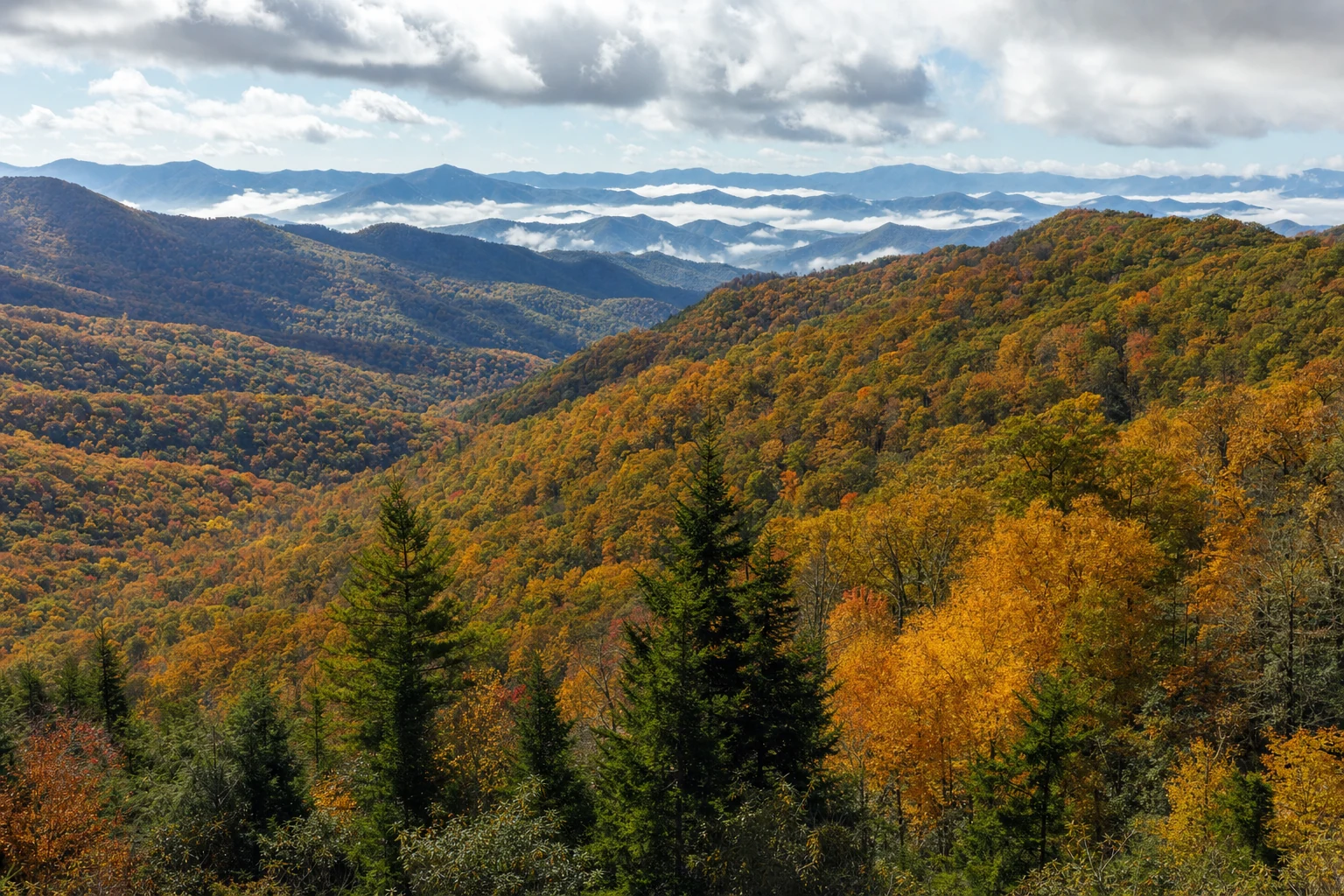
Mid-October into early November delivers leaf color across the surrounding forest. The water runs lower than in spring, but the falls don't disappear, and the combination of autumn canopy and moving water makes a strong case for the seasonal trade-off.
Winter is the quietest window. Ice forms on the rock face alongside the falls, and the bare canopy lets more light reach the trail and creek. The falls themselves don't close in cold weather; road access is the variable to check before driving.
What the Hike Feels Like
The lower section of trail runs through mixed forest along the creek, wide enough to walk comfortably and shaded even in summer. It's an easy approach, flat and unhurried. The stairs at the end are the transition: wooden, with railings, and steep enough that most people slow to a deliberate pace. They're frequently damp from the mist thrown off by the falls above, so footwear with actual grip matters more than most trail ratings at this length would suggest.
The viewing area at the top of the stairs is the destination. You stop there, take it in, and eventually turn around. There's no continuation beyond the viewpoint on this route.
Know Before You Go
Shoes with traction are worth the thought; smooth-soled sandals or slip-ons work against you on wet wooden stairs and root-laced trail segments. Trekking poles aren't essential for most people, but they earn their keep on the descent for anyone who finds stairs hard on their knees.
Cell coverage on Big Cove Road and at the trailhead is unreliable. Download offline maps in Cherokee or Gatlinburg before heading out. The Oconaluftee Visitor Center on US-441 in Cherokee is a reasonable stop for maps and current conditions if you want a physical check-in before driving Big Cove Road.
Black bears range throughout the Qualla Boundary as they do in the broader Smokies. Standard practice applies: don't leave food unattended, maintain distance if you spot one, and don't approach. Sightings near the parking area happen; encounters on the brief trail are less common.
The hike suits a wide range of visitors, from families with children old enough to manage stairs independently to travelers who want a significant waterfall without the time investment of a full-day backcountry push. The staircase is the one real filter. If stairs aren't a problem, this trail isn't a problem.
Frequently asked questions
- How long is Mingo Falls Trail (Qualla Boundary / EBCI Lands)?
- Mingo Falls Trail (Qualla Boundary / EBCI Lands) is 0.5 miles one-way (1.0 miles round-trip), with 150 feet of elevation gain. It is rated easy.
- Do I need a parking tag?
- Yes — a Park It Forward parking tag is required for vehicles parked more than 15 minutes anywhere inside Great Smoky Mountains National Park. Daily ($5), weekly ($15), or annual ($40) tags are available via recreation.gov or park kiosks.