
About Oconaluftee River Trail
Now I have everything I need. Writing the page copy now.
---
Most trails in Great Smoky Mountains National Park ban dogs, prohibit bicycles, and demand some genuine elevation gain before they open up to anything worth seeing. The Oconaluftee River Trail does none of those things: 3 miles one-way, flat throughout, and one of only two trails in the entire park where dogs and bikes are both permitted. The trailhead sits at the Oconaluftee Visitor Center on the North Carolina side of the park, a short drive from Cherokee, making it the natural first stop if you're approaching GSMNP from the south.
What the trail is like
The surface is paved or hard-packed gravel, wide enough for foot traffic and cyclists to share without constant negotiation. It follows the Oconaluftee River for its full length, so moving water is a constant presence; the elevation change is negligible. How far you go is the only real decision: the full out-and-back runs 6 miles, but plenty of people walk a mile or two, find a good stretch of riverbank, and turn back on their own schedule.
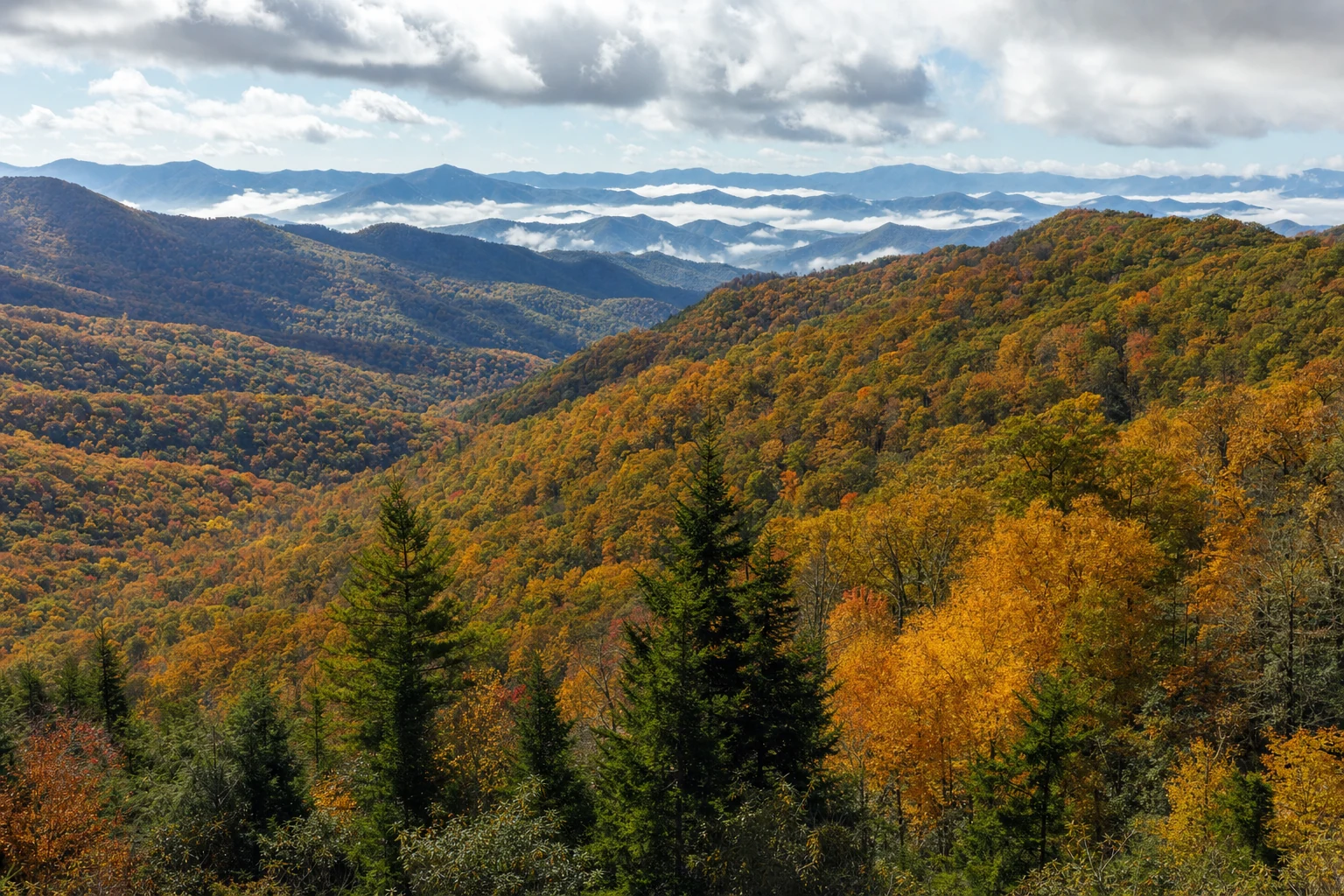
The river carries different character by season. Spring snowmelt pushes it fast and loud; late summer brings lower, clearer water where the streambed is visible. The banks are edged with hardwood canopy, and in fall the color reflected off the water gives you a reason to slow down. Wildlife sightings along the route are common: great blue herons work the shallow margins and white-tailed deer appear at the tree line; the open fields near the visitor center are well-known elk territory.
Elk viewing
The Oconaluftee area holds a resident elk herd, and the meadows adjacent to the visitor center and along the early section of the trail are among the more reliable spots in the park to observe them. Elk are most visible at dawn and dusk, with midday sightings considerably less frequent. The cooler months, roughly fall through early spring, produce the most consistent activity.
The NPS requires at least 25 yards of distance from all wildlife, and elk earn that buffer. They look calm; during the fall rut, bull elk can be genuinely dangerous. If an elk has stopped feeding and turned to watch you, you've already closed the gap too far — back up slowly, don't run, and give them a wide arc. The rule about not feeding wildlife also extends to the indirect kind: don't leave bags or packs unattended on the trail or near the parking area.
Dogs and bicycles
The Oconaluftee River Trail and the Gatlinburg Trail on the Tennessee side are the only two trails in the entire park open to dogs and bikes; the rest of the trail system excludes both. Dogs must stay on a leash of 6 feet or less at all times, a regulation that applies everywhere inside park boundaries, not only on trails. The flat terrain and wide surface make this route workable for visitors with dogs who can't manage steep climbs, or for families with younger kids on bikes who aren't ready for technical terrain.
Keep dogs clear of the river's edge when spring water levels are high; the current moves faster than it looks. Cyclists should call out when overtaking foot traffic — there's room to pass, but speed differentials catch people off guard.
The visitor center and Mountain Farm Museum
The Oconaluftee Visitor Center (1194 Newfound Gap Rd, Cherokee, NC 28719) is worth arriving at a few minutes early. Staff carry current conditions for Newfound Gap Road and the NC side of the park, which matters if you're continuing deeper into GSMNP; that road closes with limited warning during winter storms. The building has maps, restrooms, and a gift shop.
Directly adjacent is the Mountain Farm Museum, a collection of original log structures relocated from across the park and assembled here to represent a late 19th-century Appalachian farm. A farmhouse, barn, apple house, and several smaller outbuildings are preserved and accessible on foot, with no extra admission beyond the park entry fee. For anyone traveling with people who'd rather walk through buildings than hike a trail, this pairs naturally with the river walk as a two- to three-hour morning.
Getting there and parking
The trailhead is at the Oconaluftee Visitor Center: 1194 Newfound Gap Rd, Cherokee, NC 28719 (35.4740° N, 83.3080° W). From Cherokee, take US-441 north about 2 miles into the park. From Gatlinburg, Newfound Gap Road crosses the state line and runs roughly an hour south to the visitor center; it's a worthwhile drive on its own, particularly in October. The trail's southern end reaches the boundary of the town of Cherokee, so if you complete the full one-way, you're already positioned to walk into town for food or shopping without getting back in the car.
A Park It Forward parking tag is required for stays over 15 minutes anywhere inside GSMNP. Tags cost $5/day, $15/week, or $40/year; buy at the kiosk near the visitor center entrance or through recreation.gov before you arrive.
Timing and what to bring
The trail is open year-round, but winter storms can ice the surface and sometimes close Newfound Gap Road, cutting off access from Tennessee entirely. Spring and fall offer the most comfortable walking: cooler temperatures, lower crowds than peak summer, and the most active wildlife window. Foliage at this elevation tends to peak around mid-October.
Summer is the park's busiest season across all sites. On weekends between late June and Labor Day, plan to arrive before 9am; the visitor center lot fills early and the trail gets noticeably more crowded by mid-morning. Because the trail runs low and partly open, without the shade canopy of a ridge path, summer heat builds faster than people expect. Carry more water than seems necessary, and a hat.
Mountain weather shifts quickly regardless of season, so a light rain layer in your pack is reasonable even when the forecast looks clear. Cell coverage along the trail is limited; download the NPS app or pick up a paper map at the visitor center before you start.
Frequently asked questions
- How long is Oconaluftee River Trail?
- Oconaluftee River Trail is 3 miles one-way (6.0 miles round-trip), with modest feet of elevation gain. It is rated easy.
- Do I need a parking tag?
- Yes — a Park It Forward parking tag is required for vehicles parked more than 15 minutes anywhere inside Great Smoky Mountains National Park. Daily ($5), weekly ($15), or annual ($40) tags are available via recreation.gov or park kiosks.