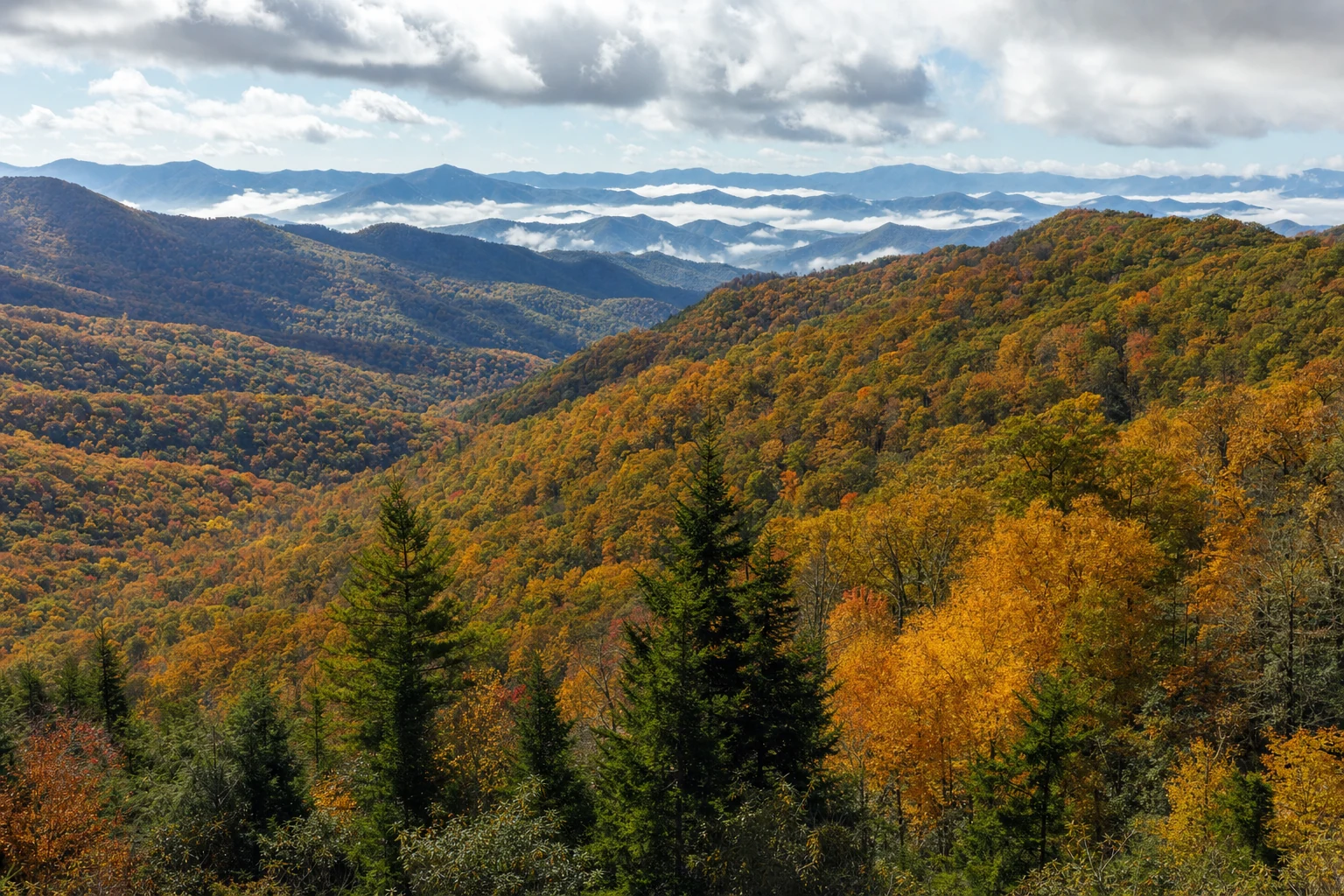

About Sugarlands Valley Nature Trail
The Sugarlands Valley Nature Trail does something unusual for a national park trail: it asks almost nothing of you physically while still delivering what most people drive hours to see. A half-mile paved loop at the Sugarlands Visitor Center, roughly two miles from downtown Gatlinburg, it runs alongside the West Prong of the Little Pigeon River through old-growth forest where the canopy filters the light in ways that photographs can't quite capture. Because the surface is paved and flat with minimal elevation gain, it's one of the few trails in GSMNP where mobility devices, strollers, and people with limited stamina can actually use the trail rather than standing at the trailhead watching everyone else leave.
What the Trail Is
The loop is short enough that most visitors complete it in well under an hour, but the pace slows naturally here. Interpretive signs appear at regular intervals, explaining the plant life and the river ecology along this stretch of the West Prong. The old-growth forest you're walking through is genuinely old; this section of the park was farmed and logged before GSMNP was established, but the trees have recovered considerably over the decades since, and you're looking at a forest in a late stage of that recovery.
The stream running alongside the trail is the West Prong of the Little Pigeon River. It's not a dramatic waterfall situation — the water moves quietly here, occasionally audible over whatever ambient noise the parking lot contributes on a busy afternoon. After heavy rain or in spring snowmelt, it picks up considerably. The trail itself is wide enough for two people walking side by side, or for a wheelchair to pass a stroller without either needing to pull off the pavement.
Accessibility: Who This Trail Is Built For
This is one of the few trails in the entire park that a manual wheelchair user can complete independently, without assistance and without assessing terrain on the go. Paved, consistently flat, and wide enough to maneuver, it has no meaningful accessibility tradeoffs. For comparison, Kuwohi (formerly Clingmans Dome) also has a paved path to its observation tower, but that ramp averages a 12% grade — steep enough to require a power wheelchair or significant assistance for a manual user. The Sugarlands Valley Nature Trail has no such catch.
Parents with strollers find it equally practical. Children who've exhausted their hiking stamina can ride; there's nothing here requiring careful foot placement or scrambling. For visitors who want to experience the park's forest without committing to a miles-long route with serious elevation gain — by choice or because trails like Alum Cave or Chimney Tops aren't viable options — this trail covers that need without compromise.
Accessible parking spaces and restrooms are available at the Sugarlands Visitor Center at the trailhead. The visitor center address is 1420 Fighting Creek Gap Rd, Gatlinburg, TN 37738.
Timing and Crowds
The trail is popular because it's easy and sits directly next to the visitor center. On summer weekends and during peak fall foliage season (mid-October is typical for the Smokies), the parking lot can fill by late morning and the trail sees steady foot traffic well into the afternoon. If you want it largely to yourself, arrive before 9 a.m. or after 4 p.m.; the difference in crowd density at those hours is substantial.
Spring visits combine relative quiet with the payoff of wildflower blooms in the forest understory. The West Prong runs higher and faster in spring, and the interpretive signs read differently when you can see active growth rather than bare branches. Fall draws the largest crowds overall, but the river corridor forest color is worth the tradeoff if you're comfortable with company on the path.
Getting There and Parking
The trailhead sits at the Sugarlands Visitor Center, GPS 35.6811° N, 83.5604° W. From Gatlinburg, take US-441 south into the park; the visitor center appears on your left within about two miles of the park entrance, before Newfound Gap Road begins climbing toward the state line.
Anywhere inside GSMNP requires a Park-It-Forward parking tag for stays over 15 minutes. Tags run $5 per day, $15 per week, or $40 annually; buy them at recreation.gov or at park entrance kiosks. If the Sugarlands lot is full on arrival, it tends to cycle through fairly steadily as visitor center traffic turns over.
Connecting Trails
Because the Sugarlands Visitor Center sits at a junction of several trail corridors, the nature loop makes a natural anchor for a longer day that stays manageable.
The Gatlinburg Trail starts at the visitor center and runs 1.9 miles one-way back toward downtown Gatlinburg along the same river, ending near traffic light #10 on River Road. It's one of only two trails in the park that allows dogs and bicycles; the surface is mostly flat, following the West Prong with paved and hard-packed gravel sections. You could walk the nature loop first, then take the Gatlinburg Trail back toward town for lunch and return by rideshare or a second vehicle — a logistically clean combination.
The Cataract Falls Trail covers 0.7 miles roundtrip and gets noticeably less foot traffic than the main visitor center routes, making it a reasonable add-on if you want a quieter second stop near the same area.
For a longer point-to-point option, the Huskey Gap Trail connects to the Sugarlands Valley Nature Trail from a trailhead on Newfound Gap Road. It covers 2.1 miles one-way with 600 feet of elevation gain, rated moderate. That connection works well if you want to use the nature trail as a gentle finish after a more demanding stretch.
What to Bring
Even on a half-mile paved loop, the standard GSMNP checklist still applies. Carry water. Bear activity is common throughout the park, including near visitor centers, so food stays in your vehicle or a bear canister; don't leave anything edible unattended in an open bag while you walk. A rain layer is worth packing between May and September, when afternoon thunderstorms roll through even on mornings that looked clear at departure.
Cell coverage is poor inside the park. Download your maps offline before you arrive, and if you're combining the nature trail with the Gatlinburg Trail or any connecting route, note your plan before you lose signal. The visitor center staff answer questions about current trail conditions and road closures with more accuracy than any app; the stop is worth 15 minutes before or after the walk.
Frequently asked questions
- How long is Sugarlands Valley Nature Trail?
- Sugarlands Valley Nature Trail is 0.5 miles one-way, with modest feet of elevation gain. It is rated easy.
- Do I need a parking tag?
- Yes — a Park It Forward parking tag is required for vehicles parked more than 15 minutes anywhere inside Great Smoky Mountains National Park. Daily ($5), weekly ($15), or annual ($40) tags are available via recreation.gov or park kiosks.