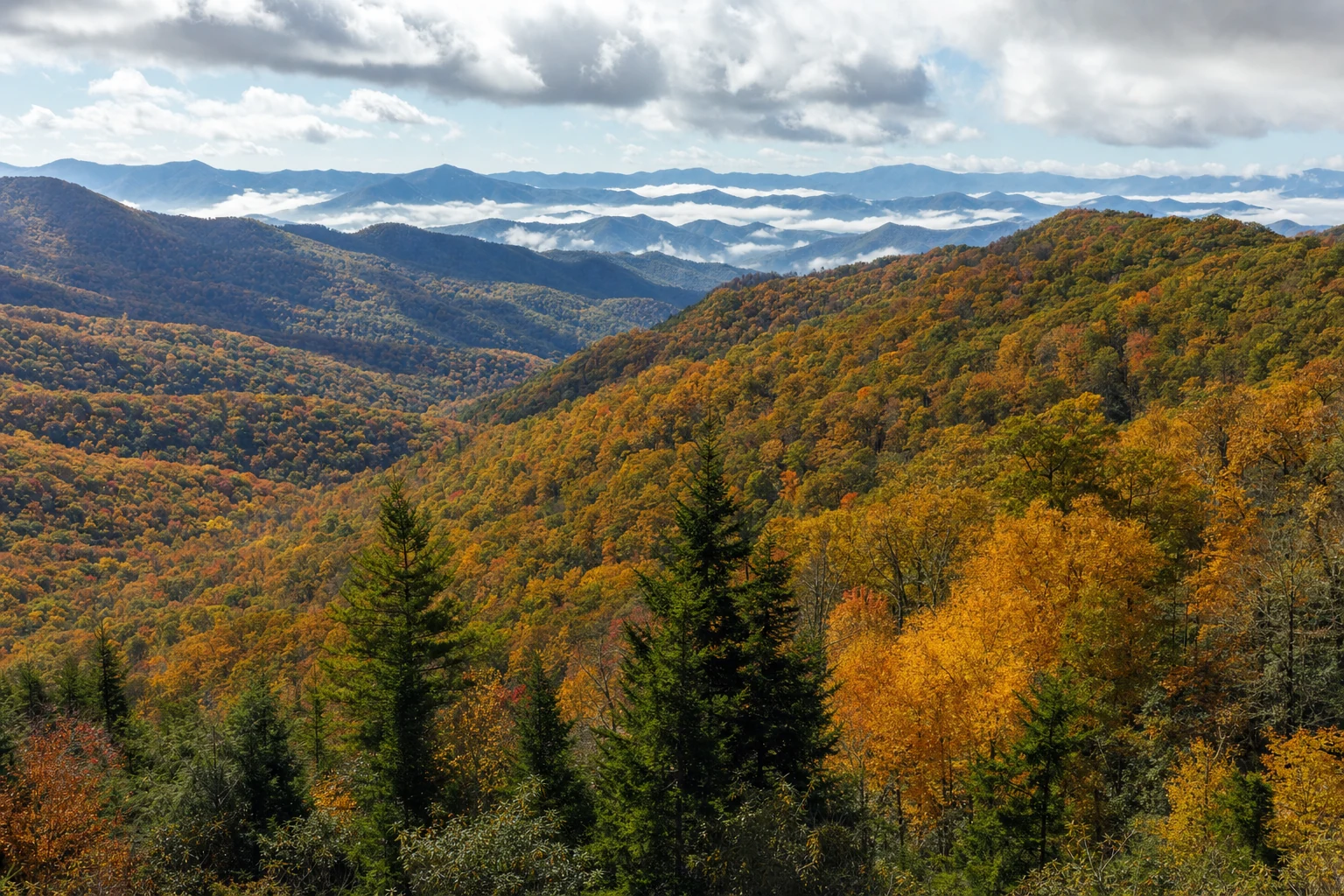

About Twentymile Loop Trail
The Twentymile Loop Trail sits in the quietest corner of Great Smoky Mountains National Park, routed through old-growth forest via the Wolf Ridge Trail to form a 5.7-mile loop with 1,000 feet of elevation gain. This is one of the least-trafficked corridors in the park; you won't be sharing the narrow trail with tour groups. The distance is manageable for most hikers with moderate experience, but the remoteness requires preparation before you leave the car.
The Route
The loop departs from the Twentymile Ranger Station, combining a stretch of Twentymile Creek Trail with a segment of Wolf Ridge Trail to complete the circuit. The elevation gain is gradual enough that the moderate rating holds for hikers in reasonable shape; it's the combination of trail length, absence of facilities, and poor cell coverage that pushes it toward strenuous for some parties.
A creek follows you through much of the lower stretch, with several footbridge crossings along the way. After you gain the ridge via Wolf Ridge Trail, the trail connects briefly to the Appalachian Trail before looping back down to the station. That junction is one of the quieter sections of the AT in this entire park, which makes it a low-effort add for anyone who has wanted to touch the famous corridor without fighting a crowded approach.
Old-Growth Forest
The Smokies contain one of the largest tracts of old-growth temperate forest remaining in the eastern United States, and the Twentymile watershed is part of it. On the ground, that translates to tulip poplars and hemlocks reaching canopy heights you rarely see outside this region, with an understory open enough to see real distance through the trees. It's a different atmosphere than overgrown second-growth forest.
Fallen trees stay where they fall here, creating nurse logs thick with fern and moss. The biodiversity reflects the intact ecosystem, with bird species particularly rich along the creek corridor. None of this requires a field guide to appreciate; you'll notice the scale almost immediately after leaving the trailhead.
Connecting to the Appalachian Trail
At 5.7 miles total with 1,000 feet of gain, the loop stands on its own as a day hike, but the AT connection opens longer options for parties with more time or stronger legs. Continuing north from the junction adds significant mileage and ridge walking. Just note that the Twentymile Ranger Station is your only entry and exit point; there's no shuttle infrastructure in this area, so any extension requires retracing the same distance back.
Gregory Bald and the Ridge Trail
The Twentymile Ranger Station also serves as the starting point for the Gregory Ridge Trail, which climbs to Gregory Bald. This is a harder undertaking than the loop, involving more elevation gain and a genuinely demanding ascent in places. The reward at the top is a grassy, open bald with wide views and, in a short window around mid-June, a bloom of flame azaleas that draws hikers from well outside the region.
The azaleas on Gregory Bald don't linger: the bloom window peaks around mid-June and shifts year to year, so check recent trip reports before committing to a long drive specifically for the flowers. Outside bloom season, the bald still delivers the kind of open-summit experience the forested lower trails can't offer. That contrast between the dense forest corridor on the approach and the sudden openness at the top is one of the park's better transitions. The proximity to Fontana Lake to the south reinforces the sense of genuinely remote terrain, one that continues well beyond the official park boundary.
Best Time to Visit
Timing matters less here than at the park's northern entrances, because Twentymile never draws the same visitor volume regardless of season.
Spring brings the most dramatic creek volume. From March through May the footbridges and waterfalls are at their loudest, and the wildflower progression moves up the elevation as the weeks pass: bloodroot and trillium on the lower slopes in April, later bloomers pushing higher into May. Cold fronts arrive through most of spring, so pack a warm layer even on days that start mild.
Summer extends the hiking day and keeps the trail drier underfoot. The canopy keeps lower elevations manageable even in July, though afternoon thunderstorms build most days. This is peak season for both ticks and bear activity; neither should deter you, but both require attention.
Fall peaks around mid-October for foliage at the lower elevations in this corner of the park. Crowds at Twentymile stay comparatively thin even during peak color weekends, which is one practical argument for this side of the park over Newfound Gap or Clingmans Dome.
Winter empties the trails. The longer drive to this trailhead discourages casual visitors in cold weather, and the bare forest opens up long sight lines through the old-growth that are simply unavailable with leaves on. Road closures at high elevation don't typically affect the Twentymile access road, but verify conditions before making the drive.
Getting There and Parking
The trailhead is at the Twentymile Ranger Station (35.4300° N, 83.7700° W), located in the southwestern corner of Great Smoky Mountains National Park. The most direct approach from the north is via US-129 south from Maryville, Tennessee; from the east, Fontana Village Road provides another option. From Gatlinburg, budget roughly an hour of driving. The access road to the station is paved but narrow.
A Park It Forward parking tag is required for any stay over 15 minutes anywhere inside the park. Tags run $5 per day, $15 per week, or $40 per year, available through Recreation.gov or at kiosks at the main staffed entrances. The Twentymile Ranger Station parking area has no kiosk, so purchase your tag before arriving if you won't be passing through a staffed entrance on the way in.
Cell coverage at the trailhead and along most of the route is poor to nonexistent. Download an offline map before you leave, carry a paper backup if you have one, and leave your expected return time with someone who isn't on the trail.
Frequently asked questions
- How long is Twentymile Loop Trail?
- Twentymile Loop Trail is 5.7 miles one-way, with 1,000 feet of elevation gain. It is rated moderate.
- Do I need a parking tag?
- Yes — a Park It Forward parking tag is required for vehicles parked more than 15 minutes anywhere inside Great Smoky Mountains National Park. Daily ($5), weekly ($15), or annual ($40) tags are available via recreation.gov or park kiosks.