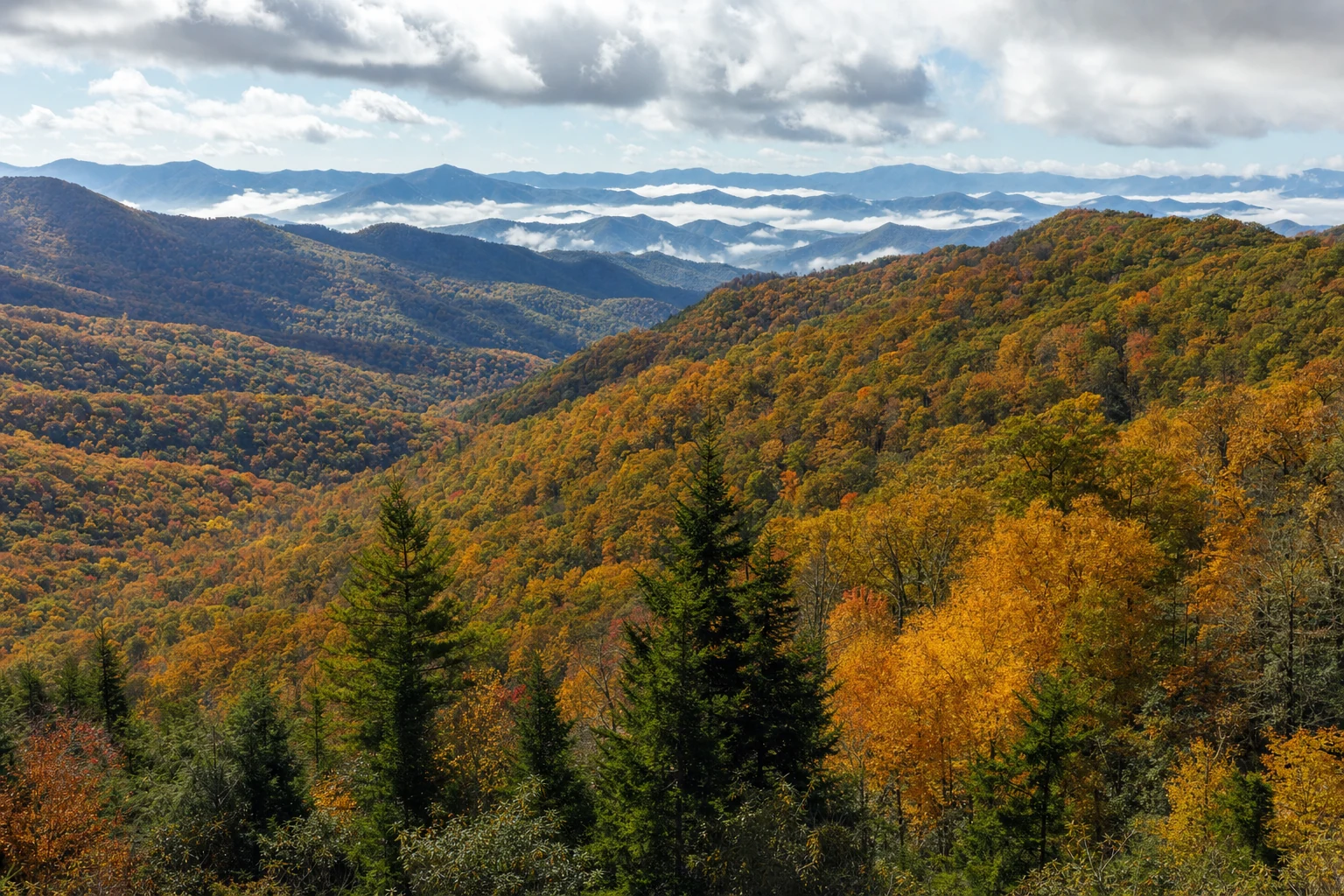

About Wolf Ridge Trail:
Wolf Ridge Trail starts at the Twentymile Ranger Station on the North Carolina side of Great Smoky Mountains National Park and climbs 3.0 miles one-way through remote old-growth forest to connect with the Appalachian Trail at high elevation. The trail is rated strenuous, and that rating earns it — this is one of the more demanding approaches in the park's southwestern corner, but it also opens access to some of the most spectacular scenery in the Southern Appalachians, including Gregory Bald, a high grassy summit famous for its June flame azalea display.
The Trail at a Glance
Wolf Ridge Trail runs 3.0 miles one-way from the Twentymile Trailhead, gaining significant elevation to meet the Appalachian Trail on the main Smokies ridgeline. It forms the return leg of the Twentymile Loop, a 5.7-mile circuit with roughly 1,000 feet of total elevation gain rated Moderate to Strenuous. For hikers who push past the loop junction and continue to Gregory Bald, the full out-and-back from Twentymile climbs approximately 3,000 feet over roughly 11 miles round-trip — a serious day hike requiring both fitness and preparation.
The Twentymile area is among the quieter corners of GSMNP. It sees a fraction of the traffic that flows through Sugarlands or Newfound Gap, which means cleaner trailheads, fewer people on the path, and a stronger sense of genuine backcountry. The old-growth forest corridor along Wolf Ridge is particularly striking — large hemlocks and hardwoods that survived logging because the terrain was too steep and remote to be worth cutting.
The Loop Option vs. the Full Climb
Most day hikers use Wolf Ridge Trail as the uphill half of the Twentymile Loop. The standard circuit leaves the Twentymile Ranger Station, follows Twentymile Creek upstream, then gains the ridge on Wolf Ridge Trail before descending back to the trailhead. At 5.7 miles with around 1,000 feet of climbing, it's a solid half-day effort that rewards you with old-growth forest, ridge views, and the quiet of the park's southern backcountry without committing to a full summit push.
Hikers targeting Gregory Bald treat Wolf Ridge Trail as the approach route, continuing past the Twentymile Loop junction to the AT and then east along the ridgeline to the bald. The full trip from Twentymile is roughly 11 miles round-trip with approximately 3,000 feet of elevation gain — plan five to seven hours and don't shortchange your turnaround time. Gregory Bald's views and azalea spectacle are worth the effort, but that elevation gain is uncompromising on the descent, and tired legs on the way back down a ridge trail cause most of the injuries in this terrain.
Gregory Bald and the Flame Azaleas
Gregory Bald is the primary reason serious hikers add Wolf Ridge Trail to their itinerary. The summit hosts one of the finest natural azalea displays in the eastern United States, with flame azaleas reaching peak bloom in mid-to-late June in vivid orange, red, and yellow. The genetic diversity on Gregory Bald produces an unusually wide color range — individual plants vary considerably, and the effect across the open bald is unlike anything else in the park.
The bald itself sits at high elevation with long views across the Smokies ridgeline when visibility allows. Because the access is genuinely difficult and the trailhead is remote, Gregory Bald draws far fewer visitors than the park's more accessible landmarks. During azalea season this is particularly valuable — you're not fighting crowds at the summit, even when the bloom is at its most spectacular.
One timing note: Parson Branch Road, a gravel road through Cades Cove, provides an alternate access point that shortens the approach to Gregory Bald, but that road is frequently closed or seasonally restricted. Check current road conditions with GSMNP before planning a Cades Cove approach. The Twentymile Trailhead via Wolf Ridge Trail is the more reliably accessible route.
What "Strenuous" Means on Wolf Ridge
The strenuous designation reflects sustained elevation gain on a ridge trail where the climbing is relentless rather than occasionally steep. There are no flat recovery sections to speak of on the upper portion — Wolf Ridge earns its name by staying on the spine of a ridge that requires continuous climbing to the AT junction. Footing is generally good but the trail narrows in sections, and downed logs and roots are common obstacles.
For the Twentymile Loop alone, fit hikers in moderate shape can handle it with appropriate preparation. For the full push to Gregory Bald, honest self-assessment matters — the combination of distance and elevation gain puts this in the same category as Charlies Bunion or Rocky Top, just on a less-trafficked path.
Stream crossings are part of the Twentymile area, particularly on the lower approach before the trail begins climbing. These are typically manageable except during and immediately after heavy rainfall, when water levels rise quickly. Check weather forecasts and be conservative — mountain streams in GSMNP can become dangerous within hours of a heavy storm upstream.
Getting There
The Twentymile Ranger Station sits on the North Carolina side of GSMNP, off US-129 south of Fontana Dam. From downtown Gatlinburg, this is a substantial drive — plan for 1.5 to 2 hours depending on route and traffic through the park. The most direct route takes you through the park via Newfound Gap Road and out the Oconaluftee entrance toward Cherokee, then south and west to US-129.
Parking at the Twentymile Trailhead requires a Park It Forward tag, as it does at all GSMNP trailheads. Tags are available at recreation.gov, the park's entrance kiosks, and self-service machines at major trailheads. A daily tag runs $5, a weekly tag $15, and an annual tag $40. Display it on your dashboard before heading out.
Cell coverage at Twentymile is poor to nonexistent. Download offline maps before leaving and don't rely on real-time navigation once you're in the park's southwestern corner. The Twentymile Ranger Station may be staffed during busy periods, but it's a remote district station — don't count on assistance being immediately available.
Best Time to Visit
June is the compelling season for Wolf Ridge Trail, timed to the Gregory Bald azalea bloom (typically mid-to-late June). The climb is hot and humid in summer, so an early start — on the trail by 7 or 8 a.m. — keeps you ahead of the worst afternoon heat and afternoon thunderstorms that build over the ridgeline most summer days.
Spring offers wildflowers in the lower forest sections and swollen streams from snowmelt and spring rains. The upper ridge may retain wet, slick conditions into April. Fall brings cleaner air and longer views from the ridge, and the Twentymile area's hardwood canopy turns well in October. Winter closes several access roads in the region and the upper trail may be icy — check current conditions before a cold-weather attempt, and bring traction devices if temperatures have been below freezing.
What to Carry
Given the remoteness and elevation change, Wolf Ridge Trail demands more preparation than most day hikes. Carry more water than you think you need — the climbing will deplete you faster than the mileage suggests, and while the lower trail runs near streams, NPS guidelines recommend treating or filtering any backcountry water rather than drinking directly.
A rain layer and insulating layer belong in your pack regardless of the forecast. Ridge weather in the Smokies turns without warning, and being caught in a squall at elevation without a shell is genuinely uncomfortable and potentially dangerous if temperatures drop. Bear canisters or bear-hang practice matters here — Twentymile is black bear country, and the remoteness of the area means a bear encounter is less likely to resolve quickly with nearby help. Keep 50 yards between you and any bear you see, make noise on the trail, and secure all food and scented items.
Tell someone your itinerary and expected return time before heading out. The combination of poor cell coverage, strenuous terrain, and genuine remoteness means this trail demands more situational awareness than a busy park corridor. Go prepared, go early, and the southwestern corner of GSMNP will give you one of the park's most rewarding days on trail.
Frequently asked questions
- Do I need a parking tag?
- Yes — a Park It Forward parking tag is required for vehicles parked more than 15 minutes anywhere inside Great Smoky Mountains National Park. Daily ($5), weekly ($15), or annual ($40) tags are available via recreation.gov or park kiosks.